Seeing that the door did not open, the Little Man flung it wide with a tremendous kick; and having come into the room, he said to Pinocchio and Lampwick with his usual little smirk:
“Well done, boys! You brayed nicely; I recognised you by your voices at once, and that’s why I’m here.”
At these words the two little donkeys stood there crestfallen, with their heads down, their ears drooping and their tails between their legs.
At first the Little Man stroked them, patted them, felt them all over; then, taking out the curry-comb, he began to groom them thoroughly.
And when, by dint of grooming, he had made them shine like two mirrors, he put halters on them and led them to the market square, hoping to sell them and pocket a tidy profit.
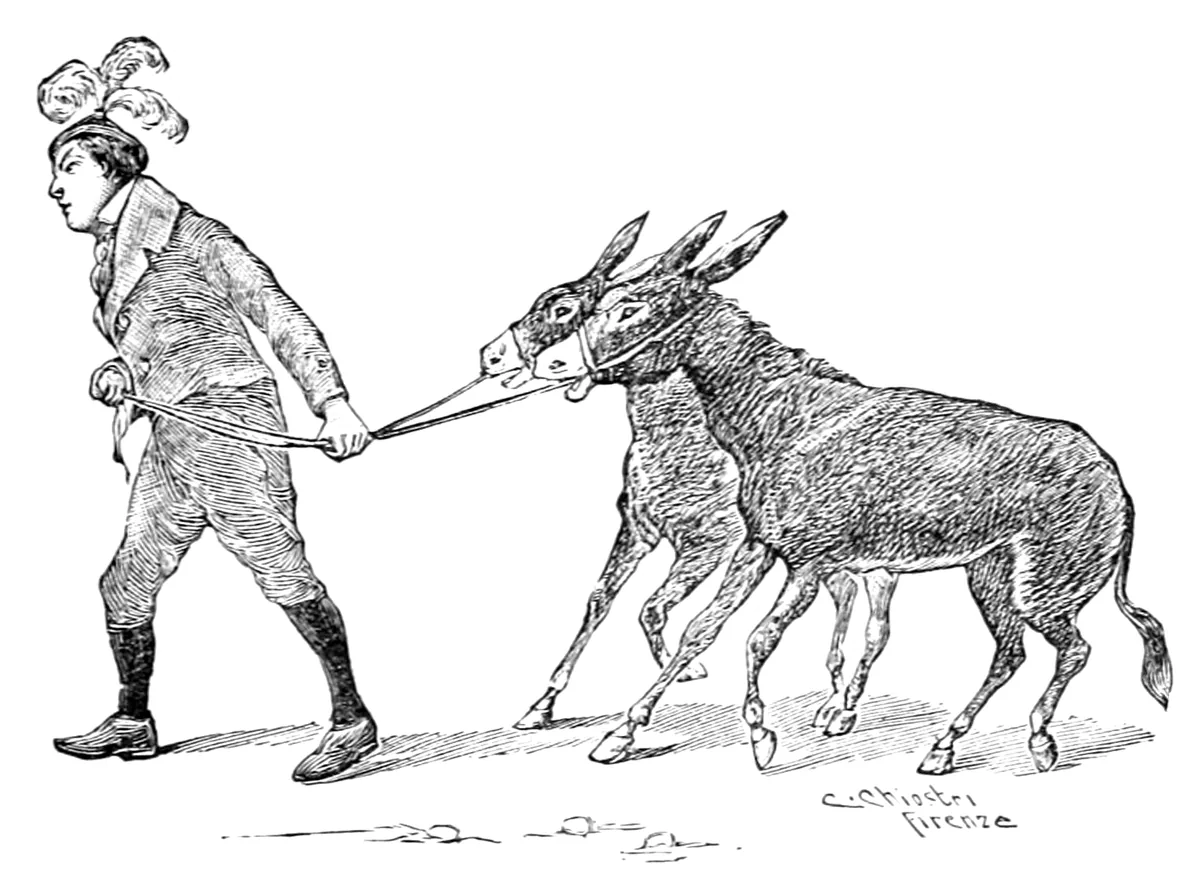
And sure enough, buyers were not slow in coming. Lampwick was bought by a farmer whose donkey had died the day before, and Pinocchio was sold to the Ringmaster of a company of clowns and tightrope walkers, who bought him to train him and then make him jump and dance along with the other animals of the company.
And now, my little readers, have you understood what fine trade the Little Man followed? This nasty little monster, whose face was all milk and honey, went travelling round the world every now and then with a wagon; along the way, with promises and coaxing, he gathered up all the lazy boys who were tired of books and schools; and after loading them onto his wagon, he took them to the “Land of Toys,” so that they could spend all their time in games, in uproar and in amusements. Then, when those poor deluded boys, from always playing and never studying, turned into so many little donkeys, he would take hold of them, as merry and pleased as could be, and carry them off to be sold at fairs and markets. And in this way, in a few years, he had made piles of money and become a millionaire.
What became of Lampwick I do not know; I do know, however, that from the very first days Pinocchio faced a very hard and gruelling life.
When he was led into the stable, his new master filled his manger with straw; but Pinocchio, after tasting a mouthful, spat it out again.
Then his master, grumbling, filled his manger with hay; but he did not like the hay either.
“Ah! so you don’t like hay either?” shouted his master, flying into a temper. “Just you wait, my pretty little donkey: if you’ve got whims in your head, I’ll see to getting rid of them!…”
And by way of correction he at once gave him a lash of the whip across the legs.
Pinocchio, in great pain, began to cry and to bray, and braying he said:
“Hee-haw, hee-haw, I can’t digest straw!…”
“Then eat the hay!” replied his master, who understood the donkey dialect perfectly well.
“Hee-haw, hee-haw, hay gives me a stomach-ache!…”
“So you expect me to feed a donkey like you on breast of chicken and capon in aspic, do you?” added his master, getting angrier and angrier, and giving him a second lash of the whip.
At that second lash Pinocchio wisely fell silent at once and said no more.
Meanwhile the stable was shut, and Pinocchio was left alone; and since it was many hours since he had eaten, he began to yawn with hunger. And as he yawned, he opened a mouth that looked like an oven.
At last, finding nothing else in the manger, he resigned himself to chewing a little hay; and after chewing it thoroughly, he shut his eyes and swallowed it down.
“This hay isn’t bad,” he then said to himself, “but how much better it would have been if I had kept on studying!… By now, instead of hay, I could be eating a crust of fresh bread and a nice slice of salami. Patience!…”
The next morning, when he woke up, he looked straight away in the manger for some more hay; but he found none, because he had eaten it all during the night.
Then he took a mouthful of chopped straw; and while he was chewing it, he had to admit that the taste of chopped straw was not in the least like risotto alla milanese or macaroni alla napoletana.
“Patience!” he repeated, still chewing. “At least let my misfortune serve as a lesson to all disobedient boys who don’t feel like studying. Patience!… patience!”
“Patience, my foot!” yelled his master, coming into the stable at that very moment. “Do you think, my pretty little donkey, that I bought you just to give you food and drink? I bought you so that you would work and earn me lots of money. Come on, then, there’s a good donkey! Come with me into the Circus, and there I’ll teach you to jump through hoops, to burst paper barrels with your head, and to dance the waltz and the polka, standing upright on your hind legs.”
Poor Pinocchio, willy-nilly, had to learn all these fine things; but to learn them it took him three months of lessons and lashes of the whip hard enough to take the hair off his hide.
At last the day came when his master was able to announce a truly extraordinary show. The posters of various colours, stuck up on the street corners, read as follows:
GRAND GALA PERFORMANCE
Tonight THERE WILL TAKE PLACE THE USUAL ASTONISHING LEAPS AND FEATS PERFORMED BY ALL THE ARTISTES and by all the horses of both sexes of the Company, and in addition
There will be presented for the first time the famous
LITTLE DONKEY PINOCCHIO
known as THE STAR OF THE DANCE
The theatre will be lit as bright as day
That evening, as you can imagine, an hour before the show began, the theatre was packed full.
There was not an armchair, nor a reserved seat, nor a box to be had, not even if you paid its weight in gold.
The tiers of the Circus swarmed with little boys, little girls and children of all ages, who were in a fever of eagerness to see the famous little donkey Pinocchio dance.
When the first part of the show was over, the Ringmaster, dressed in a black tailcoat, tight white breeches and leather boots reaching above his knees, presented himself to the packed audience and, making a deep bow, solemnly recited the following absurd speech:
“Most respectable public, ladies and gentlemen!
“The humble undersigned, being in transit through this illustrious metropolitan, has wished to procreate for himself the honour as well as the pleasure of presenting to this intelligent and conspicuous audience a celebrated little donkey, who has already had the honour of dancing in the presence of His Majesty the Emperor of all the principal courts of Europe.
“And with thanking you, assist us with your animating presence and have pity on us!”
This speech was greeted with much laughter and much applause; but the applause doubled and became a kind of hurricane when the little donkey Pinocchio appeared in the middle of the Circus. He was all dressed up in his finery. He had a new bridle of shiny leather, with brass buckles and studs; two white camellias at his ears; his mane divided into lots of curls tied with little bows of red silk; a great sash of gold and silver round his middle, and his tail all plaited with ribbons of purple and sky-blue velvet. He was, in short, a little donkey to fall in love with!
The Ringmaster, in presenting him to the public, added these words:
“My respectable auditors! I shall not stand here telling you fibs about the great difficulties suppressed by me in order to comprehend and subjugate this mammal, while he was grazing freely from mountain to mountain in the plains of the torrid zone. Observe, I pray you, how much venison oozes from his eyes, whereas, all means of domesticating him to the life of civilised quadrupeds having proved vainglorious, I have had more than once to resort to the affable dialect of the whip. But all my kindness, instead of making him love me, has only captivated his spirit all the more. I, however, following the system of Gaul, found in his cranium a small bony Carthage, which the Medicean Faculty of Paris itself recognised to be the regenerating bulb of the hair and of the Pyrrhic dance. And for this reason I resolved to train him in dancing, as well as in the relative leaps through hoops and through barrels lined with paper. Admire him, and then judge him! Before taking my leaf of you, however, permit me, ladies and gentlemen, to invite you to the daytime performance tomorrow evening: but in the apotheosis that rainy weather should threaten water, then the performance, instead of tomorrow evening, will be postponed until tomorrow morning, at 11 a.m. in the afternoon.”
And here the Ringmaster made another very deep bow; then, turning to Pinocchio, he said to him:
“Come along, Pinocchio! Before you begin your exercises, salute this respectable audience, ladies, gentlemen and children!”
Pinocchio obediently bent both his front knees at once, and stayed kneeling until the Ringmaster cracked his whip and shouted at him:
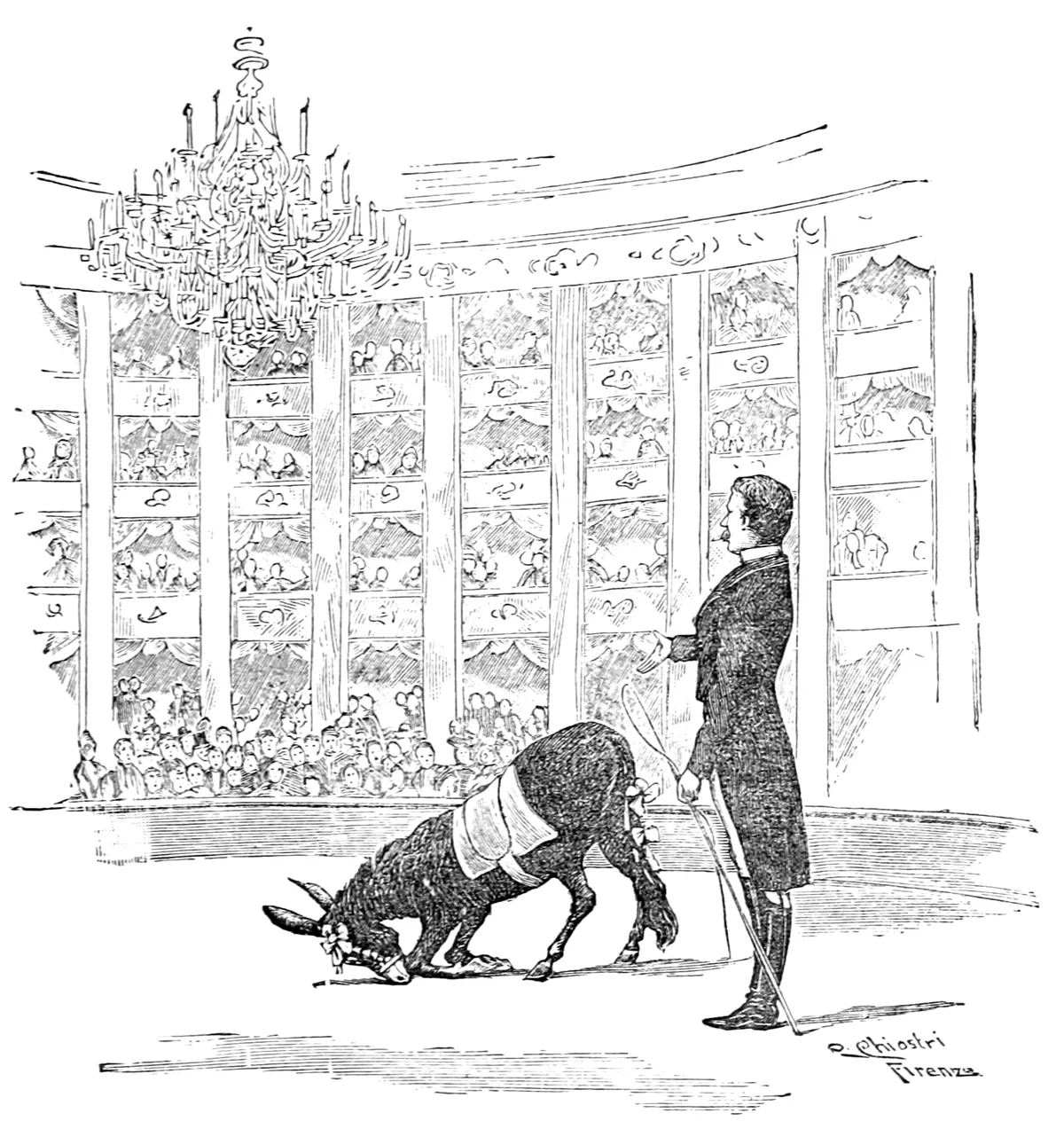
“Walk!”
Then the little donkey got up on all four legs and began to go round the Circus, keeping always to a walk.
After a while the Ringmaster shouted:
“Trot!” And Pinocchio, obeying the command, changed his walk to a trot.
“Gallop!” and Pinocchio broke into a gallop.
“Full speed!” and Pinocchio set off running at full tilt. But while he was running like a racehorse, the Ringmaster raised his arm in the air and fired a pistol.
At that shot the little donkey, pretending to be wounded, fell stretched out in the Circus as if he were really dying.
As he got up from the ground amid a burst of applause, shouts and clapping that rose to the stars, he naturally happened to lift his head and look up… and looking up, he saw in a box a beautiful lady who wore round her neck a heavy gold chain, from which hung a medallion. In the medallion was painted the portrait of a puppet.
“That portrait is mine!... That lady is the Fairy!” Pinocchio said to himself, recognising her at once; and, carried away by his great joy, he tried to cry out:
“Oh, my little Fairy! Oh, my little Fairy!”
But instead of these words, out of his throat came a bray so loud and so long that it made all the spectators laugh, and especially all the children in the theatre.
Then the Ringmaster, to teach him and make him understand that it is not good manners to start braying in the public's face, gave him a rap on the nose with the handle of his whip.
The poor little donkey stuck out a good hand's breadth of tongue and kept licking his nose for at least five minutes, thinking perhaps that in this way he could wipe away the pain he had felt.
But what was his despair when, looking up a second time, he saw that the box was empty and that the Fairy had vanished!...
He felt as if he were dying: his eyes filled with tears and he began to weep bitterly. Nobody noticed, however, and least of all the Ringmaster, who, on the contrary, cracked his whip and shouted:
“Come on, Pinocchio, there's a good fellow! Now you shall show these ladies and gentlemen how gracefully you can jump through the hoops.”
Pinocchio tried two or three times: but every time he came up to the hoop, instead of going through it, he found it more comfortable to go underneath. At last he took a leap and went through it: but unluckily his hind legs got caught in the hoop, and so he fell to the ground on the other side all in a heap.
When he got up he was lame, and he could barely manage to get back to the stable.
“Bring out Pinocchio! We want the little donkey! Bring out the little donkey!” shouted the children in the stalls, moved to pity by the sad accident.
But the little donkey was not seen again that evening.
The next morning the veterinary, that is to say the animal doctor, examined him and declared that he would stay lame for the rest of his life.
Then the Ringmaster said to his stable-boy:
“What do you expect me to do with a lame donkey? He would just eat his bread for nothing. So take him to the market-place and sell him again.”
When they reached the market-place they found a buyer straight away, who asked the stable-boy:
“How much do you want for that lame little donkey?”
“Twenty lire.”
“I'll give you twenty pennies. Don't think I'm buying him to put him to work: I'm buying him only for his skin. I can see he has a very tough skin, and with his skin I mean to make a drum for the band in my village.”
I leave it to you, children, to imagine what a fine treat it was for poor Pinocchio when he heard that he was destined to become a drum!
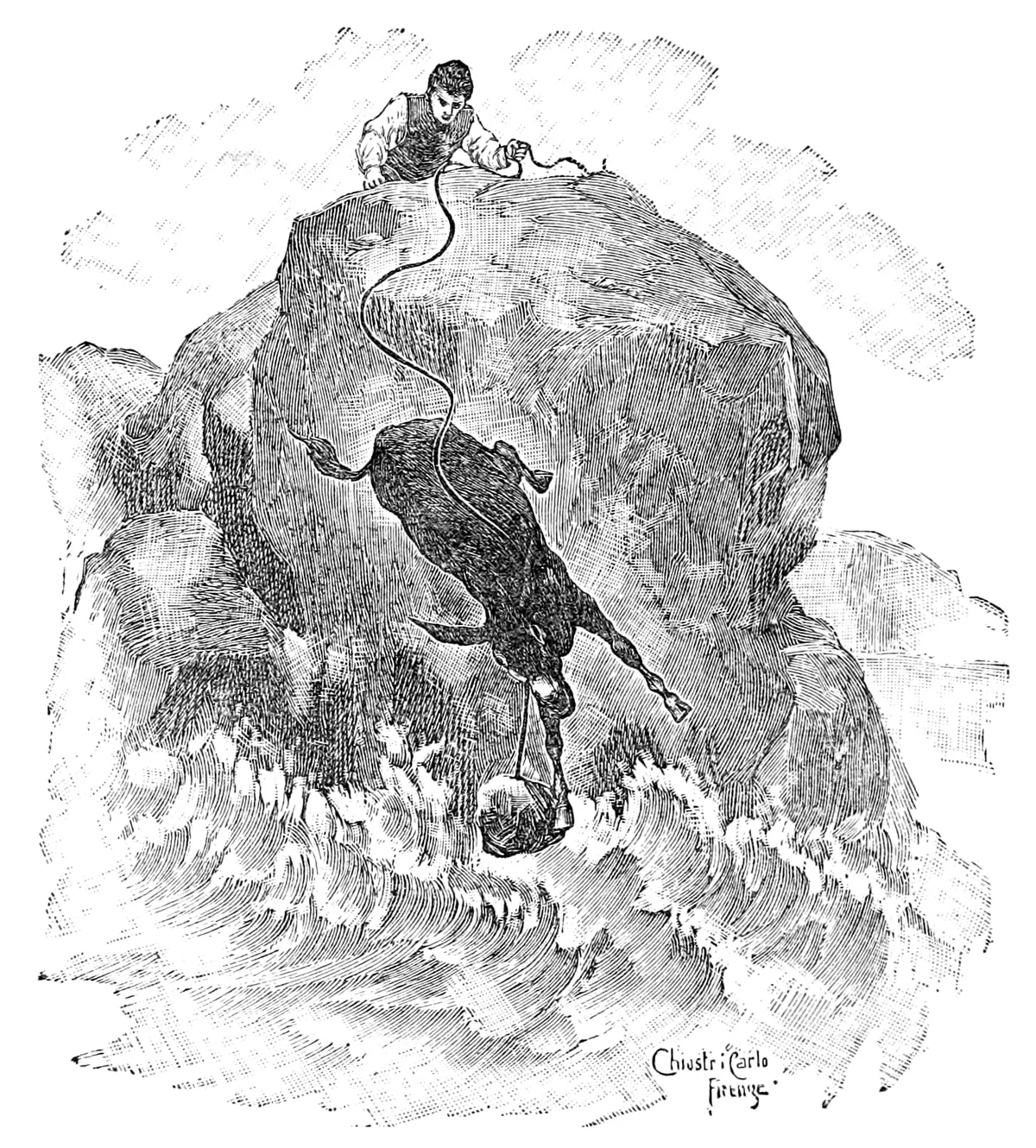
The fact is that the buyer, as soon as he had paid the twenty pennies, led the little donkey up on to a rock at the edge of the sea; and having hung a stone round his neck and tied him by one leg with a rope that he held in his hand, he suddenly gave him a shove and threw him into the water.
With that great stone round his neck, Pinocchio went straight to the bottom; and the buyer, still holding the rope tight in his hand, sat down on the rock to wait until the little donkey had had plenty of time to drown, so that he could then flay him and take off his skin.