When the little donkey had been under water for fifty minutes, the buyer said, talking to himself:
“By now my poor lame little donkey must be good and drowned. So let's pull him up and make this fine drum out of his skin.”
And he began to pull on the rope with which he had tied him by one leg: and he pulled, and pulled, and pulled, until at last he saw appear on the surface of the water.... Can you guess? Instead of a dead donkey, he saw appear on the surface of the water a live puppet, wriggling like an eel.
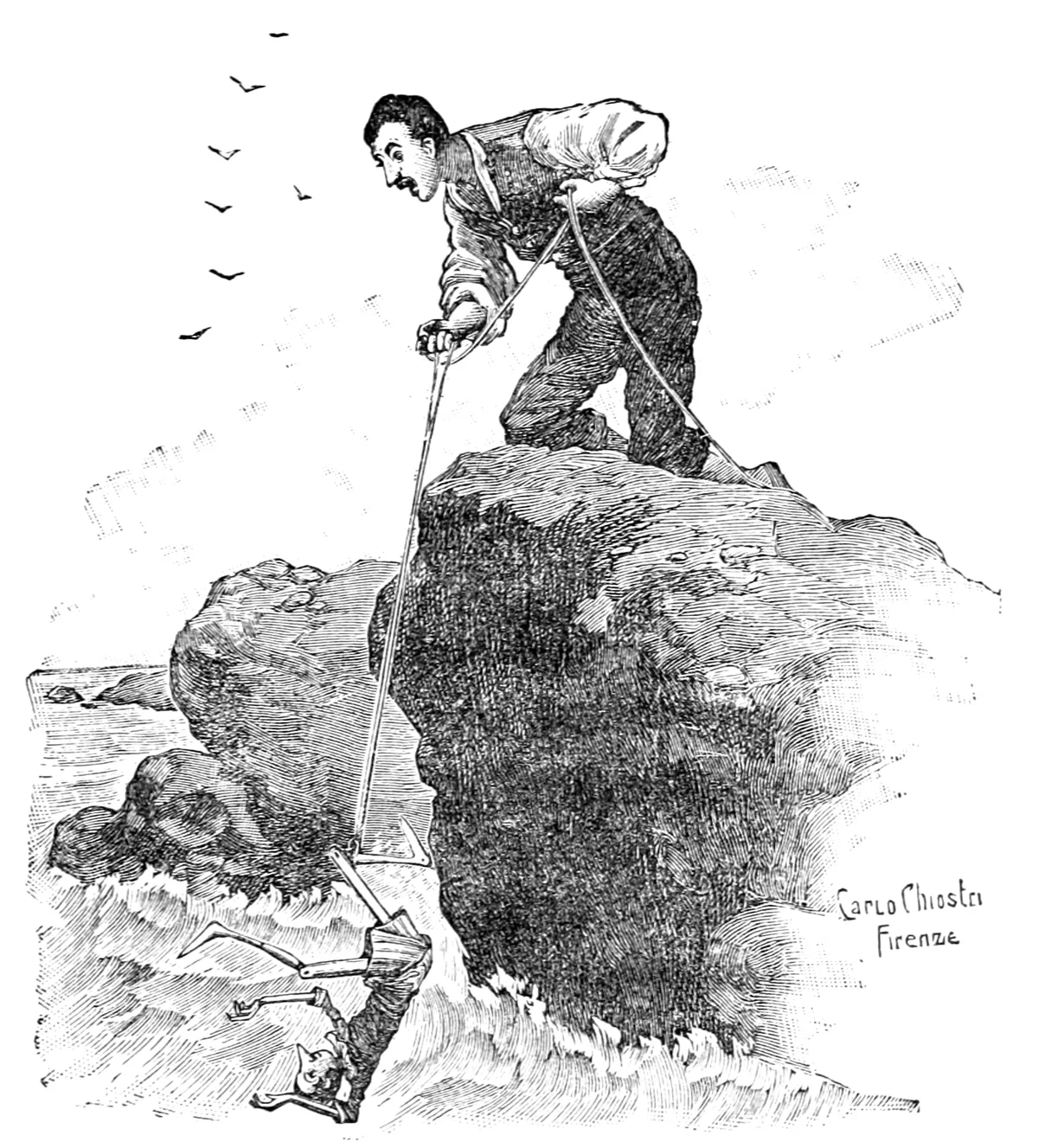
When he saw that wooden puppet, the poor man thought he was dreaming, and he stood there dazed, with his mouth open and his eyes popping out of his head.
When he had recovered a little from his first astonishment, he said, weeping and stammering:
“And the little donkey I threw into the sea, where is he?...”
“I am that little donkey!” answered the puppet, laughing.
“You?”
“Me.”
“Ah, you rascal! Are you trying to make fun of me, by any chance?”
“Make fun of you? Not at all, dear master: I'm speaking to you in earnest.”
“But how on earth can you, who were a little donkey a short while ago, have turned into a wooden puppet just by being in the water?...”
“It must be the effect of the sea water. The sea plays tricks like that.”
“Mind, puppet, mind!... Don't think you can amuse yourself at my expense. Woe betide you if I lose my patience!”
“Very well, master: do you want to know the whole true story? Untie this leg of mine and I'll tell it to you.”
That good old muddle-head of a buyer, curious to know the true story, at once undid the knot of the rope that kept him tied: and then Pinocchio, finding himself as free as a bird in the air, began to speak to him like this:
“You must know, then, that I was a wooden puppet as I am today: but I was within a whisker of becoming a boy, like so many there are in this world: only, because I had little wish to study and because I listened to bad companions, I ran away from home.... and one fine day, when I woke up, I found myself changed into a donkey with a great pair of ears.... and a great big tail!... What a shame that was for me!... A shame, dear master, that I pray blessed Saint Anthony may never make even you feel! I was taken to be sold at the donkey market and was bought by the Ringmaster of a circus, who took it into his head to make a great dancer of me and a great jumper through hoops; but one evening, during the show, I had a bad fall in the ring and went lame in both legs. Then the Ringmaster, not knowing what to do with a lame donkey, sent me to be sold again, and you bought me!”
“More's the pity! And I paid twenty pennies for you. And now who will give me back my poor twenty pennies?”
“And why did you buy me? You bought me to make a drum out of my skin!... a drum!...”
“More's the pity! And now where shall I find another skin!...”
“Don't give way to despair, master. There are plenty of little donkeys in this world!”
“Tell me, you cheeky little rascal: does your story end here?”
“No,” answered the puppet, “there are two more words, and then it's finished. After buying me, you brought me to this spot to kill me, but then, giving in to a merciful feeling of humanity, you preferred to tie a stone round my neck and throw me to the bottom of the sea. This delicate feeling does you great honour, and I shall be eternally grateful to you for it. All the same, dear master, this time you reckoned without the Fairy....”
“And who is this Fairy?”
“She is my mamma, who is like all those good mammas who love their children dearly and never let them out of their sight, and lovingly help them in every misfortune, even when those children, because of their thoughtless pranks and their bad behaviour, deserve to be abandoned and left to fend for themselves. Well, as I was saying, as soon as the good Fairy saw me in danger of drowning, she straight away sent round me an endless shoal of fish, who, really believing I was a little donkey good and dead, began to eat me! And what mouthfuls they took! I would never have believed that fish were even greedier than children! One ate my ears, one ate my muzzle, another my neck and mane, another the skin of my legs, another the coat on my back.... and among the rest there was one little fish so polite that he even condescended to eat my tail.”
“From this day on,” said the buyer, horrified, “I swear never to taste fish again. I would hate too much to cut open a red mullet or a fried hake and find a donkey's tail inside it!”
“I think just as you do,” replied the puppet, laughing. “Besides, you must know that when the fish had finished eating all that donkey's hide that covered me from head to foot, they came, naturally, to the bone.... or rather, they came to the wood, because, as you see, I am made of very hard wood. But after the first few bites, those greedy fish soon realised that wood was not the sort of meat for their teeth, and, sickened by this indigestible food, they went off, some this way and some that, without even turning round to say thank you.... And there you have the story of how it was that you, pulling up the rope, found a live puppet instead of a dead donkey.”
“I don't care a fig for your story,” shouted the buyer in a fury. “All I know is that I spent twenty pennies to buy you, and I want my money back. Do you know what I'll do? I'll take you back to the market and sell you by weight, as seasoned wood for lighting the fire in the hearth.”
“Sell me by all means: I'm quite happy,” said Pinocchio. But as he said it, he gave a leap and dived into the middle of the water. And swimming merrily away from the shore, he shouted to the poor buyer:
“Goodbye, master; if you need a skin to make a drum, remember me.”
And then he laughed and went on swimming: and after a while, turning round, he yelled even louder:
“Goodbye, master;... if you need a bit of seasoned wood to light your fire, remember me.”
The fact is that in the twinkling of an eye he was so far away that he could hardly be seen any more; that is, all that could be seen on the surface of the sea was a tiny black dot, which every now and then stuck its legs up out of the water and turned somersaults and leaps, like a dolphin in high good humour.
As Pinocchio swam along wherever chance took him, he saw in the middle of the sea a rock that seemed to be made of white marble, and up on top of the rock a pretty little Goat, who was bleating lovingly and beckoning him to come closer.
The strangest thing was this: that the little Goat's wool, instead of being white, or black, or spotted with several colours like that of other goats, was blue, but of a blue so dazzling that it was very much like the hair of the beautiful Little Girl.
I leave you to imagine whether poor Pinocchio's heart began to beat faster! Doubling his strength and energy, he set off swimming towards the white rock; and he was already halfway there, when, lo and behold, out of the water there rose and came towards him the horrible head of a sea monster, with its mouth gaping wide like a chasm, and three rows of fangs that would have frightened you even in a picture.
And do you know who that sea monster was?
That sea monster was neither more nor less than that gigantic Shark mentioned several times in this story, who, because of his slaughters and his insatiable greed, was nicknamed “the Attila of fish and fishermen.”
Just imagine poor Pinocchio's terror at the sight of the monster. He tried to dodge it, to change course: he tried to escape: but that enormous gaping mouth kept coming at him with the speed of lightning.
“Hurry, Pinocchio, for pity's sake!” cried the pretty little Goat, bleating.
And Pinocchio swam desperately with his arms, his chest, his legs and his feet.
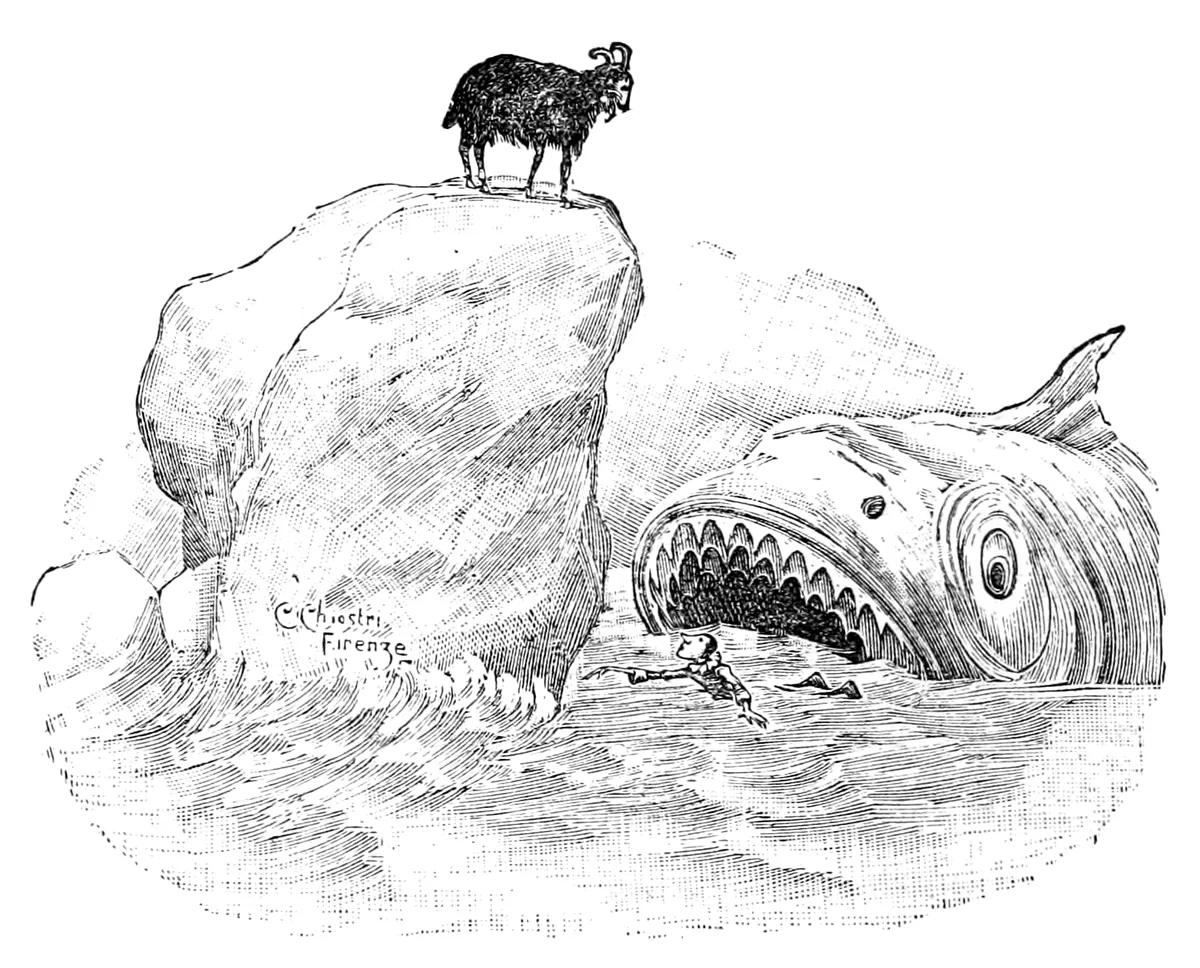
“Quick, Pinocchio, the monster is getting closer!...”
And Pinocchio, gathering all his strength, swam twice as hard.
“Look out, Pinocchio!... The monster is catching you up! There he is!... There he is!... Hurry, for pity's sake, or you're lost!...”
And Pinocchio swam faster than ever, on and on and on, like a bullet from a gun. And already he was nearing the rock, and already the little Goat, leaning right out over the sea, was holding out her little front legs to help him out of the water.... But!...
But by now it was too late! The monster had caught him. Drawing in his breath, the monster drank down the poor puppet as he would have drunk a hen's egg, and swallowed him with such violence and such greed that Pinocchio, tumbling down into the Shark's belly, landed with such a rude bump that he was left stunned for a quarter of an hour.
When he came to his senses after that shock, he could not make out, even he himself, what world he was in. All around him on every side there was a great darkness: but a darkness so black and deep that he felt as if he had dipped his head into an inkwell full of ink. He listened and heard no sound; only every now and then he felt great gusts of wind blowing in his face. At first he could not understand where that wind came from: but then he realised that it came from the monster's lungs. For you must know that the Shark suffered very badly from asthma, and when he breathed it really seemed as if the north wind were blowing.
At first Pinocchio did his best to keep his courage up: but when he had proof upon proof that he was shut up inside the sea monster's belly, then he began to cry and to scream; and crying, he said:
“Help! Help! Oh, poor me! Is there nobody who will come and save me?”
“Who do you expect to save you, you poor wretch?” said a nasty cracked voice in the darkness, like an out-of-tune guitar.
“Who is that speaking?” asked Pinocchio, feeling himself go cold with fright.
“It's me! I'm a poor Tunny, swallowed by the Shark together with you. And what kind of fish are you?”
“I have nothing whatever to do with fish. I'm a puppet.”
“Then if you're not a fish, why did you let the monster swallow you?”
“It wasn't me that let myself be swallowed: it was him that swallowed me! And now, what are we to do here in the dark?...”
“Resign ourselves and wait for the Shark to digest us both!...”
“But I don't want to be digested!” howled Pinocchio, starting to cry again.
“I shouldn't like to be digested either,” added the Tunny, “but I am something of a philosopher, and I console myself by thinking that, when one is born a Tunny, there is more dignity in dying under water than under oil!...”
“Nonsense!” cried Pinocchio.
“It's my opinion,” replied the Tunny, “and opinions, as the political Tunnies say, must be respected!”
“Anyway.... I want to get out of here.... I want to escape....”
“Escape, if you can!...”
“Is he very big, this Shark that has swallowed us?” asked the puppet.
“Just imagine, his body is more than a kilometre long, not counting the tail.”
While he was having this conversation in the dark, Pinocchio thought he saw, far, far away, a sort of glimmer of light.
“Whatever can that little light be, far, far away?” said Pinocchio.
“It must be some companion in misfortune, waiting like us for the moment when he'll be digested!...”
“I want to go and find him. Couldn't it just be some old fish who could show me the way to escape?”
“I hope so with all my heart, dear puppet.”
“Goodbye, Tunny.”
“Goodbye, puppet; and good luck.”
“Where shall we meet again?...”
“Who knows?... It's better not even to think about it!”