During that desperate race there was a terrible moment, a moment when Pinocchio thought he was lost: for you must know that Alidoro (that was the mastiff’s name), by dint of running and running, had very nearly caught up with him.
Suffice it to say that the puppet could hear behind him, barely a hand’s breadth away, the heavy panting of that horrid beast, and could even feel the hot blast of its breath.
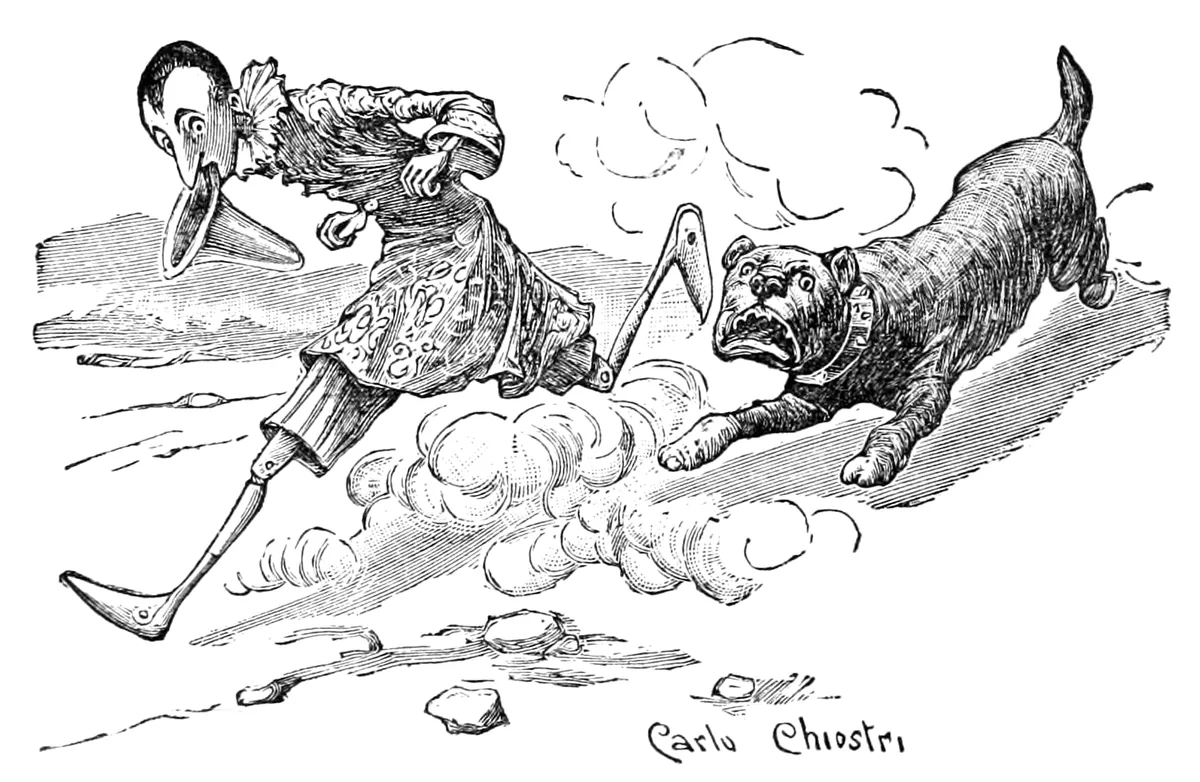
Luckily the shore was close by now, and the sea could be seen only a few steps away.
As soon as he was on the beach, the puppet made a splendid leap, just as a frog might have done, and landed in the middle of the water. Alidoro, on the other hand, wanted to stop; but, carried along by the speed of his run, he went into the water too. And the wretched creature could not swim; so he at once began to paddle wildly with his paws to keep himself afloat; but the more he paddled, the more his head went under.
When he managed to get his head out again, the poor dog’s eyes were terrified and rolling, and he cried out, barking:
“I’m drowning! I’m drowning!”
“Then drop dead!” Pinocchio answered him from afar, for he now saw himself safe from all danger.
“Help me, dear Pinocchio!… Save me from death!…”
At those heartrending cries the puppet, who at bottom had an excellent heart, was moved to pity, and turning to the dog he said:
“But if I help you to save yourself, will you promise not to bother me any more and not to chase me?”
“I promise! I promise! Hurry, for pity’s sake, because if you wait another half a minute, I’ll be dead and done for.”
Pinocchio hesitated a little; but then, remembering that his father had told him many times that one never loses by doing a good deed, he swam over to Alidoro and, taking him by the tail with both hands, brought him safe and sound onto the dry sand of the beach.
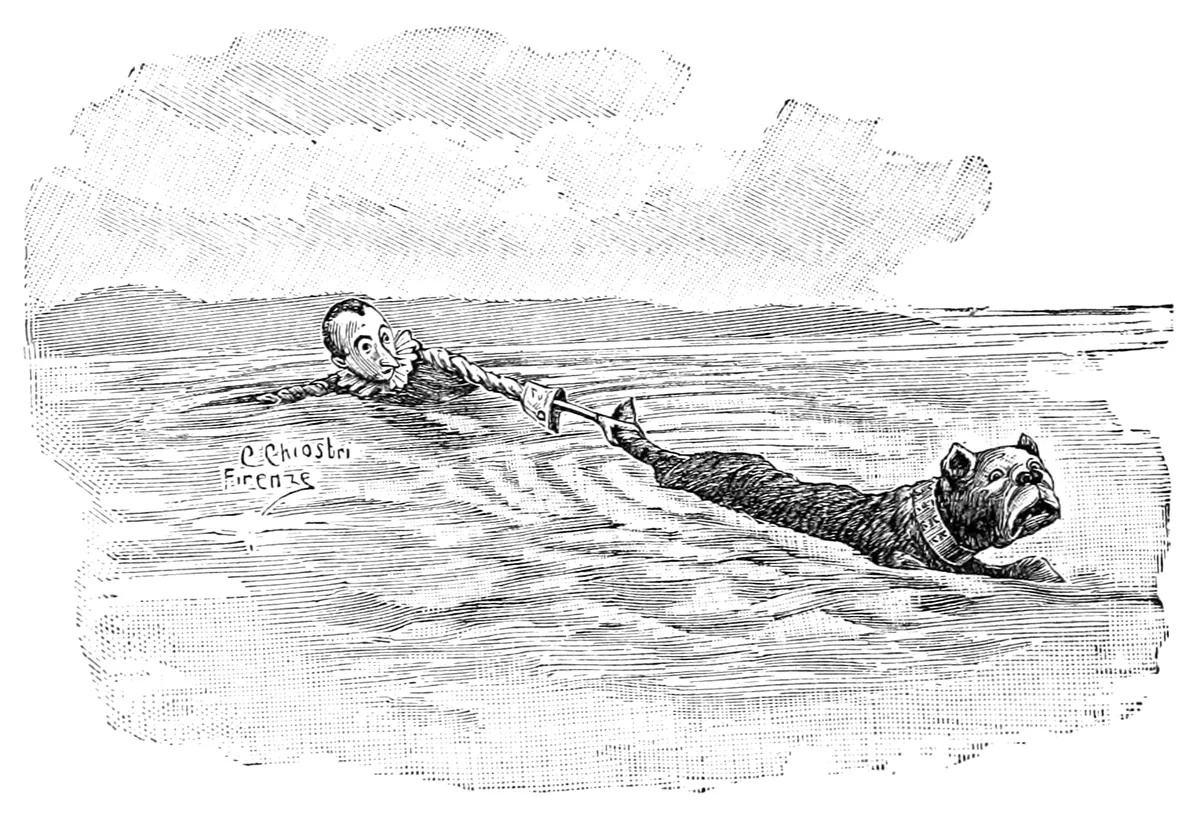
The poor dog could no longer stand on his feet. Without meaning to, he had drunk so much salt water that he was swollen up like a balloon. All the same, the puppet, not wanting to trust him too far, thought it wise to throw himself back into the sea; and, swimming away from the shore, he called out to the friend he had saved:
“Goodbye, Alidoro; have a good journey, and my best regards to everyone at home.”
“Goodbye, Pinocchio,” answered the dog, “and a thousand thanks for saving me from death. You have done me a great service: and in this world one good turn deserves another. If the chance comes, we shall meet again…”
Pinocchio went on swimming, keeping always close to the land. At last he thought he had reached a safe place; and, glancing at the shore, he saw among the rocks a sort of cave, out of which rose a very long plume of smoke.
“In that cave,” he said then to himself, “there must be a fire. So much the better! I’ll go and dry myself and get warm, and then?… and then, come what may.”
Having made up his mind, he swam towards the rocks; but just as he was about to climb up, he felt something under the water that rose, and rose, and rose, and lifted him into the air. He tried at once to escape, but by now it was too late, because to his very great astonishment he found himself shut up inside a big net, in the middle of a swarm of fish of every shape and size, flapping their tails and thrashing about like so many souls in despair.
And at the same moment he saw a fisherman come out of the cave, so ugly, but so very ugly, that he looked like a sea monster. Instead of hair, he had on his head a very thick bush of green grass; green was the skin of his body, green his eyes, green his very long beard, which hung all the way down to here. He looked like a big green lizard standing up on its hind legs.
When the fisherman had pulled the net out of the sea, he cried out in delight:
“Blessed Providence! Today, too, I shall be able to have a fine feast of fish!”
“Thank goodness I’m not a fish!” said Pinocchio to himself, plucking up a little courage.
The net full of fish was carried into the cave, a dark and smoky cave, in the middle of which a big pan of oil was sizzling, giving off such a smell of burnt candle-wick that it took your breath away.
“Now let’s have a look at what fish we’ve caught!” said the Green Fisherman; and, thrusting into the net a hand so enormous that it looked like a baker’s shovel, he pulled out a handful of red mullet.
“Good, these mullet!” he said, looking at them and sniffing them with satisfaction. And after sniffing them, he flung them into a tub with no water in it.
Then he repeated the same operation several times; and as he pulled out the other fish, his mouth began to water, and he said, gloating:
“Good, these hake!…”
“Exquisite, these grey mullet!…”
“Delicious, these soles!…”
“Choice, these weevers!…”
“Sweet, these anchovies with their heads on!”
As you can imagine, the hake, the grey mullet, the soles, the weevers and the anchovies all went higgledy-piggledy into the tub to keep the red mullet company.
The last one left in the net was Pinocchio.
As soon as the fisherman had pulled him out, he opened his big green eyes wide in amazement and cried, almost frightened:
“What sort of fish is this? I don’t remember ever eating fish made like this.”
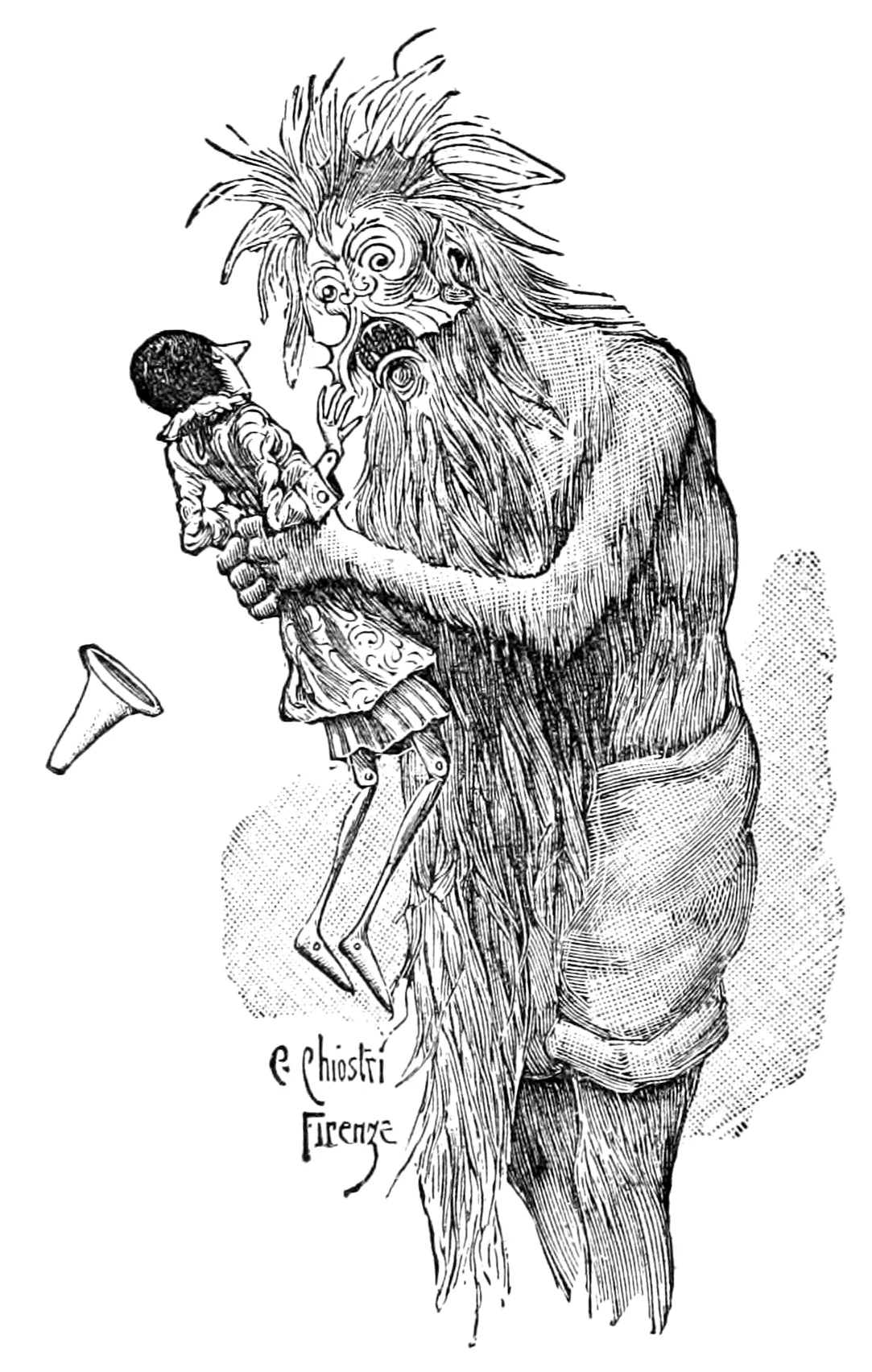
And he looked at him carefully again, and after having looked him over well from every side, he ended by saying:
“I see; it must be a sea crab.”
Then Pinocchio, mortified at being taken for a crab, said in an offended voice:
“Crab, indeed! What crab? Look how you treat me! For your information, I am a puppet.”
“A puppet?” replied the fisherman. “To tell the truth, the puppet fish is a new fish to me! So much the better! I’ll eat you all the more gladly.”
“Eat me? Will you please understand that I’m not a fish? Can’t you hear that I talk, and reason, just as you do?”
“Very true,” the fisherman added, “and since I see that you are a fish, and that you have the good fortune to talk and reason as I do, I too mean to show you due consideration.”
“And this consideration would be?…”
“As a token of friendship and particular esteem, I shall leave it to you to choose how you wish to be cooked. Would you like to be fried in the pan, or would you rather be stewed in the pot with tomato sauce?”
“To tell the truth,” answered Pinocchio, “if I must choose, I would much rather be set free, so that I can go back home.”
“You’re joking! Do you think I want to lose the chance of tasting such a rare fish? It isn’t every day, you know, that a puppet fish turns up in these seas. Leave it to me: I’ll fry you in the pan together with all the other fish, and you’ll be pleased with it. Being fried in company is always a comfort.”
At this tune the unhappy Pinocchio began to cry, to scream, to beg for mercy; and, crying, he said: “How much better it would have been if I had gone to school!… I chose to listen to my schoolmates, and now I’m paying for it!… Ee!… Ee!… Ee!…”
And because he was wriggling like an eel and making incredible efforts to slip out of the Green Fisherman’s clutches, the fisherman took a good strip of rush and, after tying him hand and foot like a sausage, threw him into the bottom of the tub with the others.
Then, bringing out a big old wooden tray full of flour, he set about flouring all those fish; and as fast as he floured them, he threw them into the pan to fry.
The first to dance in the boiling oil were the poor hake; then it was the weevers’ turn, then the grey mullet’s, then the soles’ and the anchovies’, and then came Pinocchio’s turn. Seeing himself so close to death (and what a horrible death!), he was seized by such trembling and such terror that he had neither voice nor breath left to beg for mercy.
The poor boy begged with his eyes! But the Green Fisherman, without paying him the least attention, rolled him five or six times in the flour, flouring him so well from head to foot that he looked as if he had turned into a plaster puppet.
Then he took him by the head, and…