As soon as he reached the beach, Pinocchio at once took a long look out over the sea; but he saw no Shark. The sea was as smooth as a great sheet of looking-glass.
“Well, where's the Shark?” he asked, turning to his companions.
“He must have gone off to have his breakfast,” answered one of them, laughing.
“Or he'll have flopped onto his bed for a little nap,” added another, laughing louder than ever.
From those nonsensical answers and that silly sniggering, Pinocchio understood that his companions had played a nasty trick on him, making him believe something that was not true; and taking it badly, he said to them in a peevish voice:
“And now? What was the good of making me believe that story about the Shark?”
“There was some good in it, all right!…” answered those scamps all together.
“And what was that?”
“To make you miss school and come with us. Aren't you ashamed of showing yourself so punctual and so diligent at lessons every day? Aren't you ashamed of studying as hard as you do?”
“And if I study, what's it to you?”
“It matters a great deal to us, because you make us look bad in front of the schoolmaster…”
“Why?”
“Because pupils who study always put in the shade the ones like us who don't feel like studying. And we don't want to be put in the shade! We have our pride too!…”
“So what must I do to please you?”
“You must get sick of school too, and of lessons and the schoolmaster, which are our three great enemies.”
“And what if I wanted to go on studying?”
“We won't look you in the face ever again, and at the first chance we get, you'll pay for it.”
“Honestly, you almost make me laugh,” said the puppet with a little shake of his head.
“Hey, Pinocchio!” shouted the biggest of those boys then, coming right up to his face. “Don't you come here acting the bully: don't you come here strutting like a little rooster!… because if you're not afraid of us, we're not afraid of you either! Remember, you're one and we're seven.”
“Seven, like the deadly sins,” said Pinocchio with a great laugh.
“Did you hear that? He's insulted all of us! He called us the deadly sins!…”
“Pinocchio! Say sorry for that insult… or else, woe betide you!…”
“Cuckoo!” went the puppet, tapping the tip of his nose with his forefinger, to make fun of them.
“Pinocchio! This will end badly!…”
“Cuckoo!”
“You'll get a beating fit for a donkey!…”
“Cuckoo!”
“You'll go home with a broken nose!…”
“Cuckoo!”
“I'll give you cuckoo, now!” shouted the boldest of those scamps. “Take this on account, for a start, and save it for your supper tonight.”
And as he said this, he landed a punch on his head.
But it was, as they say, tit for tat; for the puppet, as was to be expected, answered at once with another punch: and there and then, from one moment to the next, the fight became general and fierce.
Pinocchio, though he was alone, defended himself like a hero. He worked those feet of his, made of the hardest wood, so well that he kept his enemies at a respectful distance the whole time. Wherever his feet could reach and land, they always left a bruise as a keepsake.
Then the boys, vexed at not being able to get to grips with the puppet hand to hand, thought it a good idea to take up missiles; and untying the bundles of their schoolbooks, they began hurling at him their spelling-books, their grammars, their Giannettinos, their Minuzzolos, their Thouar's Tales, their Baccini's Little Chicks and other schoolbooks: but the puppet, who was quick of eye and wily, always ducked in time, so that the volumes, passing over his head, all went falling into the sea.
Just imagine the fish! The fish, thinking those books were something to eat, came rushing in shoals to the surface; but after taking a bite of a page or a title-page, they spat it out again at once, pulling a sort of face with their mouths that seemed to say: “This is no food for us: we're used to eating much better!”
Meanwhile the fight grew fiercer and fiercer, when all at once a big Crab, who had come out of the water and had clambered slowly, slowly up onto the beach, shouted in a dreadful voice like a trombone with a cold:
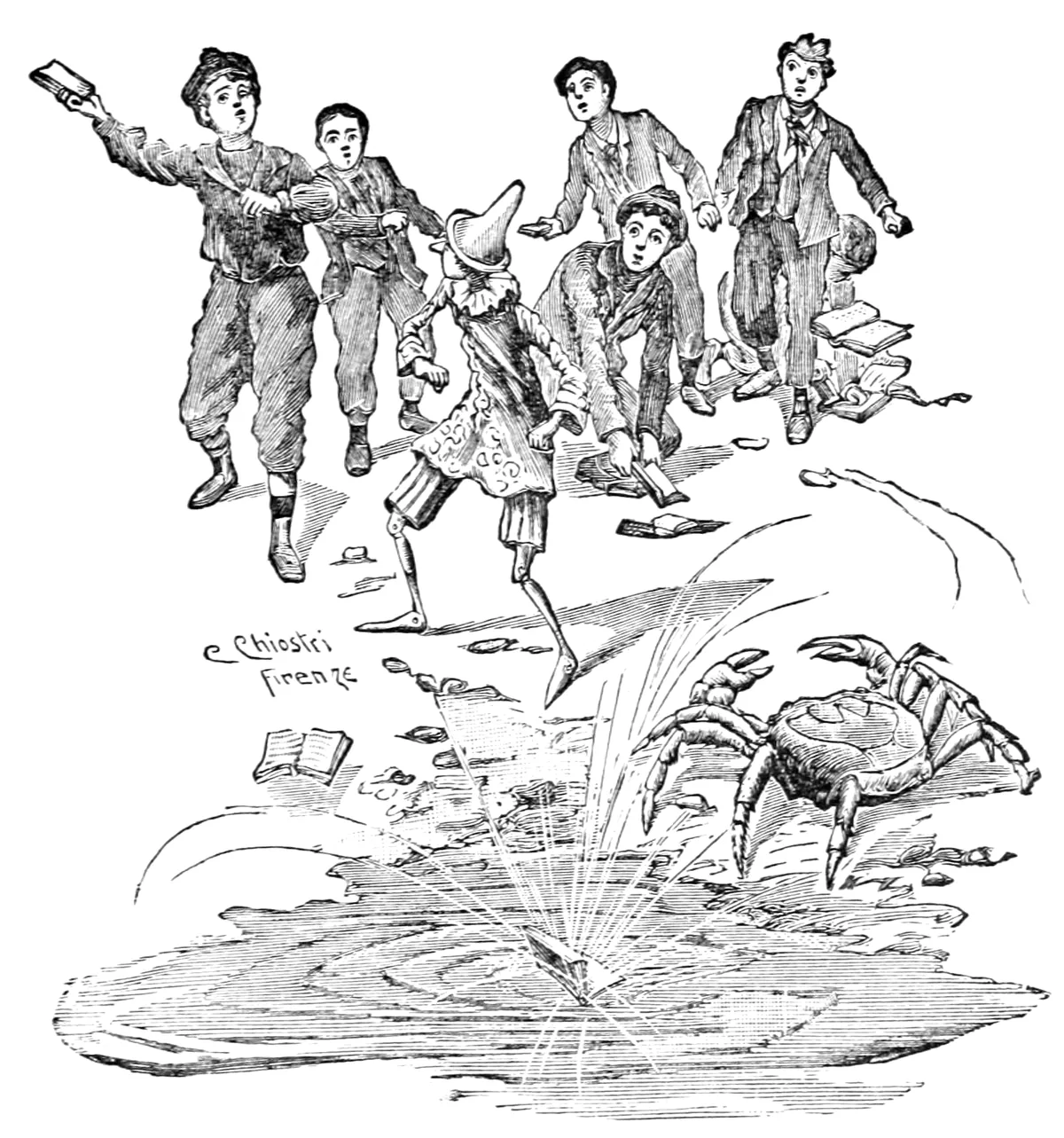
“Stop it, you little rascals, that's all you are! These fist-fights between boys rarely end well. Some misfortune always happens!…”
Poor Crab! He might just as well have preached to the wind. What's more, that rascal Pinocchio, turning round to glare at him, said to him rudely:
“Hush, you tiresome Crab! You'd do better to suck a couple of lichen lozenges to cure that cold in your throat. Go to bed instead, and try to sweat it out!…”
Meanwhile the boys, who by now had thrown all their books, spotted the puppet's bundle of books lying a little way off, and seized it in less time than it takes to tell.
Among these books there was a volume bound in thick cardboard, with a parchment spine and corners. It was a Treatise on Arithmetic. I leave you to imagine how very heavy it was!
One of those scamps grabbed that volume, and taking aim at Pinocchio's head, hurled it with all the strength he had in his arm: but instead of hitting the puppet, it hit one of his companions on the head, who went as white as a washed sheet and said nothing but these words:
“Oh, Mamma mia… help me, for I'm dying!…” Then he fell flat on the sand of the beach.
At the sight of that poor little dead boy, the frightened boys took to their heels, and in a few minutes they were nowhere to be seen.
But Pinocchio stayed there; and although he too was more dead than alive from grief and fright, he nevertheless ran to soak his handkerchief in the seawater, and began bathing the temple of his poor schoolmate. And all the while, weeping bitterly and in despair, he called him by name and said to him:
“Eugenio!… my poor Eugenio!… open your eyes and look at me!… Why don't you answer me? It wasn't me, you know, who hurt you so badly! Believe me, it wasn't me!… Open your eyes, Eugenio… If you keep your eyes shut, you'll make me die too… Oh, good heavens! How will I ever go home now?… How will I have the courage to face my good mother? What will become of me?… Where will I run away to?… Where will I go and hide?… Oh, how much better, a thousand times better it would have been if I'd gone to school!… Why did I listen to these companions, who are my ruin? And the schoolmaster had told me!… and my mother had said it to me over and over: ‘Beware of bad companions!’ But I'm stubborn… a dreadful pig-head… I let everybody talk, and then I always go my own way! And afterwards I have to pay for it… And so, ever since I came into the world, I've never had a single happy quarter of an hour. Oh, good heavens! What will become of me, what will become of me, what will become of me?”
And Pinocchio went on crying, howling, beating his head with his fists and calling poor Eugenio by name, when all of a sudden he heard a muffled sound of footsteps coming closer.
He turned round: it was two carabineers.
“What are you doing lying there on the ground like that?” they asked Pinocchio.
“I'm looking after this schoolmate of mine.”
“Has he been taken ill?”
“It seems so!…”
“Taken ill, indeed!” said one of the carabineers, bending down and looking closely at Eugenio. “This boy has been wounded in the temple: who wounded him?”
“Not me!” stammered the puppet, who had no breath left in his body.
“If it wasn't you, then who was it that wounded him?”
“Not me!” repeated Pinocchio.
“And what was he wounded with?”
“With this book.” And the puppet picked up the Treatise on Arithmetic, bound in cardboard and parchment, from the ground to show it to the carabineer.
“And whose book is this?”
“Mine.”
“That’s enough: nothing more is needed. Get up at once and come along with us.”
“But I…”
“Come along with us!…”
“But I’m innocent…”
“Come along with us!”
Before leaving, the carabineers called some fishermen who just at that moment happened to be passing close to the shore in their boat, and said to them:
“We are leaving this boy in your care; he has been wounded in the head. Take him to your house and look after him. We’ll come back to see him tomorrow.”
Then they turned to Pinocchio, and after placing him between the two of them, they ordered him in a soldierly voice:
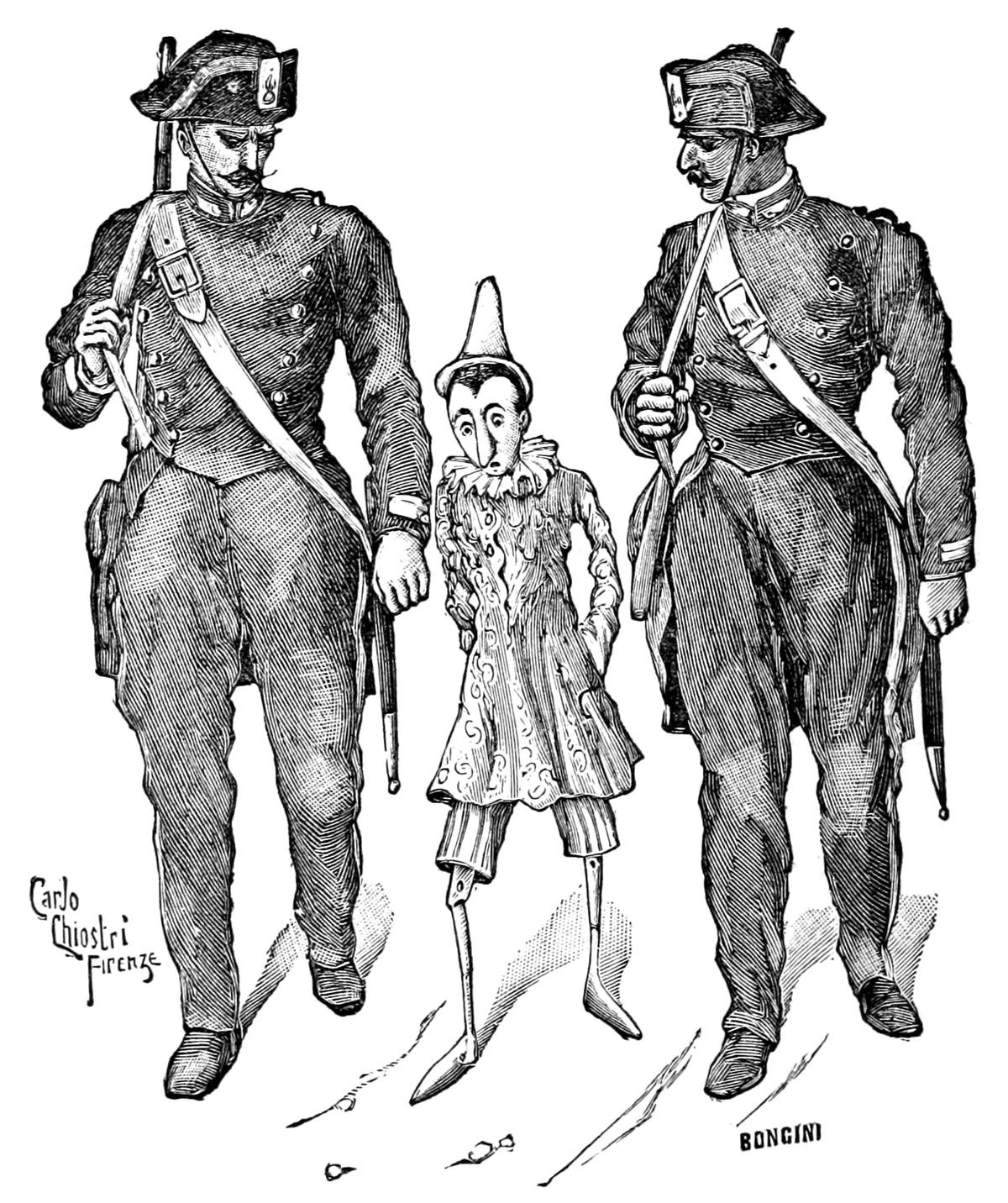
“Forward! And step lively! Or it will be the worse for you!”
Without waiting to be told twice, the puppet began to walk along the lane that led to the village. But the poor devil no longer knew what world he was in. He felt as if he were dreaming, and what a horrid dream! He was beside himself. His eyes saw everything double; his legs trembled; his tongue had stuck to the roof of his mouth, and he could not get out a single word. And yet, in the middle of that sort of daze and stupor, one very sharp thorn kept piercing his heart: the thought, that is, of having to pass under the windows of his good Fairy’s house between the carabineers. He would rather have died.
They had already arrived and were about to enter the village, when a rough gust of wind blew Pinocchio’s cap off his head and carried it a good ten paces away.
“Would you allow me,” the puppet said to the carabineers, “to go and fetch my cap?”
“Go on, then; but be quick about it.”
The puppet went and picked up the cap… but instead of putting it on his head, he put it in his mouth, between his teeth, and then began to run at full speed towards the seashore. Off he went like a bullet from a gun.
The carabineers, judging that it would be hard to catch him, set on him a big mastiff that had won first prize in every dog race. Pinocchio ran, and the dog ran faster still; so all the people leaned out of their windows and crowded into the middle of the street, eager to see the end of such a fierce race. But they could not satisfy their wish, because the mastiff and Pinocchio raised such a cloud of dust along the road that after a few minutes it was impossible to see anything at all.