The next day Pinocchio went to the village school.
Just imagine those rascally boys when they saw a puppet walk into their school! There was a burst of laughter that never seemed to end. One played one trick on him, another played another: one snatched the cap from his hand; one tugged at his little jacket from behind; one tried to draw two big moustaches in ink under his nose, and one even dared to tie strings to his feet and hands to make him dance.
For a while Pinocchio kept his cool and took no notice; but at last, feeling his patience running out, he turned to the ones who were pestering him and making fun of him the most, and said to them sternly:
“Look here, boys: I didn't come here to be your clown. I respect others and I want to be respected.”
“Bravo, Old Nick! You talk like a printed book!” yelled those scamps, splitting their sides with laughter: and one of them, cheekier than the rest, stretched out his hand meaning to grab the puppet by the tip of his nose.
But he was not quick enough: for Pinocchio stretched out his leg under the desk and gave him a kick on the shins.
“Ow! What hard feet!” howled the boy, rubbing the bruise the puppet had given him.
“And what elbows!… even harder than his feet!” said another, who for his rude jokes had got an elbow in the stomach.
The fact is that after that kick and that jab of the elbow, Pinocchio at once won the respect and the liking of all the boys at school: and they all made a great fuss of him, and they all loved him with all their hearts.
And even the schoolmaster praised him, because he found him attentive, studious and intelligent, always the first to come into school, always the last to get up from his seat when school was over.
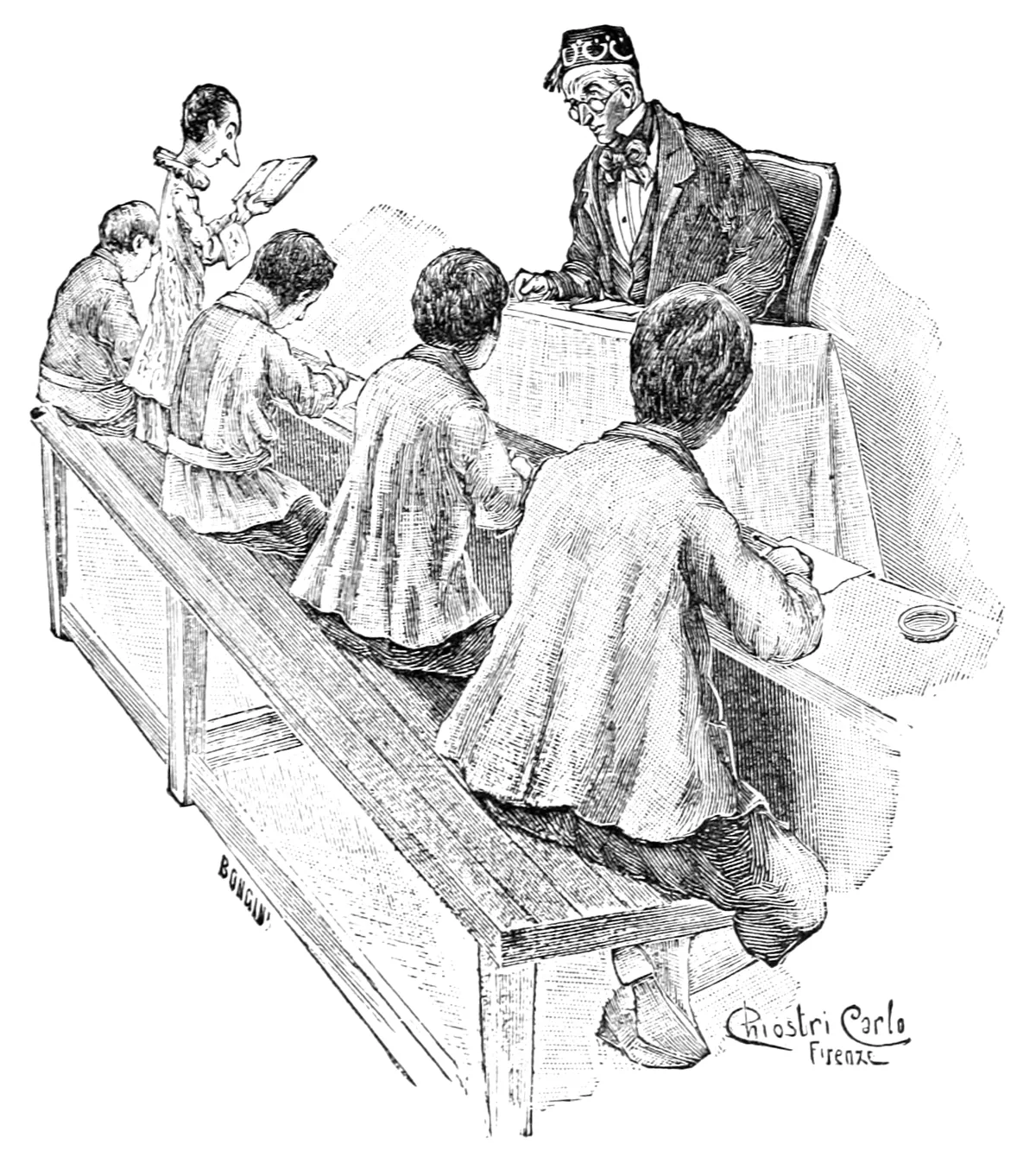
The only fault he had was that he went about with too many companions; and among them were many scamps well known for having little wish to study or to do themselves credit.
The schoolmaster warned him every day, and the good Fairy, too, never failed to tell him over and over again:
“Watch out, Pinocchio! Those bad schoolmates of yours will end, sooner or later, by making you lose your love of study and, perhaps, perhaps, by bringing some great misfortune down on you.”
“There's no danger of that!” the puppet would answer, shrugging his shoulders and tapping his forefinger in the middle of his forehead, as if to say: “There's plenty of sense in here!”
Now it happened that one fine day, as he was walking to school, he met a gang of his usual companions, who came up to him and said:
“Have you heard the great news?”
“No.”
“A Shark as big as a mountain has come into the sea near here.”
“Really?… Could it be the very same Shark from the time my poor father drowned?”
“We're going to the beach to see it. Do you want to come too?”
“Not me: I want to go to school.”
“What do you care about school? We'll go to school tomorrow. One lesson more or one lesson less, we'll stay the same donkeys anyway.”
“And what will the schoolmaster say?”
“Let the schoolmaster talk. He's paid on purpose to grumble every day.”
“And my mother?”
“Mothers never know anything,” answered those little pests.
“Do you know what I'll do?” said Pinocchio. “I want to see the Shark, for reasons of my own… but I'll go and see it after school.”
“You poor nitwit!” retorted one of the gang. “Do you think a fish that size is going to hang about there to suit you? As soon as he gets bored, he'll make off somewhere else, and then that's the last anybody will see of him.”
“How long does it take to get from here to the beach?” asked the puppet.
“We can be there and back in an hour.”
“Off we go, then! And whoever runs fastest is the best!” cried Pinocchio.
The signal for the start being given, that gang of scamps, with their books and exercise-books under their arms, set off running across the fields, and Pinocchio was always ahead of them all; he seemed to have wings on his feet.
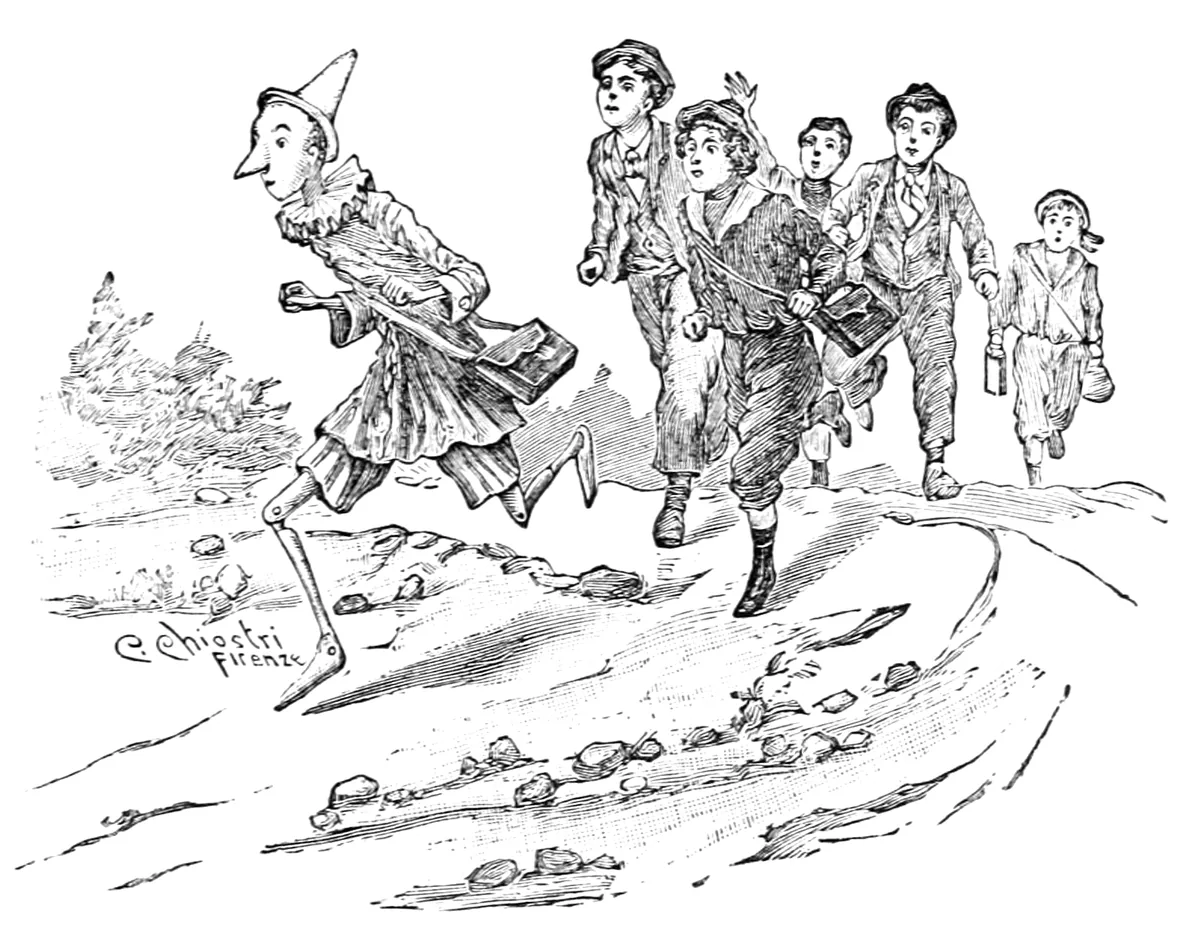
Every now and then, turning round, he jeered at his companions, who had been left a good way behind, and seeing them panting, out of breath, covered in dust and with their tongues hanging out, he laughed with all his heart. The wretched boy did not know, at that moment, what terrors and what horrible misfortunes he was running towards.