At last the wagon arrived, and it arrived without making the slightest noise, because its wheels were wrapped in tow and rags.
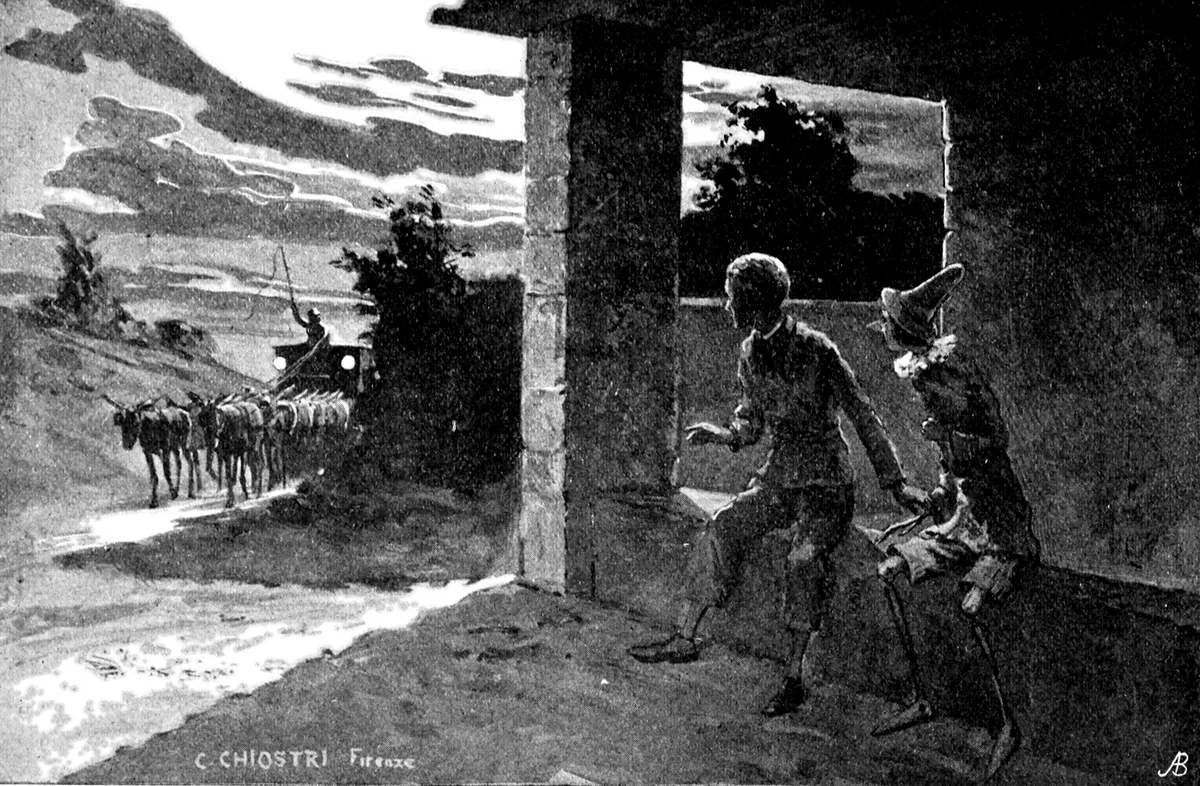
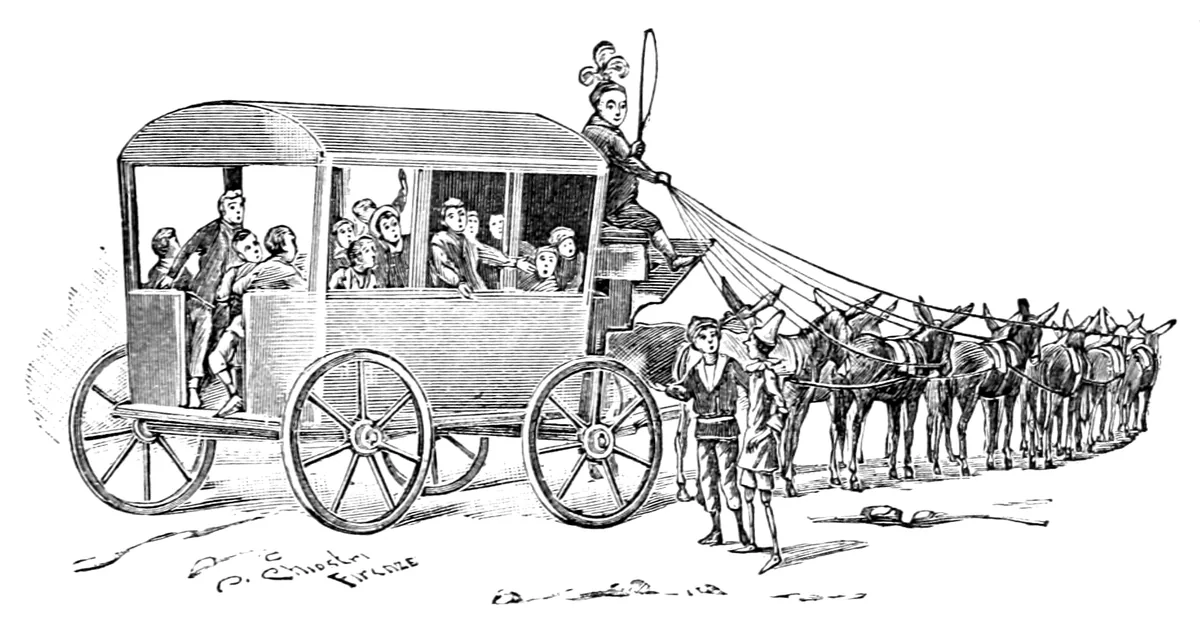
It was drawn by twelve pairs of donkeys, all the same size but with different coats.
Some were grey, others white, others speckled like pepper and salt, and others striped with broad yellow and blue stripes.
But the strangest thing of all was this: those twelve pairs, that is to say those twenty-four donkeys, instead of being shod like all other beasts of draught or burden, wore on their feet men’s lace-up boots made of white leather.
And the driver of the wagon?…
Picture to yourselves a little man wider than he was tall, soft and greasy as a pat of butter, with a little face like a rosy apple, a little mouth that was always laughing, and a thin, coaxing voice, like the voice of a cat begging for the good heart of the lady of the house.
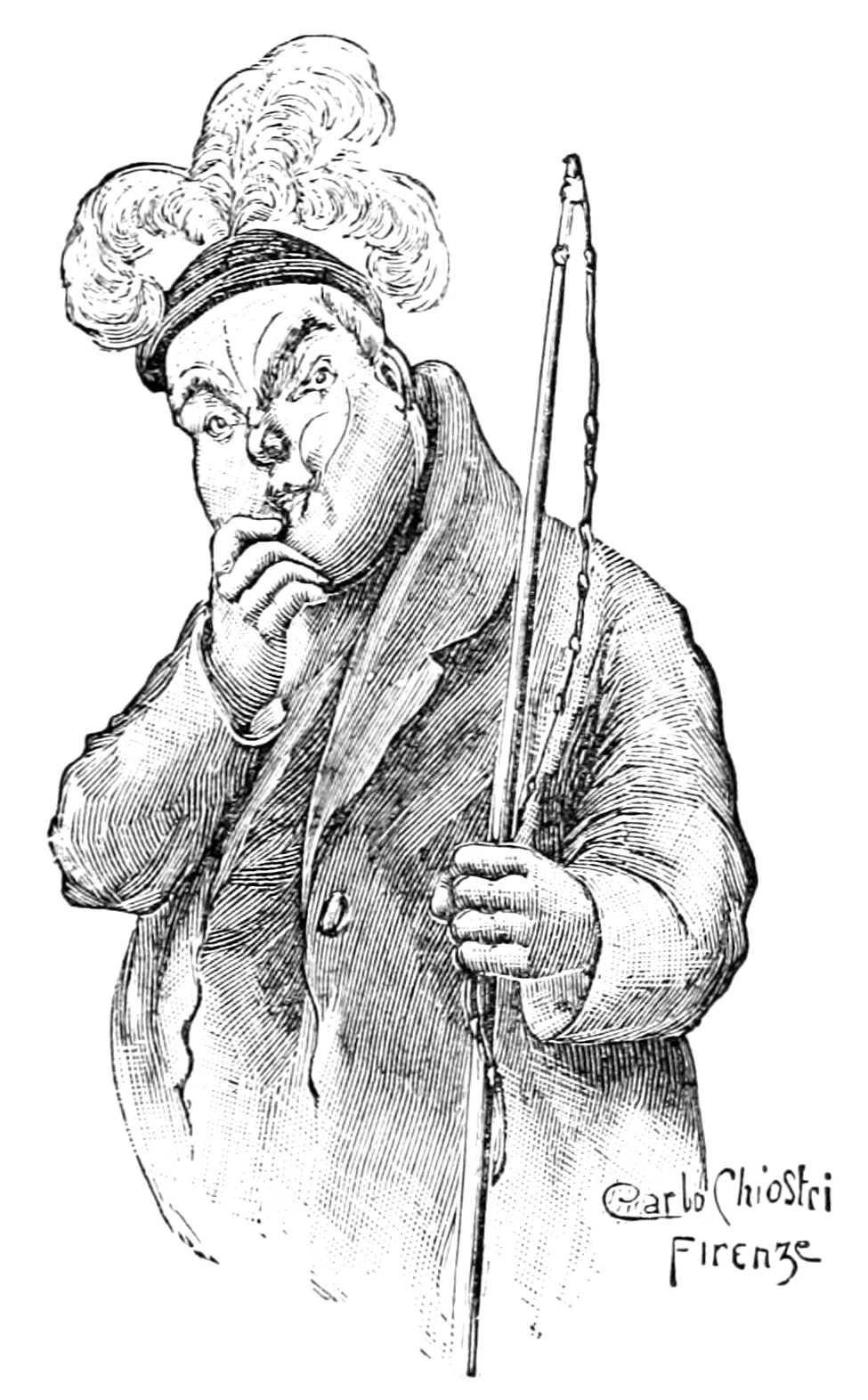
All the boys fell in love with him the moment they saw him, and they vied with one another to climb onto his wagon and be taken by him to that true land of plenty, known on the map by the alluring name of “the Land of Toys.”
In fact the wagon was already crammed with little boys between eight and twelve years old, heaped one on top of another like so many anchovies in brine. They were uncomfortable, they were squashed, they could hardly breathe: but no one said ouch! no one complained. The comfort of knowing that in a few hours they would reach a country where there were no books, no schools and no teachers made them so happy and so resigned that they felt neither the discomfort, nor the jolting, nor hunger, nor thirst, nor sleepiness.
As soon as the wagon had stopped, the Little Man turned to Lampwick and, with a thousand simpers and a thousand little airs, asked him with a smile:
“Tell me, my fine boy, do you want to come to that lucky country too?”
“Of course I want to come!”
“But I warn you, my little dear, there’s no more room in the wagon. As you can see, it’s quite full!…”
“Never mind!” replied Lampwick. “If there’s no room inside, I’ll make do with sitting on the shafts.” And with a leap he climbed up and sat astride the shafts.
“And you, my love,” said the Little Man, turning to Pinocchio with great politeness, “what do you mean to do? Are you coming with us, or staying behind?…”
“I’m staying,” answered Pinocchio. “I want to go back home: I want to study and do myself credit at school, as all good boys do.”
“Much good may it do you!”
“Pinocchio,” said Lampwick then, “listen to me: come with us and we’ll have a merry time!”
“No, no, no!”
“Come with us and we’ll have a merry time!” shouted four more voices from inside the wagon.
“Come with us and we’ll have a merry time!” roared a hundred voices all together.
“And if I come with you, what will my good Fairy say?” said the puppet, who was beginning to soften and waver.
“Don’t bother your head with such gloomy thoughts. Just think: we’re going to a country where we’ll be free to make a racket from morning till night!”
Pinocchio did not answer, but he heaved a sigh; then he heaved another sigh; then a third sigh; at last he said:
“Make a little room for me: I want to come too!…”
“The seats are all full,” replied the Little Man, “but to show you how welcome you are, I can give you my place on the driver’s box.”
“And you?”
“Oh, I’ll go on foot.”
“No, really, I won’t allow it. I’d much rather ride on the back of one of these donkeys!” cried Pinocchio.
No sooner said than done: he went up to the right-hand donkey of the first pair and made as if to mount it; but the little beast swung round sharply, gave him a great butt in the stomach with its muzzle and sent him head over heels.
Just imagine the cheeky, uproarious guffaws of all the boys who saw it.
But the Little Man did not laugh. He went up to the rebellious donkey, full of tenderness, and, pretending to give it a kiss, bit off half of its right ear.
Meanwhile Pinocchio, who had got up from the ground in a fury, sprang with one leap onto the poor animal’s back. And the leap was so fine that the boys stopped laughing and began to shout, “Hurrah for Pinocchio!” and to clap their hands in a storm of applause that never seemed to end.
When all of a sudden the donkey kicked up both its hind legs and, with a mighty buck, hurled the poor puppet into the middle of the road, onto a heap of gravel.
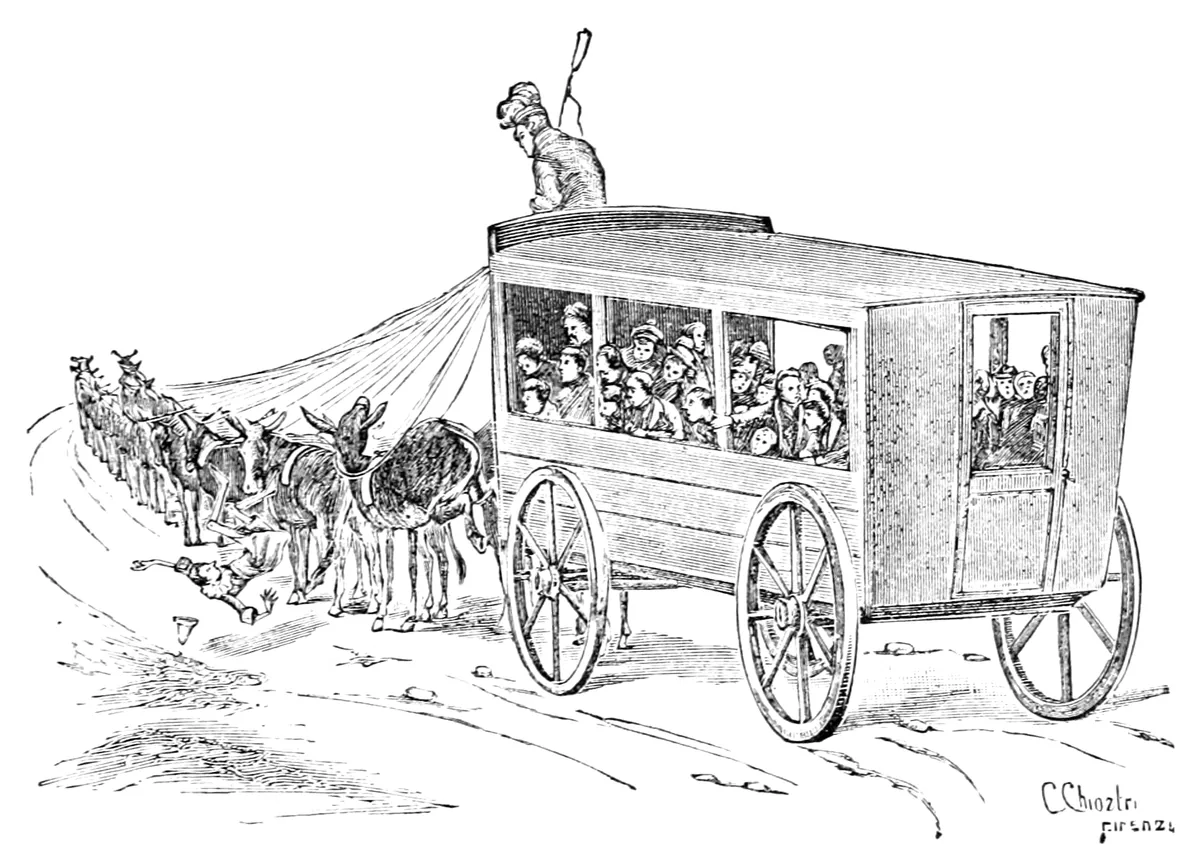
Then roars of laughter all over again; but the Little Man, instead of laughing, felt such love for that restless little donkey that with a kiss he took clean off half of its other ear. Then he said to the puppet:
“Get back on, and don’t be afraid. That donkey had a bee in its bonnet: but I’ve whispered a couple of little words in its ears, and I hope I’ve made it gentle and reasonable.”
Pinocchio mounted, and the wagon began to move; but while the donkeys were galloping and the wagon was rattling over the cobbles of the highway, the puppet thought he heard a low voice, barely understandable, which said to him:
“Poor simpleton! You wanted to have your own way, but you’ll be sorry for it!”
Pinocchio, half frightened, looked this way and that to find out where these words came from; but he saw no one: the donkeys were galloping, the wagon was rolling, the boys inside the wagon were asleep, Lampwick was snoring like a dormouse, and the Little Man, sitting on the box, was humming between his teeth:
All the world sleeps at night, But I never sleep at all….
When they had gone another half a kilometre, Pinocchio heard the faint little voice say to him:
“Mark my words, you little noodle! Boys who give up studying and turn their backs on books, schools and teachers, to give themselves up entirely to toys and amusements, can come to nothing but a miserable end! I know it from experience, and I can tell you so!… A day will come when you too will weep, as I am weeping today… but then it will be too late!…”
At these softly whispered words the puppet, more frightened than ever, jumped down from the back of his mount and went to take his donkey by the muzzle.
And imagine how he felt when he saw that his donkey was crying… and crying just like a boy!
“Hey, Mister Little Man,” Pinocchio then called to the owner of the wagon, “do you know what’s happening? This donkey is crying.”
“Let him cry: he’ll laugh on his wedding day!”
“But have you perhaps taught him to talk as well?”
“No: he learnt to mumble a few words by himself, after spending three years with a troupe of performing dogs.”
“Poor beast!…”
“Come, come…” said the Little Man, “let’s not waste our time watching a donkey cry. Get back on, and let’s be off: the night is chilly and the road is long.”
Pinocchio obeyed without a word. The wagon set off again, and in the morning, at the first light of dawn, they arrived safe and sound in the “Land of Toys.”
This country was not like any other country in the world. Its whole population was made up of boys. The oldest were fourteen; the youngest were barely eight. In the streets, such merriment, such a racket, such shrieking as to drive you out of your mind! Swarms of urchins everywhere: some were playing marbles, some quoits, some ball, some were riding bicycles, some wooden hobby-horses; these were playing blind man’s buff, those others were chasing one another; others, dressed as clowns, were eating burning tow; some were acting, some singing, some turning somersaults, some amusing themselves by walking on their hands with their legs in the air; some were bowling hoops, some strutting about dressed as generals with paper helmets and cardboard swords; some were laughing, some yelling, some calling, some clapping, some whistling, some imitating a hen that has just laid an egg: in short, such a pandemonium, such a twittering, such a devilish din, that you had to stuff cotton in your ears so as not to be deafened. In every square there were little canvas theatres, crowded with boys from morning till night, and on every wall of the houses you could read, written in charcoal, lovely things like these: HURRAH FOR TOYZ! (instead of toys); WE DONT WONT NO MOR SKOOLS (instead of we don’t want any more schools); DOWN WITH ARITH METIC (instead of arithmetic), and other such gems.
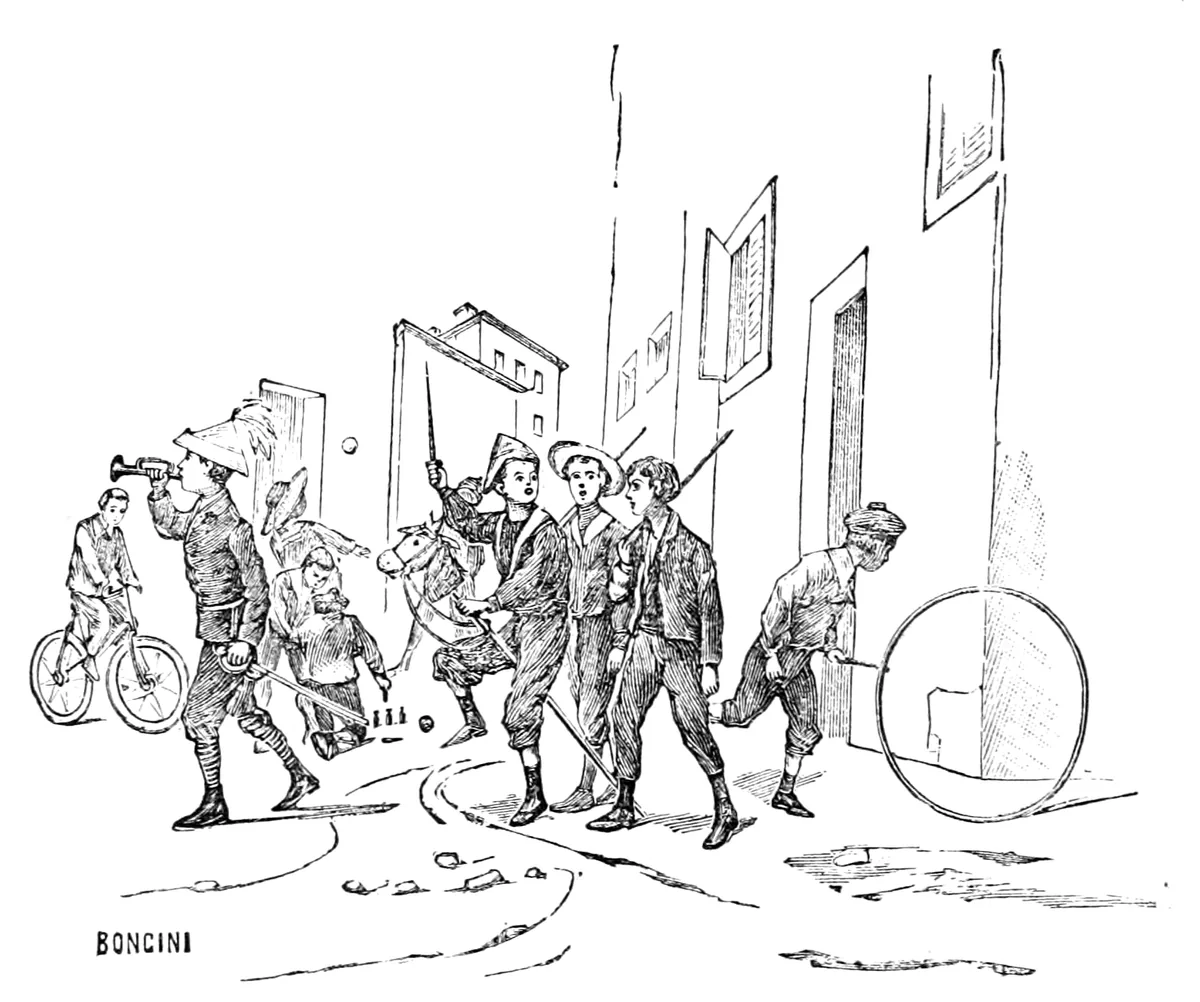
Pinocchio, Lampwick and all the other boys who had made the journey with the Little Man had no sooner set foot in the town than they plunged straight into the thick of the hubbub, and in a few minutes, as you can easily imagine, they were everybody’s friends. Who could be happier, who could be more pleased than they were? Amid the endless fun and all sorts of amusements, the hours, the days, the weeks flew by like so many flashes of lightning.
“Oh, what a wonderful life!” Pinocchio would say every time he happened to bump into Lampwick.
“So, you see I was right?” the latter would reply. “And to think you didn’t want to come! And to think you had taken it into your head to go back home to your Fairy and waste your time studying! If today you’re free of the bother of books and schools, you owe it to me, to my advice, to my care for you, don’t you agree? Only true friends know how to do such great favours.”
“It’s true, Lampwick! If today I’m a truly happy boy, it’s all thanks to you. And do you know what the teacher used to tell me about you? He always used to say: ‘Don’t go about with that rascal Lampwick, because Lampwick is a bad companion, and he can only lead you into mischief!…’”
“Poor teacher!” replied the other, shaking his head. “I know only too well that he couldn’t stand me and was always enjoying himself slandering me; but I am generous, and I forgive him!”
“Noble soul!” said Pinocchio, hugging his friend affectionately and giving him a kiss right between the eyes.
This fine life of playing and amusing themselves all day long, without ever setting eyes on a book or a school, had already been going on for five months, when one morning Pinocchio woke up and had, as they say, a very nasty surprise, which put him in a thoroughly bad temper.