Pinocchio, spurred on by the hope of arriving in time to help his poor father, swam the whole night long.
And what a horrible night it was! It poured, it hailed, it thundered frightfully, and there was such lightning that it seemed like day.
Towards morning he managed to make out, not far off, a long strip of land. It was an island in the middle of the sea.
So he did everything he could to reach that shore: but it was no use. The waves, chasing one another and tumbling over each other, tossed him about among themselves as though he were a twig or a wisp of straw. At last, and by good luck for him, there came a wave so mighty and so violent that it flung him bodily onto the sand of the beach.
The blow was so hard that when he hit the ground all his ribs and all his joints cracked; but he consoled himself at once by saying: “I've had a lucky escape this time too!”
Meanwhile, little by little, the sky cleared; the sun came out in all its splendour, and the sea grew perfectly calm and smooth as oil.
Then the puppet spread his clothes out in the sun to dry, and began looking this way and that, in case he might spot on that vast expanse of water a little boat with a little man in it. But after looking long and hard, he saw nothing before him but sky, sea, and a few ships' sails, and those so very far away that they looked like flies.
“If only I knew what this island is called!” he kept saying. “If only I knew whether this island is inhabited by decent people, I mean people who aren't in the habit of hanging boys from the branches of trees! But who can I possibly ask? Who, if there's nobody here?…”
The thought of being alone, alone, all alone in the middle of that great empty land made him so miserable that he was on the very point of crying; when all of a sudden he saw a big fish swimming past, not far from the shore, going quietly about its own business with its whole head out of the water.
Not knowing what to call it, the puppet shouted to it in a loud voice, to make himself heard:
“Hey, Mr Fish, may I have a word with you?”
“Two, if you like,” answered the fish, who was a Dolphin so polite that you'd find few like him in all the seas of the world.
“Would you be so kind as to tell me whether on this island there are any villages where one can eat without the danger of being eaten?”
“There certainly are,” answered the Dolphin. “In fact, you'll find one not far from here.”
“And which way do I go to get there?”
“You must take that path there, on the left, and keep walking straight ahead, following your nose. You can't go wrong.”
“Tell me something else. You who swim about the sea all day and all night, haven't you by any chance met a tiny little boat with my father in it?”
“And who is your father?”
“He's the best father in the world, just as I'm the worst son there could ever be.”
“With the storm we had last night,” answered the Dolphin, “the little boat must have gone under.”
“And my father?”
“By now he'll have been swallowed by the terrible Shark, which came a few days ago to spread slaughter and desolation in our waters.”
“Is this Shark very big?” asked Pinocchio, who was already beginning to tremble with fear.
“Big, you say!…” replied the Dolphin. “To give you some idea, I'll tell you that he's bigger than a five-storey building, and he has a great ugly mouth so wide and so deep that a whole railway train, engine and all with its fire lit, could pass through it with room to spare.”
“Mamma mia!” cried the puppet in terror; and dressing himself again in a mad hurry, he turned to the Dolphin and said:
“Goodbye, Mr Fish: so sorry to have troubled you, and a thousand thanks for your kindness.”
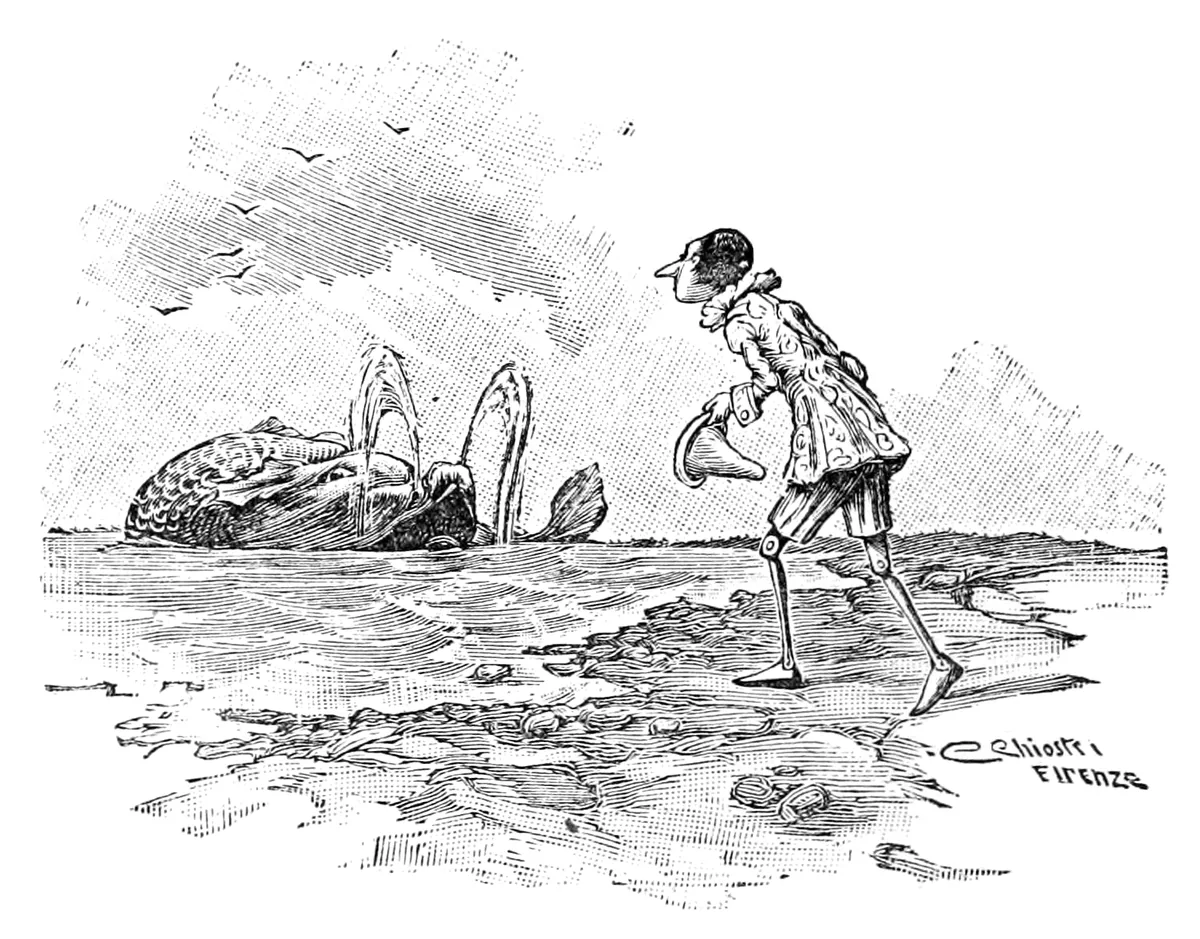
With that he took the path at once and began to walk at a brisk pace: so brisk that he almost seemed to be running. And at the slightest little noise he heard, he turned round at once to look behind him, for fear of seeing himself chased by that terrible Shark as big as a five-storey house with a railway train in his mouth.
After walking for more than half an hour, he came to a little village called “the Village of the Busy Bees.” The streets were swarming with people running this way and that about their business: everybody was working, everybody had something to do. You could not find an idler or a loafer there even if you went looking with a lantern.
“I see,” said that lazybones Pinocchio at once, “this village isn't the place for me! I wasn't born to work!”
Meanwhile hunger was tormenting him, for twenty-four hours had now gone by since he had eaten anything at all; not even a plate of vetch.
What was he to do?
There were only two ways left for him to break his fast: either to ask for a little work, or to beg for a penny or a mouthful of bread.
He was ashamed to beg: because his father had always preached to him that only the old and the sick have the right to beg. The truly poor in this world, the ones who deserve help and pity, are none other than those who, because of age or illness, find themselves condemned to be no longer able to earn their bread by the work of their own hands. Everybody else is bound to work; and if they don't work and go hungry, so much the worse for them.
Just then a man came down the street, all sweaty and out of breath, who was pulling, all by himself and with great effort, two carts loaded with coal.
Pinocchio, judging from his face that he was a kind man, went up to him and, lowering his eyes for shame, said to him in a low voice:
“Would you be so charitable as to give me a penny, because I feel I'm dying of hunger?”
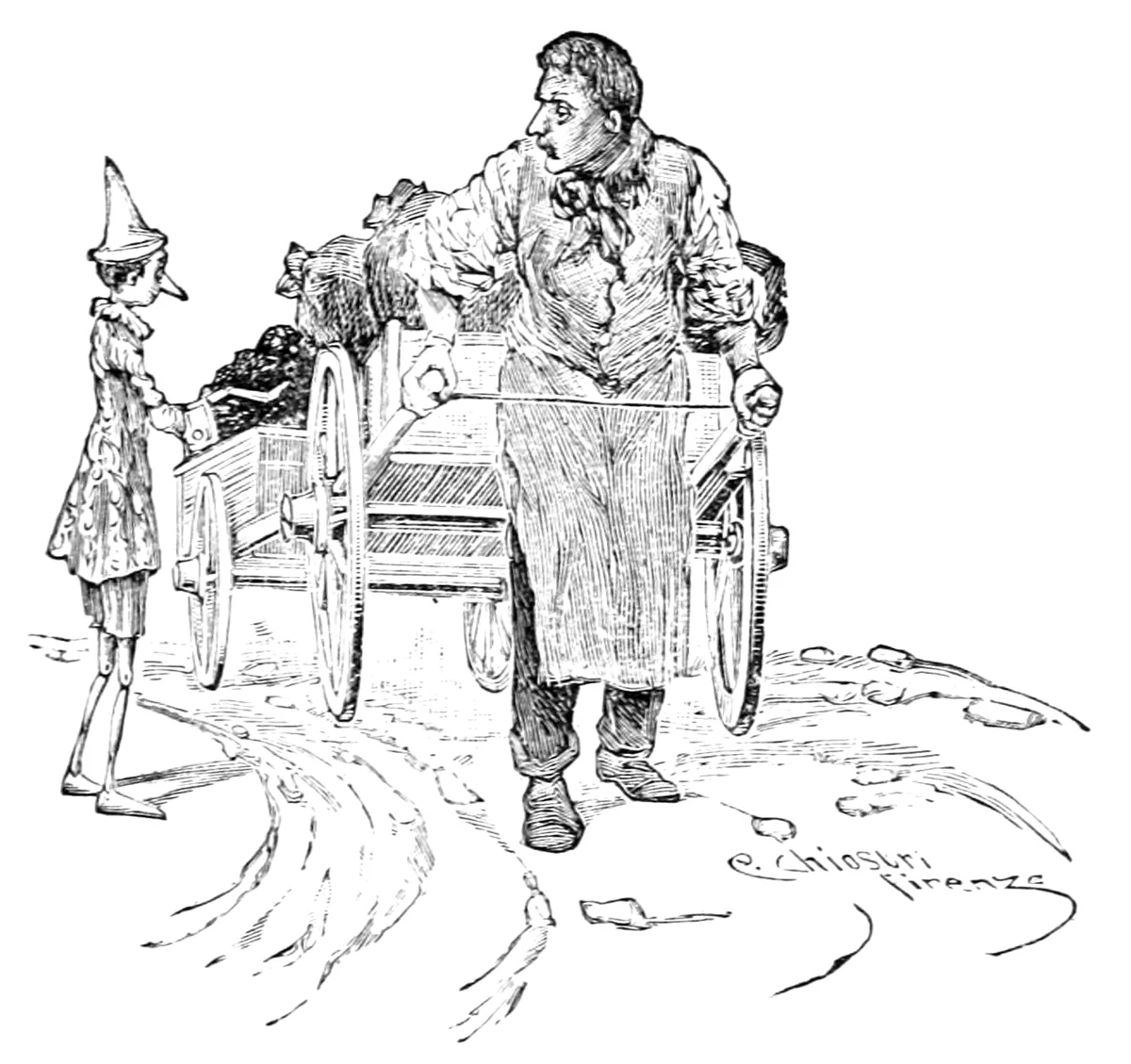
“Not just one penny,” answered the coalman, “I'll give you four, on condition that you help me pull these two carts of coal all the way home.”
“I'm surprised at you!” answered the puppet, almost offended. “For your information, I have never been a donkey; I have never pulled a cart!”
“Good for you!” answered the coalman. “Then, my boy, if you really feel you're dying of hunger, eat two nice slices of your pride, and mind you don't get indigestion.”
A few minutes later a bricklayer came along the road, carrying a basket of mortar on his shoulders.
“Good sir, would you be so charitable as to give a penny to a poor boy who is yawning with hunger?”
“Gladly; come with me and carry mortar,” answered the bricklayer, “and instead of one penny, I'll give you five.”
“But mortar is heavy,” replied Pinocchio, “and I don't want to tire myself out.”
“If you don't want to tire yourself out, then, my boy, enjoy your yawning, and much good may it do you.”
In less than half an hour twenty more people went by, and Pinocchio asked every one of them for a little charity, but they all answered him:
“Aren't you ashamed of yourself? Instead of loafing about the streets, go and look for some work, and learn to earn your bread!”
At last a kind little woman came by, carrying two jugs of water.
“Would you mind, good woman, if I had a sip of water from your jug?” asked Pinocchio, who was burning with thirst.
“Drink away, my boy!” said the little woman, setting the two jugs down on the ground.
When Pinocchio had drunk like a sponge, he muttered under his breath, wiping his mouth:
“I've got rid of my thirst! If only I could get rid of my hunger the same way!…”
The kind little woman, hearing these words, added at once:
“If you help me carry one of these jugs of water home, I'll give you a nice big piece of bread.”
Pinocchio looked at the jug and said neither yes nor no.
“And along with the bread I'll give you a nice plate of cauliflower dressed with oil and vinegar,” added the good woman.
Pinocchio took another look at the jug, and said neither yes nor no.
“And after the cauliflower I'll give you a lovely sugared sweet filled with rosolio liqueur.”
At the temptation of this last titbit Pinocchio could hold out no longer, and making up his mind firmly, he said:
“Oh, all right! I'll carry the jug all the way home for you!”
The jug was very heavy, and the puppet, not having the strength to carry it in his hands, resigned himself to carrying it on his head.
When they got home, the kind little woman sat Pinocchio down at a small table that was laid ready, and set before him the bread, the dressed cauliflower and the sugared sweet.
Pinocchio did not eat, he gobbled. His stomach was like an apartment that had been left empty and unlived in for five months.
When the savage pangs of hunger had calmed down little by little, he raised his head to thank his benefactress: but he had hardly begun to look her in the face when he let out a long, long “ohhh!” of wonder, and sat there spellbound, his eyes wide open, his fork in the air and his mouth full of bread and cauliflower.
“Whatever is all this astonishment about?” said the good woman, laughing.
“It's…” stammered Pinocchio, “it's… it's… that you look like… you remind me of… yes, yes, yes, the same voice… the same eyes… the same hair… yes, yes, yes… you have blue hair too… like her! Oh, my little Fairy!… Oh, my little Fairy!… tell me it's you, really you!… Don't make me cry any more! If you only knew! I've cried so much, I've suffered so much!…”
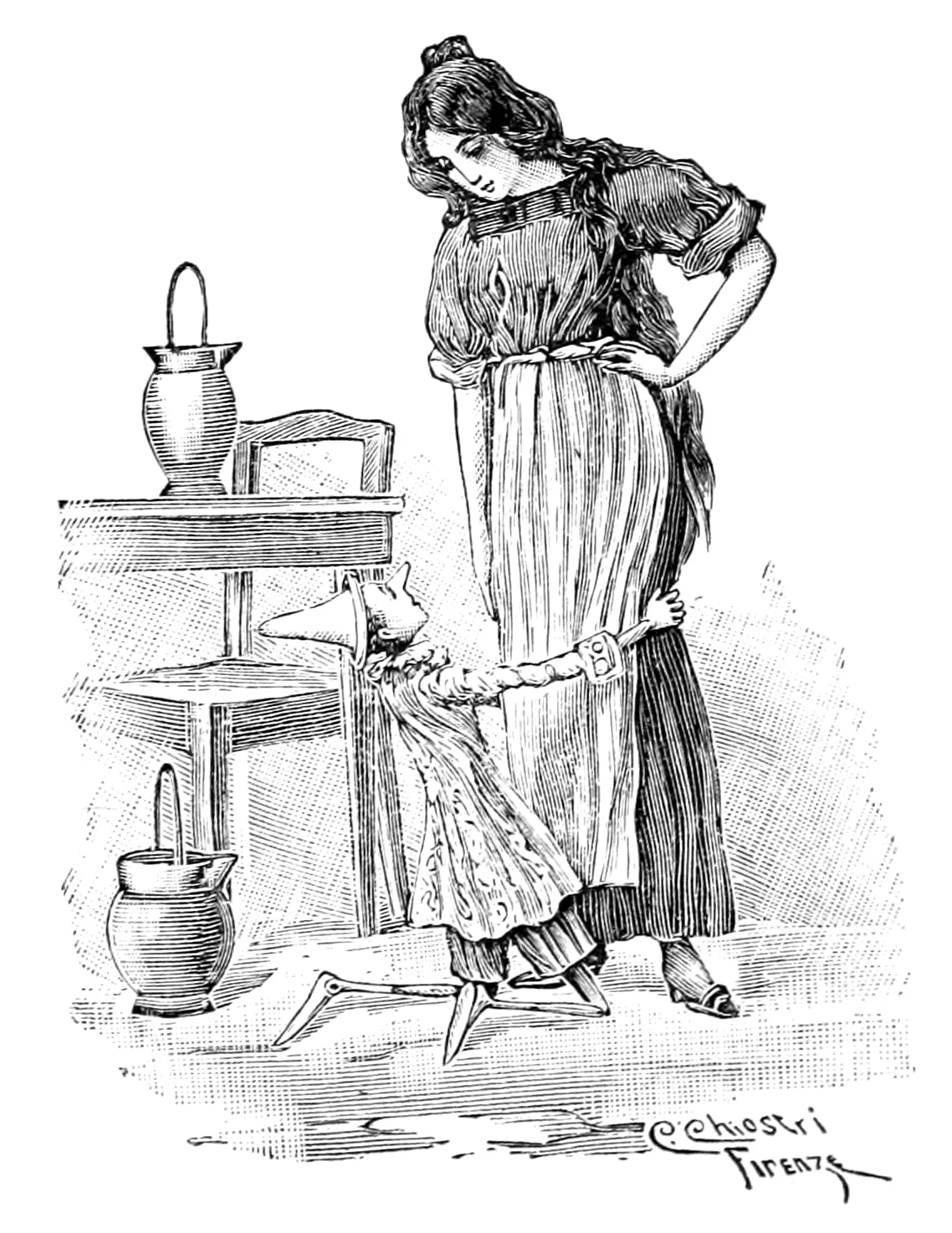
And as he said this, Pinocchio wept and wept, and throwing himself on his knees on the floor he hugged the knees of that mysterious little woman.