As soon as Pinocchio no longer felt the hard, humiliating weight of that collar round his neck, he took off across the fields, and he did not stop for a single minute until he had reached the high road that was to take him back to the Fairy's little house.
When he reached the high road, he turned and looked down at the plain below, and with his naked eye he could see quite clearly the wood where he had unluckily met the Fox and the Cat; he saw, rising among the trees, the top of that Big Oak from which he had been left dangling by the neck; but look this way and look that way as he might, he could not see the little house of the beautiful Little Girl with Blue Hair.
Then he had a sort of gloomy foreboding; and running with all the strength left in his legs, in a few minutes he found himself on the meadow where the little White House had once stood. But the little White House was no longer there. Instead there was a small marble stone, on which these sorrowful words could be read in capital letters:
HERE LIES THE LITTLE GIRL WITH BLUE HAIR WHO DIED OF GRIEF AT BEING ABANDONED BY HER LITTLE BROTHER PINOCCHIO.
How the puppet felt when he had spelt out those words as best he could, I leave you to imagine. He fell flat on his face on the ground and, covering that gravestone with a thousand kisses, burst into a great flood of tears. He wept all night, and the next morning, at daybreak, he was still weeping, although there were no more tears left in his eyes: and his cries and lamentations were so heartrending and shrill that all the hills around echoed with them.
And as he wept he said:
“Oh, my little Fairy, why did you die?… Why didn't I die instead of you, I who am so bad, while you were so good?… And where can my father be? Oh, my little Fairy, tell me where I can find him, for I want to stay with him always and never leave him again! Never! Never!… Oh, my little Fairy, tell me it isn't true that you're dead!… If you really love me… if you love your little brother, come back to life… come back alive as you were before! Doesn't it make you sad to see me all alone, abandoned by everyone?… If the assassins come, they'll hang me from the branch of the tree all over again… and then I shall die for ever. What do you expect me to do here, all alone in this world? Now that I've lost you and my father, who will give me anything to eat? Where shall I go to sleep at night? Who will make me a new little jacket? Oh! It would be better, a hundred times better, if I died too! Yes, I want to die! Boo-hoo! Boo-hoo! Boo-hoo!”
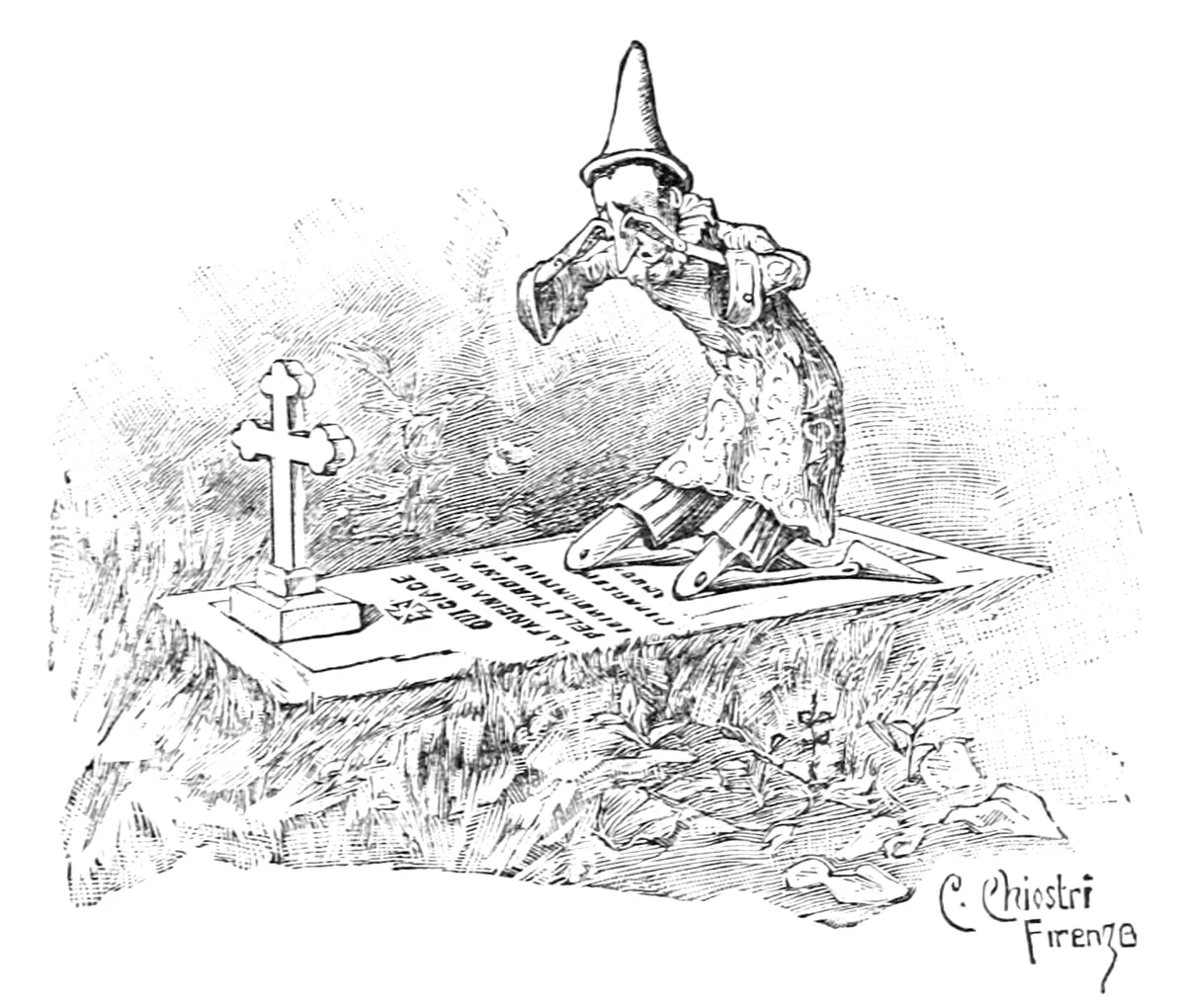
And as he was despairing like this, he made as if to tear out his hair; but his hair being made of wood, he could not even have the satisfaction of thrusting his fingers into it.
Just then a big Pigeon flew by overhead; he stopped, hovering on outspread wings, and called down to him from a great height:
“Tell me, little boy, what are you doing down there?”
“Can't you see? I'm crying!” said Pinocchio, raising his head towards the voice and rubbing his eyes with the sleeve of his jacket.
“Tell me,” the Pigeon went on, “among your friends, do you by any chance know a puppet whose name is Pinocchio?”
“Pinocchio? Did you say Pinocchio?” repeated the puppet, jumping straight to his feet. “I'm Pinocchio!”
At this answer the Pigeon swooped down quickly and came to rest on the ground. He was bigger than a turkey.
“Then you must know Geppetto as well?” he asked the puppet.
“Do I know him! He's my poor father! Has he talked to you about me? Will you take me to him? But is he still alive? Answer me, for pity's sake: is he still alive?”
“I left him three days ago on the seashore.”
“What was he doing?”
“He was building himself a little boat, to cross the Ocean. That poor man has been wandering about the world for more than four months looking for you; and since he has never been able to find you, now he has taken it into his head to look for you in the faraway countries of the New World.”
“How far is it from here to the shore?” asked Pinocchio anxiously and lovingly.
“More than a thousand kilometres.”
“A thousand kilometres? Oh, dear Pigeon, how wonderful it would be if I had your wings!…”
“If you want to come, I'll take you there.”
“How?”
“Riding on my back. Are you very heavy?”
“Heavy? Not a bit of it! I'm as light as a leaf.”
And there and then, without another word, Pinocchio jumped on to the Pigeon's back; and with one leg on this side and the other on that, as riders do, he shouted happily: “Gallop, gallop, my little horse, for I'm in a hurry to get there!…” The Pigeon took off and in a few minutes had flown so high that he almost touched the clouds. When they had reached that extraordinary height, the puppet was curious to turn and look down; and he was seized by such fear and such dizziness that, to avoid the danger of falling off, he wound his arms tight, tight round the neck of his feathered steed.
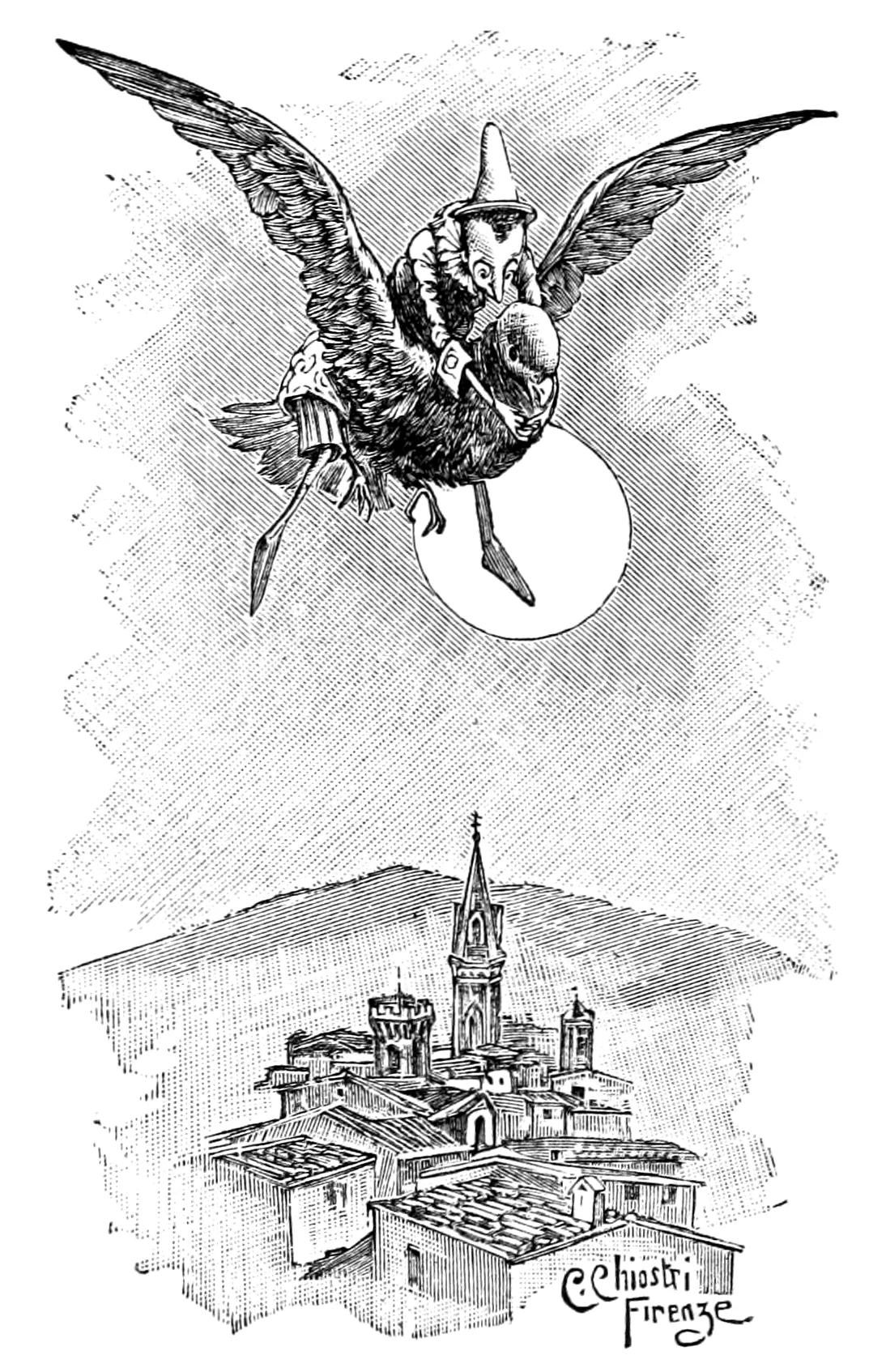
They flew all day. Towards evening the Pigeon said:
“I'm terribly thirsty!”
“And I'm terribly hungry!” added Pinocchio.
“Let's stop at this dovecote for a few minutes; and afterwards we'll set off again, so as to be on the seashore at dawn tomorrow.”
They went into an empty dovecote, where there was nothing but a basin full of water and a little basket heaped with vetch.
Never in all his life had the puppet been able to stand vetch: to hear him talk, it made him feel sick and turned his stomach; but that evening he ate until he nearly burst, and when he had almost finished it he turned to the Pigeon and said:
“I'd never have believed vetch was so good!”
“You must understand, my boy,” replied the Pigeon, “that when hunger is in earnest and there's nothing else to eat, even vetch becomes delicious! Hunger has no whims and no fancy tastes!”
Having quickly had a little snack, they set off again, and away they went! The next morning they reached the seashore.
The Pigeon set Pinocchio down on the ground and, not even wanting the bother of being thanked for doing a good deed, flew off again at once and vanished.
The beach was full of people shouting and waving their arms, looking out to sea.
“What has happened?” Pinocchio asked a little old woman.
“What's happened is that a poor father, who lost his son, wanted to get into a little boat to go and look for him on the other side of the sea; and the sea is very rough today, and the little boat is about to sink…”
“Where is the little boat?”
“There it is, out there, straight along my finger,” said the old woman, pointing to a small boat which, seen from that distance, looked like a nutshell with a tiny little man inside it.
Pinocchio fixed his eyes in that direction and, after looking carefully, let out a piercing scream, shouting:
“It's my father! It's my father!”
Meanwhile the little boat, tossed about by the raging waves, now vanished among the great breakers, now bobbed up again; and Pinocchio, standing on the top of a high rock, kept on calling his father by name and making signals to him with his hands, with his handkerchief and even with the cap on his head.
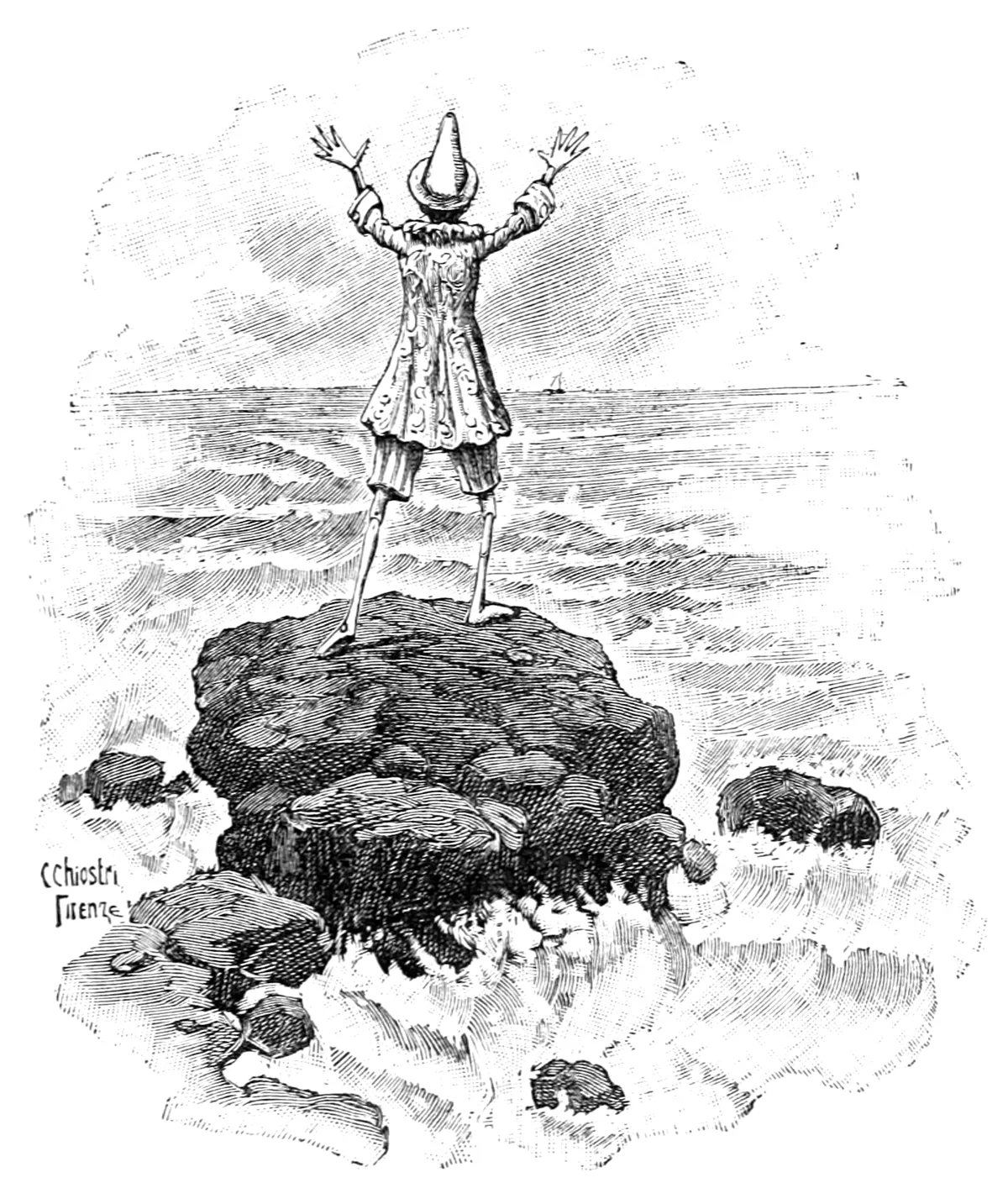
And it seemed that Geppetto, although he was very far from the shore, recognised his son, because he too took off his cap and waved to him and, by dint of gestures, made him understand that he would gladly have turned back, but the sea was so rough that it prevented him from working his oar and getting near the land.
All of a sudden a terrible wave came, and the boat vanished. They waited for the boat to come back up to the surface: but the boat was never seen again.
“Poor man!” said the fishermen, who were gathered on the beach; and muttering a prayer under their breath, they started off back to their homes.
But just then they heard a desperate cry, and turning round, they saw a little boy throw himself into the sea from the top of a rock, shouting:
“I want to save my father!”
Pinocchio, being made all of wood, floated easily and swam like a fish. Now they saw him vanish under the water, carried along by the force of the waves; now he reappeared with a leg or an arm out, a very long way from land. In the end they lost sight of him and saw him no more.
“Poor boy!” said the fishermen, who were gathered on the beach; and muttering a prayer under their breath, they went back to their homes.