As soon as the three doctors had left the room, the Fairy went up to Pinocchio, and when she had touched his forehead, she found that he was burning with a fever beyond words.
Then she dissolved a certain white powder in half a glass of water, and handing it to the puppet, she said to him lovingly:
“Drink it, and in a few days you will be well.”
Pinocchio looked at the glass, made a bit of a face, and then asked in a whining voice:
“Is it sweet or bitter?”
“It is bitter, but it will do you good.”
“If it's bitter, I don't want it.”
“Listen to me: drink it.”
“I don't like bitter things.”
“Drink it: and when you have drunk it, I'll give you a lump of sugar to take the taste away.”
“Where is the lump of sugar?”
“Here it is,” said the Fairy, taking it out of a golden sugar bowl.
“First I want the lump of sugar, and then I'll drink that nasty bitter water....”
“Do you promise?”
“Yes....”
The Fairy gave him the lump, and Pinocchio, after crunching it up and swallowing it in a flash, said, licking his lips:
“How lovely it would be if sugar were medicine too!... I'd take my medicine every day.”
“Now keep your promise and drink these few drops of water, which will make you well again.”
Pinocchio unwillingly took the glass in his hand and poked the tip of his nose into it: then he raised it to his mouth: then he poked the tip of his nose into it again: at last he said:
“It's too bitter! Too bitter! I can't drink it.”
“How can you say so, when you haven't even tasted it?”
“I can imagine! I could tell by the smell. First I want another lump of sugar.... and then I'll drink it!”
Then the Fairy, with all the patience of a good mother, put a little more sugar in his mouth; and after that she held out the glass to him once more.
“I can't drink it like this!” said the puppet, pulling a thousand faces.
“Why not?”
“Because that pillow down there on my feet is bothering me.”
The Fairy took the pillow away.
“It's no use! I can't drink it like this either.”
“What else is bothering you?”
“The bedroom door is bothering me, because it's half open.”
The Fairy went and shut the bedroom door.
“The long and short of it is,” cried Pinocchio, bursting into tears, “I don't want to drink this nasty bitter water, no, no, no!...”
“My boy, you will be sorry....”
“I don't care....”
“Your illness is serious.”
“I don't care.....”
“In a few hours the fever will carry you off to the other world....”
“I don't care....”
“Aren't you afraid of death?”
“Not a bit afraid! I'd rather die than drink that horrid medicine.”
At that moment the door of the room flew open, and in came four rabbits as black as ink, carrying a little coffin on their shoulders.
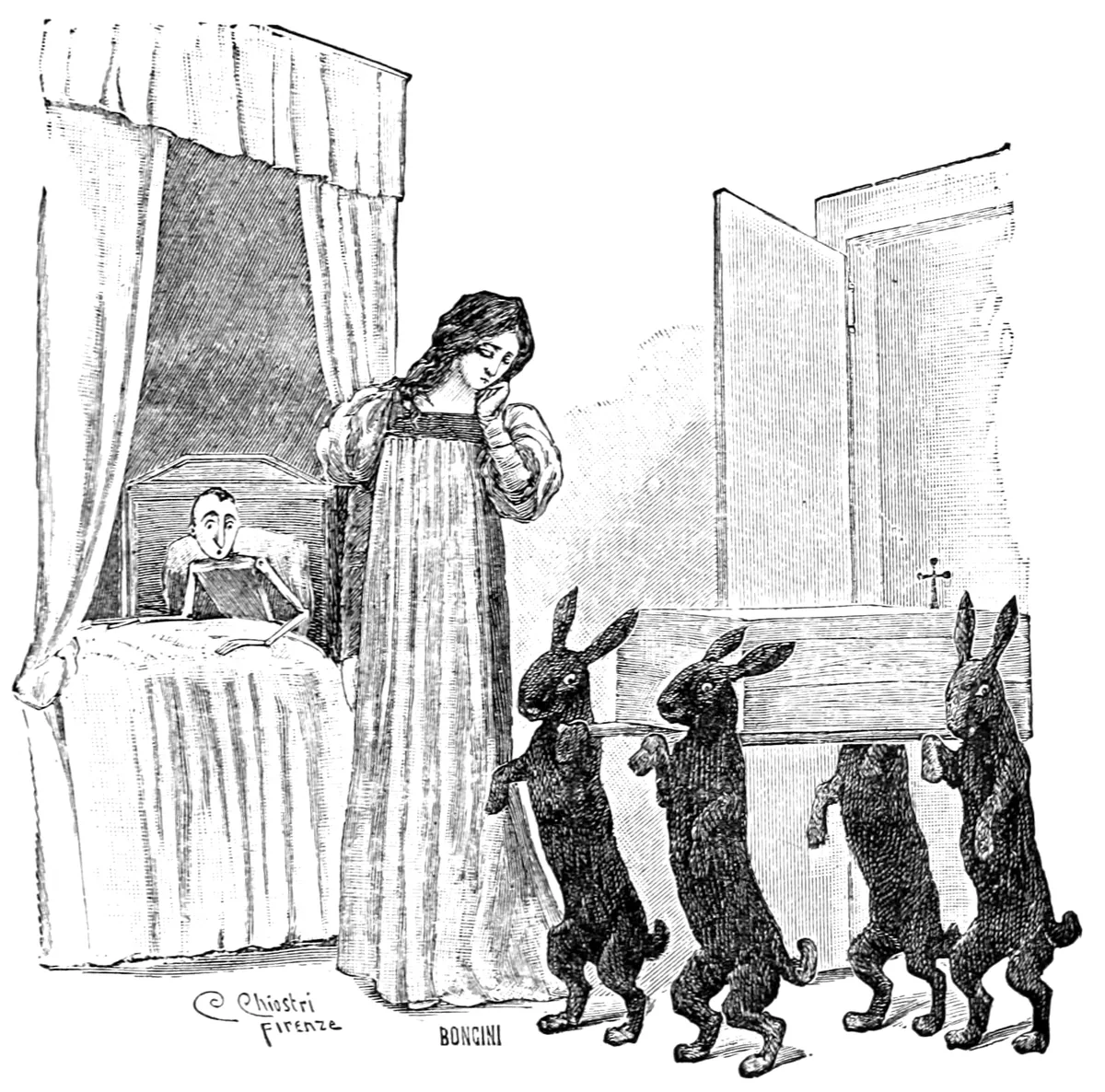
“What do you want with me?” cried Pinocchio, sitting bolt upright in bed in a great fright.
“We have come to fetch you,” answered the biggest rabbit.
“To fetch me? But I'm not dead yet!...”
“Not yet: but you have only a few moments of life left, since you refused to drink the medicine that would have cured your fever!”
“Oh, Fairy, my Fairy!” the puppet began to shriek. “Give me that glass at once.... Hurry, for pity's sake, because I don't want to die, no.... I don't want to die.”
And taking the glass in both hands, he emptied it in one gulp.
“Oh well!” said the rabbits. “This time we've made the trip for nothing.” And hoisting the little coffin onto their shoulders again, they went out of the room, grumbling and muttering under their breath.
The fact is that a few minutes later Pinocchio jumped out of bed, completely cured; for you must know that wooden puppets have the privilege of seldom falling ill and of getting better very quickly.
And the Fairy, seeing him running and romping about the room, as lively and merry as a young cockerel, said to him:
“So my medicine really did you good?”
“Good? I should say so! It's brought me back to life!”
“Then why on earth did you need so much coaxing to drink it?”
“It's because we boys are all like that! We're more afraid of medicine than of being ill.”
“For shame! Boys ought to know that a good remedy taken in time can save them from a serious illness, and perhaps even from death....”
“Oh! But another time I won't need so much coaxing! I'll remember those black rabbits with the coffin on their shoulders.... and then I'll take the glass in my hand straight away, and down it goes....”
“Now come over here to me, and tell me how it happened that you fell into the hands of the assassins.”
“It happened like this: Fire-Eater the puppet-master gave me five gold coins and said to me: ‘Here, take them to your father!’ and instead, on the road, I met a Fox and a Cat, two very respectable people, who said to me: ‘Would you like those coins to turn into a thousand, two thousand? Come with us, and we'll take you to the Field of Miracles.’ And I said, ‘Let's go’; and they said: ‘Let's stop here at the Red Crawfish Inn, and after midnight we'll set off again.’ And when I woke up, they weren't there any more, because they had left. Then I started walking in the night, and it was so dark you wouldn't believe it, so that on the road I met two assassins inside two charcoal sacks, who said to me: ‘Out with the money’; and I said: ‘I haven't got any’; because I'd hidden the gold coins in my mouth, and one of the assassins tried to put his hand in my mouth, and I bit his hand clean off and spat it out, but instead of a hand I spat out a cat's paw. And the assassins ran after me, and I ran and ran, until they caught me, and they tied me by the neck to a tree in this wood, saying: ‘Tomorrow we'll come back here, and then you'll be dead with your mouth open, and so we'll take away the gold coins you've hidden under your tongue.’”
“And now where have you put the four coins?” the Fairy asked him.
“I've lost them!” answered Pinocchio; but he was telling a lie, because in fact he had them in his pocket.
As soon as he had told the lie, his nose, which was long already, at once grew two fingers longer.
“And where did you lose them?”
“In the wood near here.”
At this second lie, his nose went on growing.
“If you lost them in the wood near here,” said the Fairy, “we'll look for them and find them again: because everything that is lost in the wood near here is always found again.”
“Ah! Now that I remember properly,” replied the puppet, getting muddled, “I didn't lose the four coins, but I swallowed them without noticing while I was drinking your medicine.”
At this third lie his nose grew so extraordinarily long that poor Pinocchio could no longer turn round in any direction. If he turned this way, he banged his nose against the bed or the window-panes; if he turned that way, he banged it against the walls or the bedroom door; and if he raised his head a little higher, he ran the risk of poking it into the Fairy's eye.
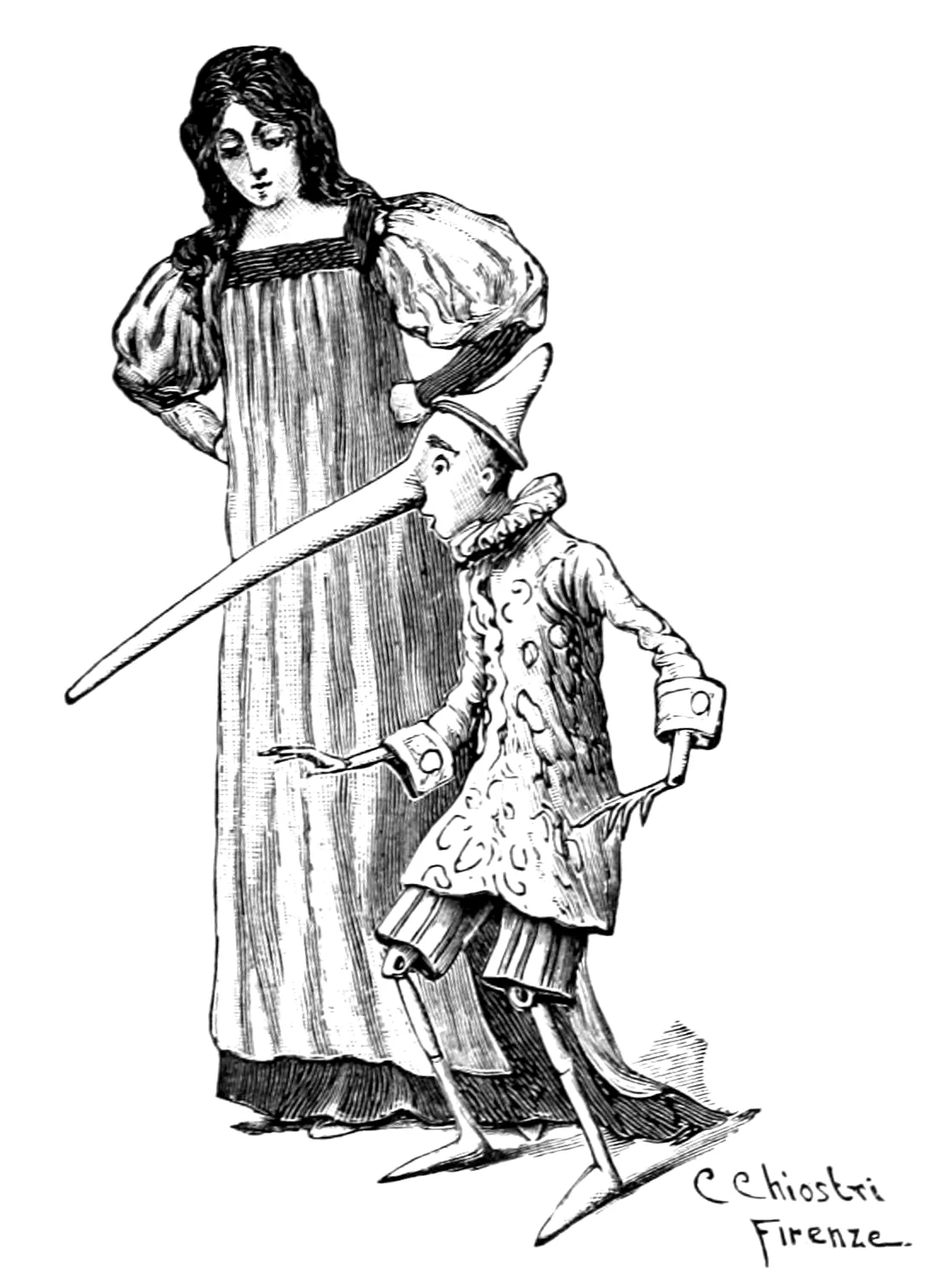
And the Fairy looked at him and laughed.
“Why are you laughing?” the puppet asked her, quite confused and worried about that nose of his, which was growing before his very eyes.
“I am laughing at the lie you told.”
“How do you know I told a lie?”
“Lies, my boy, are found out at once, because there are two kinds of them: there are lies with short legs, and lies with long noses. Yours, as it happens, is one of the ones with a long nose.”
Pinocchio, not knowing where to hide for shame, tried to run out of the room, but he could not. His nose had grown so much that it would no longer go through the door.