At the very moment when poor Pinocchio, hanged by the assassins from a branch of the Big Oak, seemed by now more dead than alive, the beautiful Little Girl with Blue Hair came to the window once again; and moved to pity at the sight of that unhappy creature who, hanging by the neck, was dancing a jig in the gusts of the north wind, she clapped her hands together three times, making three little claps.
At this signal there was a great noise of wings flying in headlong haste, and a big Falcon came and perched on the windowsill.
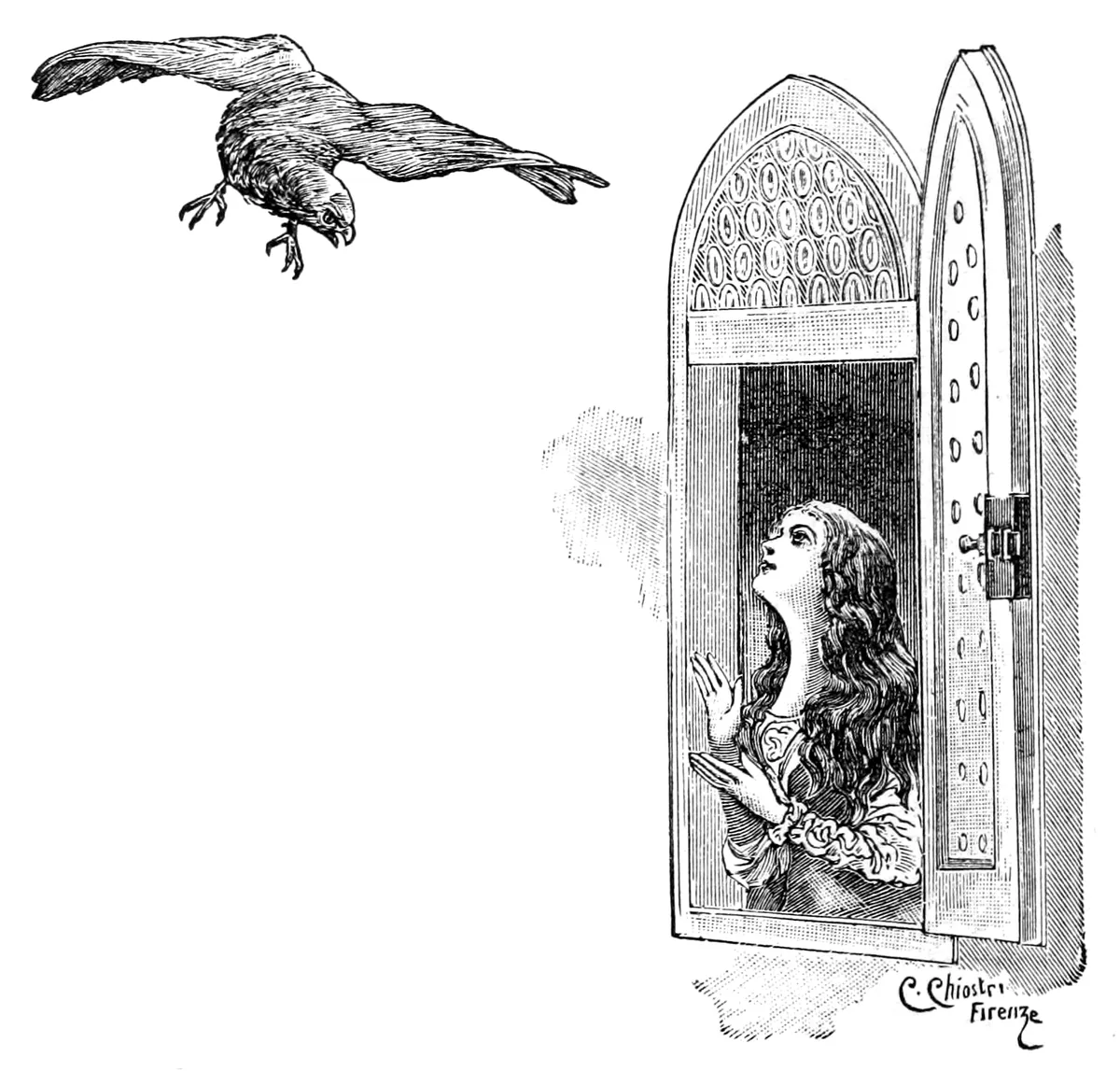
“What are your orders, my gracious Fairy?” said the Falcon, lowering his beak in a bow; for you must know that the Little Girl with Blue Hair was, when all is said and done, nothing other than a very good Fairy, who had lived near that wood for more than a thousand years.
“Do you see that puppet dangling from a branch of the Big Oak?”
“I see him.”
“Very well: fly down there at once; with your strong beak break the knot that is holding him up in the air, and lay him down gently on the grass at the foot of the Oak.”
The Falcon flew off, and two minutes later he came back, saying:
“What you ordered me to do is done.”
“And how did you find him? Alive or dead?”
“To look at him he seemed dead, but he can't be properly dead yet, because as soon as I loosened the running noose that was squeezing his throat, he let out a sigh and stammered under his breath: ‘Now I feel better!...’”
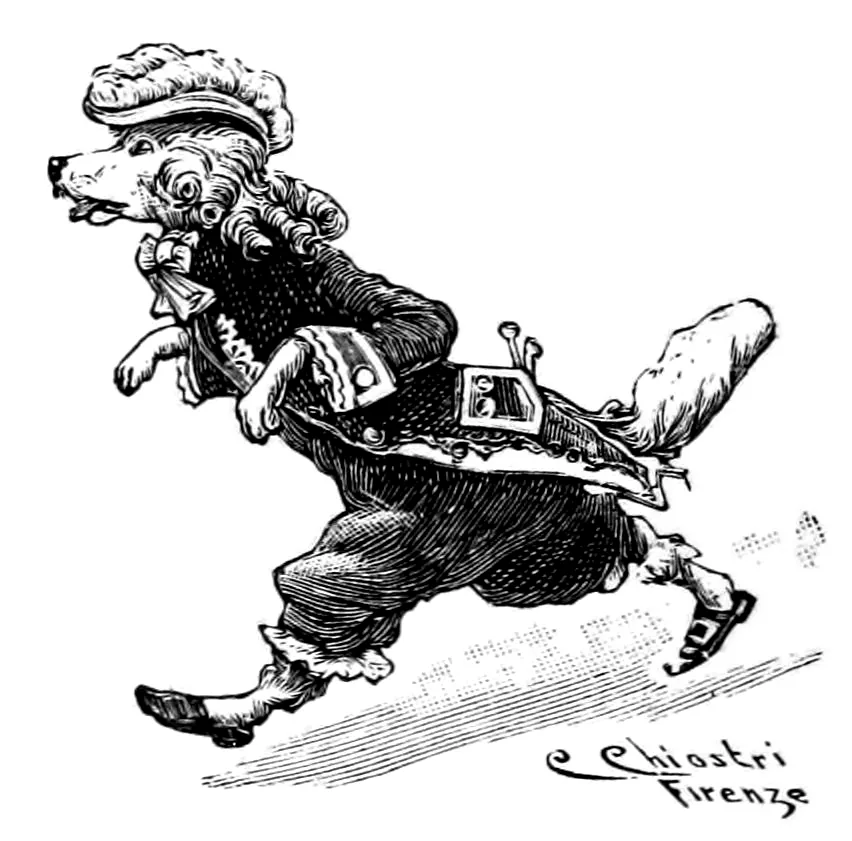
Then the Fairy clapped her hands together, making two little claps, and there appeared a magnificent Poodle, walking upright on his hind legs, exactly as if he were a man.
The Poodle was dressed as a coachman in full-dress livery. On his head he wore a little three-cornered hat trimmed with gold braid, and a fair wig with curls that came tumbling down his neck; he had a chocolate-coloured coat with diamond buttons and two big pockets to keep the bones his mistress gave him at dinner, a pair of short crimson velvet breeches, silk stockings, low-cut pumps, and behind him a sort of umbrella cover, all of blue satin, to put his tail in when it started to rain.
“Come along, there's a good fellow, Medoro!” said the Fairy to the Poodle. “Have the finest carriage in my stables harnessed at once, and take the road to the wood. When you get to the Big Oak, you will find a poor half-dead puppet lying on the grass. Pick him up carefully, lay him gently on the cushions of the carriage, and bring him here to me. Do you understand?”
The Poodle, to show that he had understood, wagged the blue satin cover he had behind him three or four times, and was off like a racehorse.
Shortly afterwards a lovely little sky-blue carriage was seen coming out of the stables, all padded with canary feathers and lined inside with whipped cream and custard and sponge fingers. The little carriage was drawn by a hundred pairs of little white mice, and the Poodle, sitting on the box, cracked his whip right and left like a cab driver afraid he is running late.
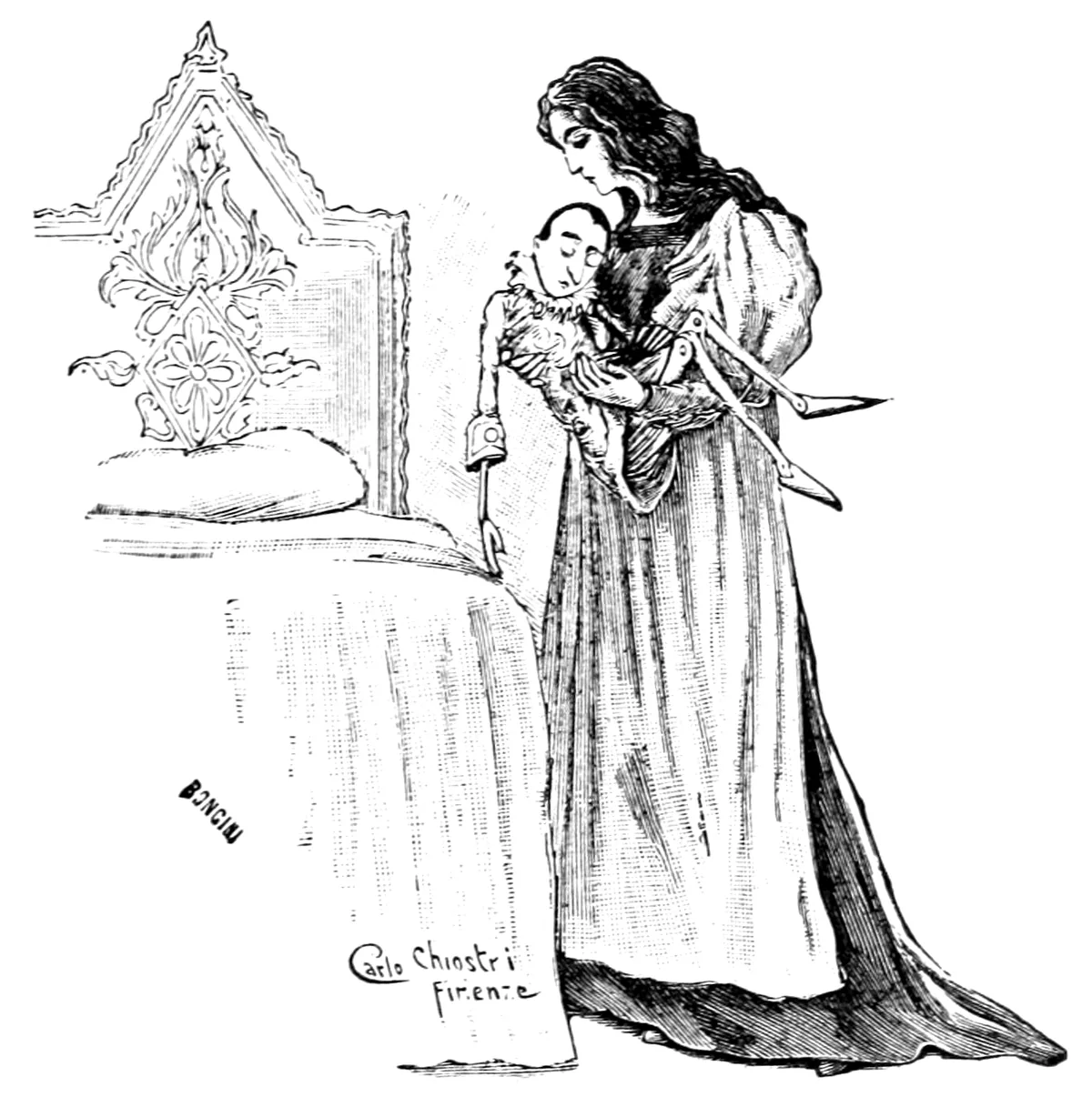
Not a quarter of an hour had passed before the little carriage came back, and the Fairy, who was waiting on the doorstep, took the poor puppet in her arms, carried him into a little room with walls of mother-of-pearl, and sent at once for the most famous doctors in the neighbourhood.
And the doctors arrived at once, one after another: that is to say, there arrived a Crow, an Owl and a Talking Cricket.
“I should like to know from you gentlemen,” said the Fairy, turning to the three doctors gathered round Pinocchio's bed, “I should like to know from you gentlemen whether this unfortunate puppet is alive or dead!...”
At this invitation the Crow, stepping forward first, felt Pinocchio's pulse; then he felt his nose, then his little toe: and when he had felt him thoroughly all over, he solemnly pronounced these words:
“In my opinion the puppet is quite dead: but if by some misfortune he should not be dead, then that would be a sure sign that he is still alive!”
“I am sorry,” said the Owl, “to have to contradict the Crow, my illustrious friend and colleague; in my view, on the contrary, the puppet is still alive; but if by some misfortune he should not be alive, then that would be a sign that he is really dead.”
“And have you nothing to say?” the Fairy asked the Talking Cricket.
“I say that when a prudent doctor does not know what he is talking about, the best thing he can do is keep quiet. Besides, that puppet there is no new face to me: I have known him for quite a while!”
Pinocchio, who until then had been as still as a real piece of wood, gave a sort of convulsive shiver that made the whole bed shake.
“That puppet there,” the Talking Cricket went on, “is a thorough rascal....”
Pinocchio opened his eyes and shut them again at once.
“He is a little ruffian, a lazybones, a vagabond....”
Pinocchio hid his face under the sheets.
“That puppet there is a disobedient son, who will make his poor father die of a broken heart!...”
At this point a muffled sound of weeping and sobbing was heard in the room. Just imagine how they all looked when, lifting the sheets a little, they discovered that the one weeping and sobbing was Pinocchio.
“When the dead man weeps, it is a sign that he is on the road to recovery,” said the Crow solemnly.
“I regret having to contradict my illustrious friend and colleague,” added the Owl, “but in my view, when the dead man weeps, it is a sign that he is sorry to die.”