As soon as his hunger was gone, the puppet at once began to grumble and cry, because he wanted a pair of new feet.
But Geppetto, to punish him for his naughtiness, let him cry and despair for half a day; then he said to him:
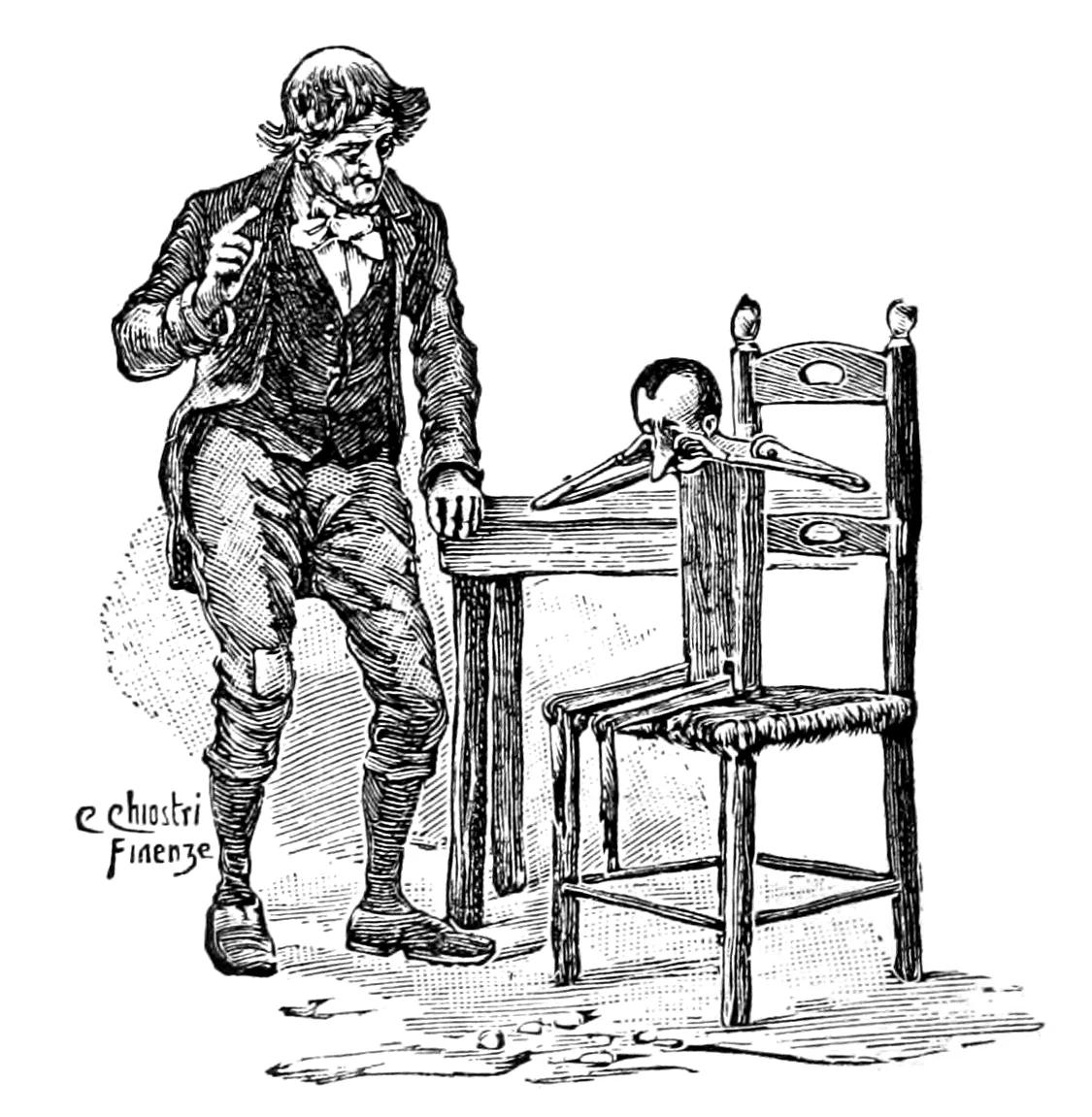
“And why should I make you new feet? So as to see you run away from home again?”
“I promise you,” said the puppet, sobbing, “that from today on I'll be good....”
“All boys,” replied Geppetto, “say that when they want to get something.”
“I promise you I'll go to school, I'll study and I'll do myself credit....”
“All boys, when they want to get something, tell the very same story.”
“But I'm not like other boys! I'm better than all of them, and I always tell the truth. I promise you, Father, that I'll learn a trade, and that I'll be the comfort and the staff of your old age.”
Geppetto, who, although he put on the face of a tyrant, had eyes full of tears and a heart swollen with grief at seeing his poor Pinocchio in that pitiful state, said not another word: but he took up the tools of his trade and two little pieces of seasoned wood, and set to work with the greatest care.
And in less than an hour the feet were all done: two nimble little feet, slender and sinewy, as if they had been modelled by an artist of genius.
Then Geppetto said to the puppet:
“Shut your eyes and go to sleep!”
And Pinocchio shut his eyes and pretended to be asleep. And while he was pretending to sleep, Geppetto, with a little glue melted in an eggshell, stuck the two feet on in their proper place, and he stuck them on so well that you couldn't even see the mark where they were joined.
As soon as the puppet noticed that he had feet, he jumped down from the table where he was lying and began to do a thousand capers and a thousand somersaults, as if he had gone mad with sheer happiness.
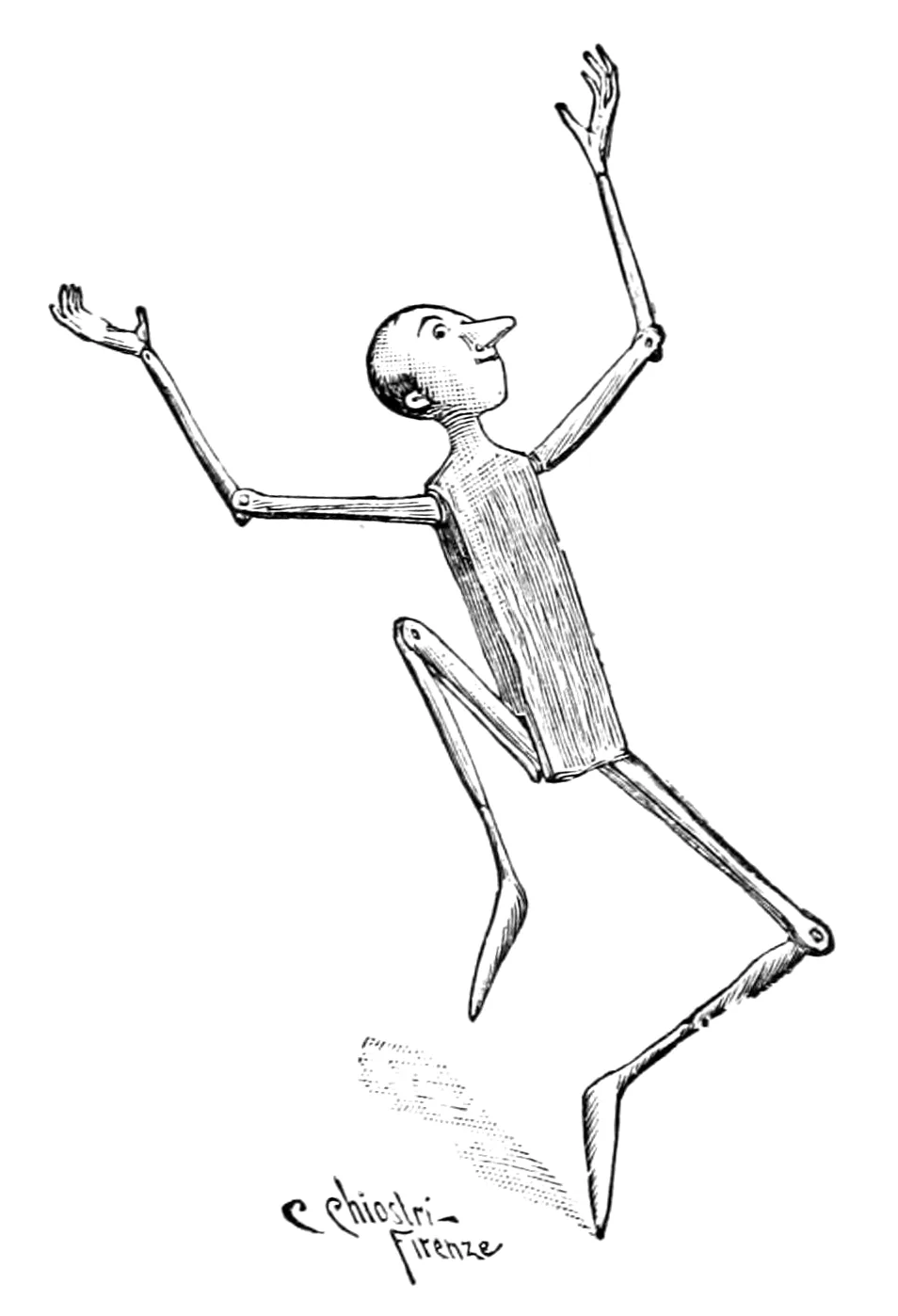
“To repay you for all you have done for me,” said Pinocchio to his father, “I want to go to school straight away.”
“Good boy.”
“But to go to school I need some clothes.”
Geppetto, who was poor and hadn't even a centesimo in his pocket, then made him a little suit of flowered paper, a pair of shoes of tree bark and a little cap of bread dough.
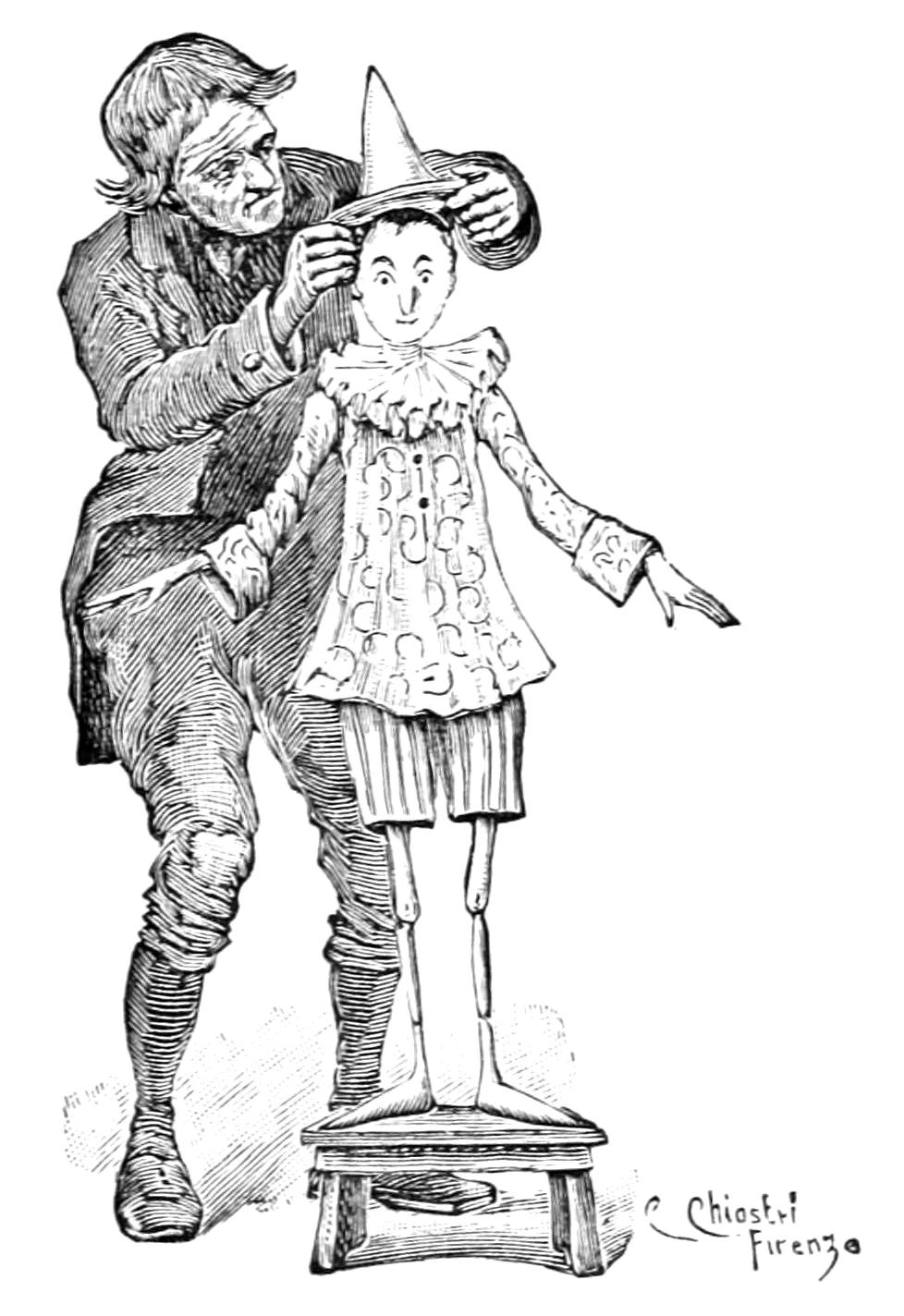
Pinocchio ran at once to look at himself in a basin full of water, and was so pleased with himself that he said, strutting like a peacock:
“I look just like a gentleman!”
“So you do,” replied Geppetto, “because, mind you remember this, it isn't fine clothes that make the gentleman, but rather clean clothes.”
“By the way,” added the puppet, “to go to school I'm still missing something: in fact I'm missing the most important thing of all.”
“What's that?”
“I haven't got an ABC book.”
“You're right: but how are we to get one?”
“It's very easy: you go to a bookseller's and you buy one.”
“And the money?”
“I haven't got any.”
“Nor have I,” added the good old man, growing sad.
And Pinocchio, although he was a very cheerful boy, grew sad too: because poverty, when it is real poverty, is understood by everybody: even by children.
“Never mind!” cried Geppetto all of a sudden, jumping to his feet; and, slipping on his old fustian coat, all patches and darns, he ran out of the house.
He was back soon after: and when he came back he had the ABC book for his son in his hand, but he no longer had his coat. The poor man was in his shirtsleeves, and outside it was snowing.
“And your coat, Father?”
“I sold it.”
“Why did you sell it?”
“Because it made me too hot.”
Pinocchio understood this answer in a flash, and, unable to hold back the rush of his good heart, he threw his arms round Geppetto's neck and began kissing him all over his face.