Poor Pinocchio, whose eyes were still half asleep, had not yet noticed that his feet were all burnt: so as soon as he heard his father's voice, he shot down from the stool to run and draw the bolt; but instead, after two or three totters, he fell flat on his face, full length on the floor.
And as he hit the ground he made the same noise that a sack of wooden ladles would have made falling from a fifth floor.
“Open up!” Geppetto was shouting meanwhile from the street.
“Father dear, I can't....” answered the puppet, crying and rolling about on the floor.
“Why can't you?”
“Because my feet have been eaten.”
“And who ate them?”
“The cat,” said Pinocchio, seeing the cat amusing itself by making some wood shavings dance with its little front paws.
“Open up, I tell you!” repeated Geppetto. “Or else, when I get in, I'll give you cat, all right!”
“I can't stand up, believe me. Oh, poor me! Poor me, I shall have to walk on my knees for the rest of my life.”
Geppetto, thinking all this whimpering was another of the puppet's pranks, decided to put an end to it; and climbing up the wall, he got into the house through the window.
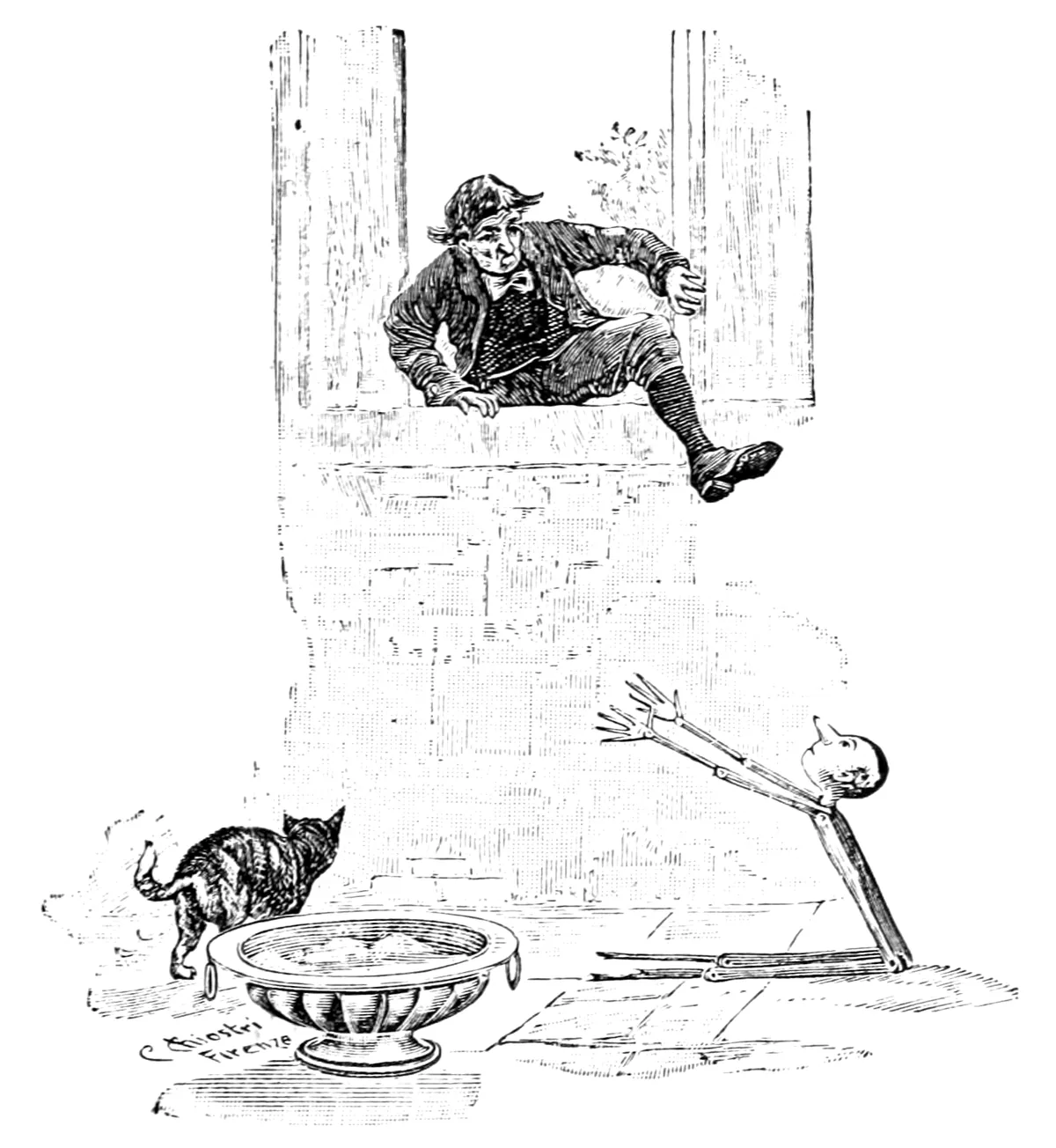
At first he meant to say this and do that; but then, when he saw his Pinocchio lying on the floor and really left without any feet, he felt his heart melt; and at once taking him up in his arms, he began to kiss him and give him a thousand caresses and a thousand fond words, and, with big shining tears rolling down his cheeks, he said to him, sobbing:
“My little Pinocchio! How did you come to burn your feet?”
“I don't know, Father, but believe me, it was a night from hell, and I'll remember it as long as I live. It thundered and it lightninged and I was terribly hungry, and then the Talking Cricket said to me: ‘Serves you right: you've been naughty and you deserve it,’ and I said to him: ‘Watch out, Cricket!...’ and he said to me: ‘You are a puppet and you've got a wooden head,’ and I threw a hammer handle at him, and he died, but it was his own fault, because I didn't want to kill him, and the proof of it is that I put a little pan on the hot coals of the brazier, but the chick jumped out and said: ‘Fare-ye-well... and my regards to all at home.’ And my hunger kept on growing, which is why that little old man in the nightcap leaned out of the window and said to me: ‘Step underneath and hold out your hat,’ and me with that basinful of water on my head, because asking for a bit of bread is nothing to be ashamed of, is it? I came straight back home, and because I was still terribly hungry, I put my feet on the brazier to dry myself, and you came back, and I found them burnt off, and all the while I'm still hungry and I haven't got my feet any more! Boo-hoo!... boo-hoo!... boo-hoo!... boo-hoo!...”
And poor Pinocchio began to cry and bawl so loudly that he could be heard five kilometres away.
Geppetto, who out of all that tangled speech had understood only one thing, namely that the puppet felt he was dying of hunger, took three pears out of his pocket and, holding them out to him, said:
“These three pears were my breakfast: but I give them to you gladly. Eat them, and much good may they do you.”
“If you want me to eat them, please be so kind as to peel them.”
“Peel them?” replied Geppetto in astonishment. “I'd never have believed, my boy, that you were so dainty and so fussy about your food. That's bad! In this world, right from when we are little, we must get used to liking things and to eating anything, because you never know what may happen to us. Anything can happen!...”
“You may well be right,” Pinocchio added, “but I will never eat a fruit that hasn't been peeled. I can't stand peel.”
And that good man Geppetto took out a little knife and, arming himself with the patience of a saint, peeled the three pears, and put all the peel on a corner of the table.
When Pinocchio had eaten the first pear in two bites, he made as if to throw away the core; but Geppetto held back his arm, saying to him:
“Don't throw it away: everything in this world may come in handy.”
“But I'm certainly not going to eat the core!...” shouted the puppet, turning on him like a viper.
“Who knows! Anything can happen!...” repeated Geppetto, without getting heated.
The fact is that the three cores, instead of being thrown out of the window, were put down on the corner of the table to keep the peel company.
Having eaten, or rather devoured, the three pears, Pinocchio gave a very long yawn and said, whimpering:
“I'm hungry again!”
“But, my boy, I have nothing more to give you.”
“Really nothing, nothing at all?”
“All I have is this peel and these pear cores.”
“Oh well!” said Pinocchio. “If there's nothing else, I'll eat a bit of peel.”
And he began to chew. At first he pulled a bit of a face: but then, one after the other, he polished off all the peel in a flash; and after the peel the cores as well, and when he had finished eating everything, he patted his tummy with both hands, very pleased, and said gleefully:
“Now I really do feel fine!”
“So you see,” observed Geppetto, “that I was right when I told you that we mustn't get into the habit of being too finicky or too delicate about our food. My dear boy, you never know what may happen to us in this world. Anything can happen!...”