While Pinocchio was swimming fast to reach the shore, he noticed that his father, who was riding piggyback on his shoulders with his legs half in the water, was trembling all over, as if the poor man had a bout of the tertian fever.
Was he trembling from cold or from fear? Who knows?... Perhaps a little of one and a little of the other. But Pinocchio, thinking the trembling came from fear, said to comfort him:
“Courage, Father! In a few minutes we'll reach land and be safe.”
“But where is this blessed shore?” asked the little old man, growing more and more uneasy and screwing up his eyes the way tailors do when they thread a needle. “Here I am, looking in every direction, and I see nothing but sky and sea.”
“But I can see the shore as well,” said the puppet. “For your information, I'm like the cats: I see better by night than by day.”
Poor Pinocchio was pretending to be in good spirits; but in fact... in fact he was beginning to lose heart: his strength was failing, his breathing was growing heavy and laboured... in short, he could go no farther, and the shore was still far away.
He swam for as long as he had breath; then he turned his head towards Geppetto and said in broken words:
“Father, help me... for I'm dying...”
And father and son were by now on the point of drowning when they heard a voice like an out-of-tune guitar, which said:
“Who is it that's dying?”
“It's me and my poor father!”
“I know that voice! You're Pinocchio!...”
“Exactly; and who are you?”
“I'm the Tunny, your fellow prisoner in the belly of the Shark.”
“And how did you manage to escape?”
“I followed your example. You were the one who showed me the way, and after you got away, I escaped too.”
“Tunny, my friend, you've come just in time! I beg you, by the love you bear your little tunny children: help us, or we are lost.”
“Gladly, and with all my heart. Hold on to my tail, both of you, and let me guide you. In four minutes I'll bring you to the shore.”
Geppetto and Pinocchio, as you can imagine, accepted the offer at once; but instead of holding on to his tail, they thought it more comfortable to sit right up on the Tunny's back.
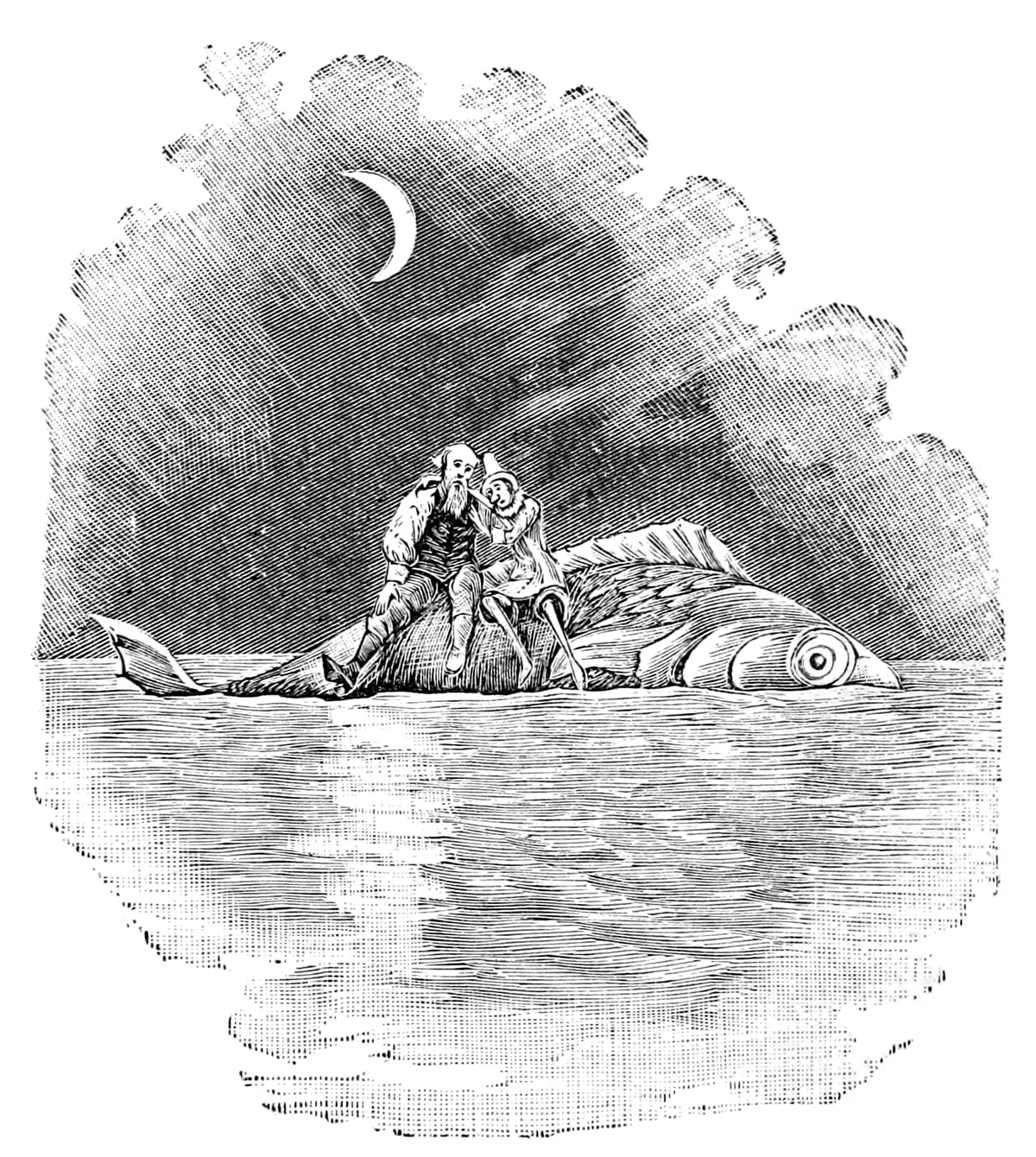
“Are we too heavy?” Pinocchio asked him.
“Heavy? Not in the least: I feel as if I had two empty seashells on my back,” answered the Tunny, who was so big and sturdy that he looked like a two-year-old calf.
When they reached the shore, Pinocchio jumped onto land first, so as to help his father do the same; then he turned to the Tunny and said in a voice full of feeling:
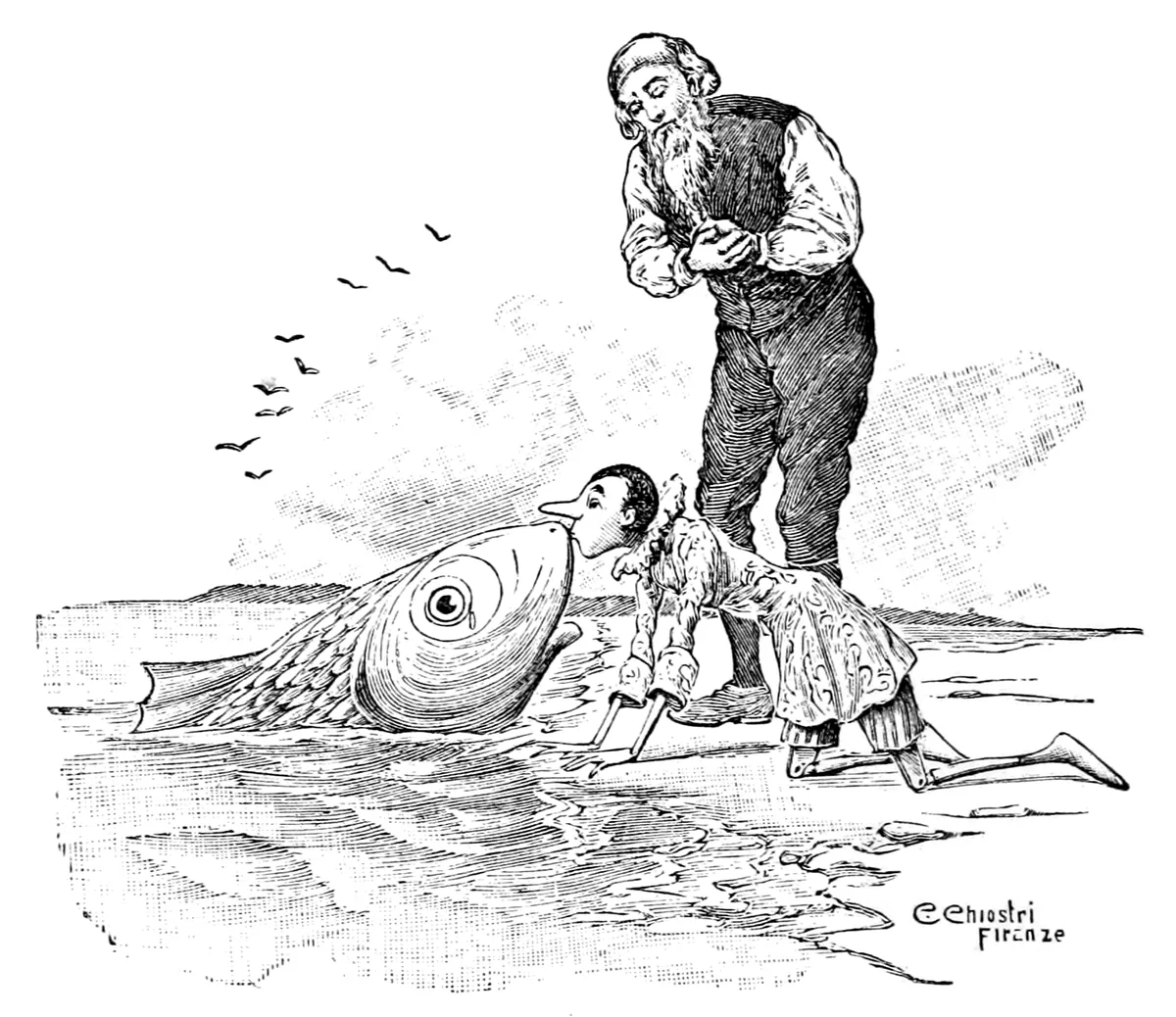
“My friend, you have saved my father! I haven't words enough to thank you! At least let me give you a kiss, as a sign of my eternal gratitude!...”
The Tunny poked his snout out of the water, and Pinocchio, kneeling down on the ground, planted a most affectionate kiss on his mouth. At this burst of spontaneous, heartfelt tenderness, the poor Tunny, who was not used to such things, was so deeply moved that, ashamed to be seen crying like a baby, he plunged his head back under the water and vanished.
Meanwhile day had broken.
Then Pinocchio, offering his arm to Geppetto, who scarcely had breath enough to stand on his feet, said to him:
“Lean on my arm, dear Daddy, and let's go. We'll walk slowly, slowly, like the ants, and when we're tired we'll rest along the way.”
“And where are we to go?” asked Geppetto.
“In search of a house or a hut where they'll give us, out of charity, a mouthful of bread and a little straw to serve as a bed.”
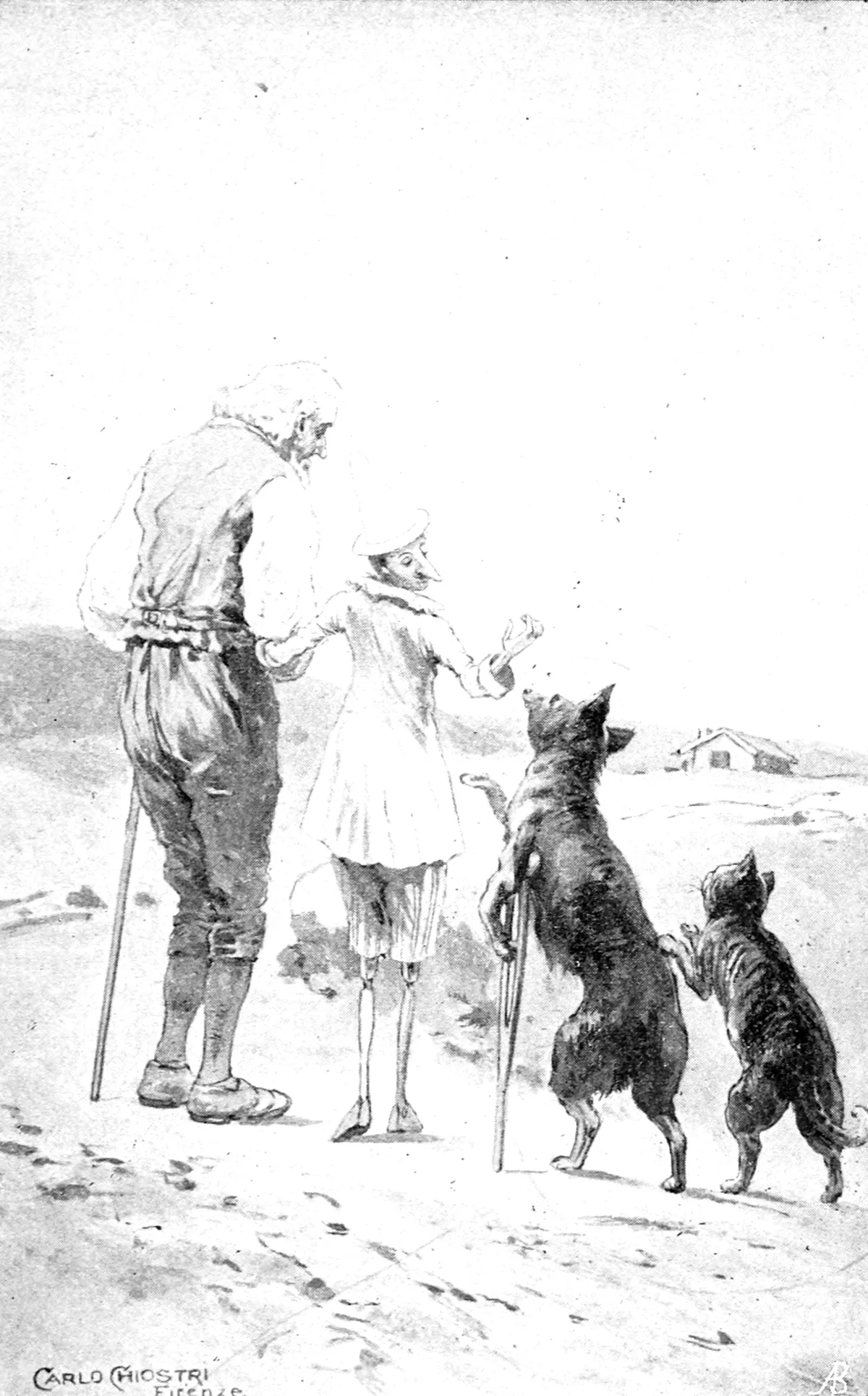
They had not gone a hundred steps when they saw two ugly-looking rascals sitting at the edge of the road, begging for alms.
They were the Cat and the Fox; but they looked nothing like their old selves. Just imagine: the Cat, by dint of pretending to be blind, had ended up going blind for real; and the Fox, grown old, mangy and paralysed down one side, had not even a tail left. That's how it was. The wretched little thief, sunk in the direst poverty, was forced one fine day to sell even that beautiful tail to a travelling pedlar, who bought it to make himself a fly-whisk.
“Oh, Pinocchio!” cried the Fox in a whining voice. “Spare a little charity for two poor invalids!”
“Invalids!” repeated the Cat.
“Goodbye, you impostors!” answered the puppet. “You fooled me once, and you won't catch me again.”
“Believe us, Pinocchio, today we really are poor and unfortunate!”
“Really!” repeated the Cat.
“If you're poor, you deserve it. Remember the proverb that says: ‘Stolen money never bears fruit.’ Goodbye, you impostors.”
“Have pity on us!...”
“On us!”
“Goodbye, you impostors! Remember the proverb that says: ‘The devil's flour all turns to bran.’”
“Don't abandon us!...”
“...don us...!” repeated the Cat.
“Goodbye, you impostors! Remember the proverb that says: ‘He who steals his neighbour's cloak usually dies without a shirt.’”
And with these words Pinocchio and Geppetto went calmly on their way, until, after another hundred steps, they saw at the end of a little lane, out in the middle of the fields, a pretty hut all made of straw, with a roof covered in tiles and bricks.
“Somebody must live in that hut,” said Pinocchio. “Let's go there and knock.”
And so they went, and knocked at the door.
“Who is it?” said a tiny voice from inside.
“We're a poor father and a poor son, without bread and without a roof,” answered the puppet.
“Turn the key, and the door will open,” said the same tiny voice.
Pinocchio turned the key, and the door opened. As soon as they were inside, they looked this way, they looked that way, and they saw nobody.
“Well, and where is the master of the hut?” said Pinocchio in amazement.
“Here I am, up here!”
Father and son turned at once towards the ceiling, and there on a rafter they saw the Talking Cricket.
“Oh, my dear little Cricket!” said Pinocchio, greeting him politely.
“So now you call me ‘your dear little Cricket’, do you? But do you remember the time when, to drive me out of your house, you threw a hammer handle at me?”
“You're right, little Cricket! Drive me out too... throw a hammer handle at me too: but have pity on my poor father...”
“I shall have pity on the father, and on the son as well! But I wanted to remind you of the rude treatment I received, to teach you that in this world, whenever we can, we must be courteous to everyone, if we want to be repaid with the same courtesy in our own days of need.”
“You're right, little Cricket, a thousand times right, and I'll keep in mind the lesson you've taught me. But tell me, how did you manage to buy this lovely hut?”
“This hut was given to me yesterday by a charming goat whose wool was of the most beautiful blue colour.”
“And where has the goat gone?” asked Pinocchio, with the liveliest curiosity.
“I don't know.”
“And when will she come back?...”
“She will never come back. Yesterday she went away all sorrowful, and in her bleating she seemed to be saying: ‘Poor Pinocchio!... I shall never see him again now!... By this time the Shark will have gobbled him up!...’”
“Did she really say that?... Then it was her!... it was her!... it was my dear little Fairy!...” Pinocchio began to wail, sobbing and weeping bitterly.
When he had cried his fill, he dried his eyes, and after making a nice little bed of straw, he laid old Geppetto down on it. Then he asked the Talking Cricket:
“Tell me, little Cricket, where could I find a glass of milk for my poor father?”
“Three fields away from here lives Giangio the market gardener, who keeps cows. Go to him, and you'll find the milk you're looking for.”
Pinocchio ran all the way to Giangio the gardener's house; but the gardener said to him:
“How much milk do you want?”
“I want a full glass.”
“A glass of milk costs a penny. So start by giving me the penny.”
“I haven't even a centesimo,” answered Pinocchio, all mortified and sorrowful.
“Too bad, my little puppet,” replied the gardener. “If you haven't even a centesimo, I haven't even a finger of milk.”
“Never mind!” said Pinocchio, and he made as if to go away.
“Wait a moment,” said Giangio. “You and I can come to an arrangement. Would you be willing to turn the water-wheel?”
“What's a water-wheel?”
“It's that wooden contraption for drawing water up from the cistern to water the vegetables.”
“I'll give it a try...”
“Well then, draw me up a hundred buckets of water, and in return I'll give you a glass of milk.”
“Agreed.”
Giangio led the puppet into the vegetable garden and showed him how to turn the water-wheel. Pinocchio set to work at once; but before he had drawn up the hundred buckets of water, he was dripping with sweat from head to foot. He had never in his life done such hard work.
“Until now,” said the gardener, “I've had my little donkey do this job of turning the water-wheel; but today the poor animal is at death's door.”
“Will you take me to see him?” said Pinocchio.
“Gladly.”
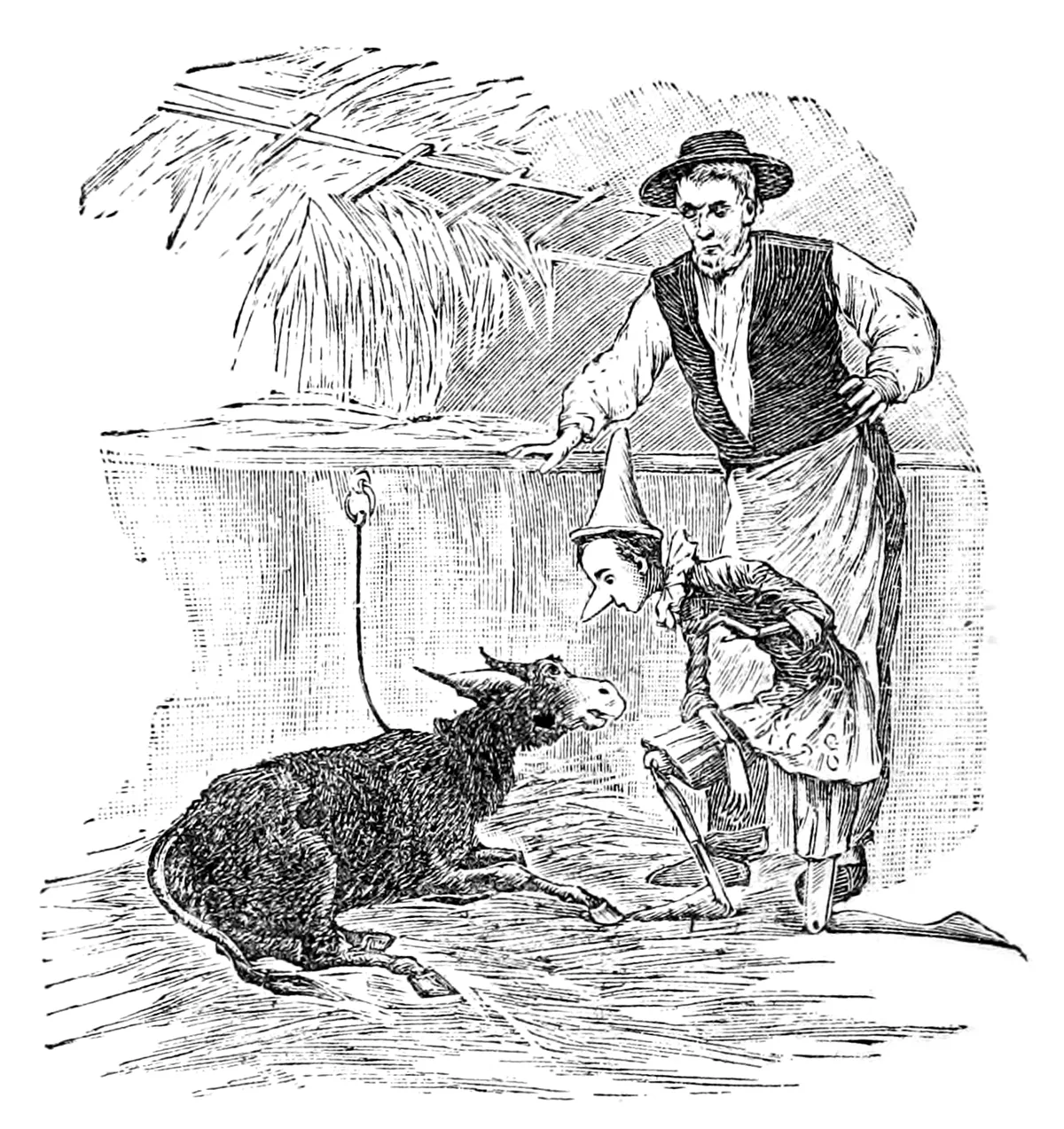
As soon as Pinocchio stepped into the stable, he saw a fine little donkey stretched out on the straw, worn out by hunger and overwork. When he had looked at him long and hard, he said to himself, troubled:
“But I know that little donkey! His face isn't new to me!”
And bending down close to him, he asked him in donkey dialect:
“Who are you?”
At this question the little donkey opened his dying eyes and answered, stammering, in the same dialect:
“I'm Lamp... wi... ick...”
And then he closed his eyes again and died.
“Oh, poor Lampwick!” said Pinocchio under his breath; and taking a handful of straw, he wiped away a tear that was trickling down his face.
“Are you so upset over a donkey that cost you nothing?” said the gardener. “What should I do, then, when I bought him with hard cash?”
“I'll tell you... he was a friend of mine...”
“A friend of yours?”
“A schoolfellow of mine!...”
“What?!” bellowed Giangio, bursting into a great laugh. “What?! You had donkeys for schoolfellows?... I can just imagine the fine studies you must have done!...”
The puppet, stung by these words, made no reply; but he took his glass of milk, still almost warm, and went back to the hut.
And from that day on, for more than five months, he got up every morning before dawn to go and turn the water-wheel, and so earn that glass of milk which did his father's frail health so much good. Nor was he content with that: for in his spare time he learned to make baskets and hampers out of rushes too, and with the money he got for them he met all their daily expenses with great good sense. Among other things, he built with his own hands a smart little cart to take his father out on fine days and let him have a breath of fresh air.
Then, in the evenings, he practised reading and writing. In the nearby village he had bought, for a few centesimi, a big book that was missing its title page and its index, and that was what he read from. As for writing, he used a twig sharpened like a pen; and since he had neither inkwell nor ink, he dipped it in a little bottle filled with blackberry and cherry juice.
The fact is that, thanks to his eagerness to try hard, to work and to get on in the world, he had not only managed to keep his ever-ailing father in something close to comfort, but had even been able to put aside forty pennies to buy himself a new suit of clothes.
One morning he said to his father:
“I'm going to the market nearby to buy myself a little jacket, a little cap and a pair of shoes. When I come home,” he added, laughing, “I'll be so well dressed that you'll take me for a fine gentleman.”
And out of the house he went, and began to run along, merry and happy. When all of a sudden he heard someone call his name, and turning round he saw a fine Snail creeping out of the hedge.
“Don't you recognise me?” said the Snail.
“I do and I don't...”
“Don't you remember the Snail who was chambermaid to the Fairy with Blue Hair? Don't you remember that time when I came down to light your way, and you were left with one foot stuck in the front door?”
“I remember everything,” cried Pinocchio. “Answer me quickly, dear little Snail: where did you leave my good Fairy? What is she doing? Has she forgiven me? Does she still remember me? Does she still love me? Is she very far from here? Could I go and see her?”
To all these questions, asked in a rush and without stopping for breath, the Snail answered with her usual calm:
“My dear Pinocchio! The poor Fairy is lying sick in a hospital bed!...”
“In hospital?...”
“Sad to say, yes. Struck by a thousand misfortunes, she has fallen gravely ill, and she no longer has enough to buy herself a mouthful of bread.”
“Really?... Oh, what a terrible grief you've given me! Oh, poor little Fairy! Poor little Fairy! Poor little Fairy! If I had a million, I'd run and take it to her... But I have only forty pennies... here they are! I was just on my way to buy myself a new suit. Take them, Snail, and go and bring them to my good Fairy at once.”
“And your new suit?”
“What do I care about a new suit? I'd sell even these rags I'm wearing, if it would help her! Go, Snail, and hurry! And come back here in two days, for I hope to be able to give you a few more pennies. Until now I've worked to keep my father; from today on I'll work five hours more to keep my good mother too. Goodbye, Snail; I'll expect you in two days.”
The Snail, quite against her habit, began to run like a lizard in the blazing August sun.
When Pinocchio got home, his father asked him:
“And the new suit?”
“I couldn't find one that fitted me. Never mind!... I'll buy it another time.”
That evening Pinocchio, instead of staying up till ten, stayed up till long past midnight! And instead of making eight rush baskets, he made sixteen.
Then he went to bed and fell asleep. And as he slept, he seemed to see the Fairy in a dream, all beautiful and smiling, and she gave him a kiss and said to him:
“Well done, Pinocchio! For the sake of your good heart, I forgive you all the mischief you have done until today. Children who lovingly care for their parents in their poverty and their sickness always deserve great praise and great affection, even if they cannot be held up as models of obedience and good behaviour. Be sensible from now on, and you will be happy.”
At this point the dream ended, and Pinocchio woke up with his eyes wide open.
Now just imagine his amazement when, on waking, he discovered that he was no longer a wooden puppet, but had become, instead, a boy like all other boys. He glanced around him, and instead of the usual straw walls of the hut he saw a pretty little room, furnished and decorated with a simplicity that was almost elegant. Jumping out of bed, he found a fine new suit of clothes laid out for him, a new cap and a pair of leather boots that fitted him to perfection.
As soon as he was dressed, he naturally put his hands in his pockets, and he pulled out a little ivory purse with these words written on it: “The Fairy with Blue Hair returns to her dear Pinocchio his forty pennies, and thanks him very much for his good heart.” When he opened the purse, instead of forty copper pennies, there glittered forty gold pieces, brand-new from the mint.
Then he went to look at himself in the mirror, and he seemed to be someone else. He no longer saw reflected there the usual image of the wooden puppet, but the lively, intelligent image of a handsome boy with chestnut hair and sky-blue eyes, looking as merry and festive as a Whitsun holiday.
In the midst of all these wonders, following one upon another, Pinocchio himself no longer knew whether he was really awake or still dreaming with his eyes open.
“And where is my father?” he cried all of a sudden; and going into the next room, he found old Geppetto healthy, sprightly and in good spirits, just as he used to be, who had already taken up his trade of woodcarving again and was at that very moment designing a beautiful frame rich with leaves, flowers and the little heads of all sorts of animals.
“Satisfy my curiosity, Daddy: how do you explain this sudden change?” Pinocchio asked him, throwing his arms round his neck and covering him with kisses.
“This sudden change in our home is all thanks to you,” said Geppetto.
“Why thanks to me?”
“Because when bad boys become good, they have the power to give a new and smiling look to the inside of their homes as well.”
“And where can the old wooden Pinocchio have hidden himself?”
“There he is!” answered Geppetto; and he pointed to a big puppet propped against a chair, its head turned to one side, its arms dangling, and its legs crossed and folded in the middle, so that it seemed a miracle it stayed upright.
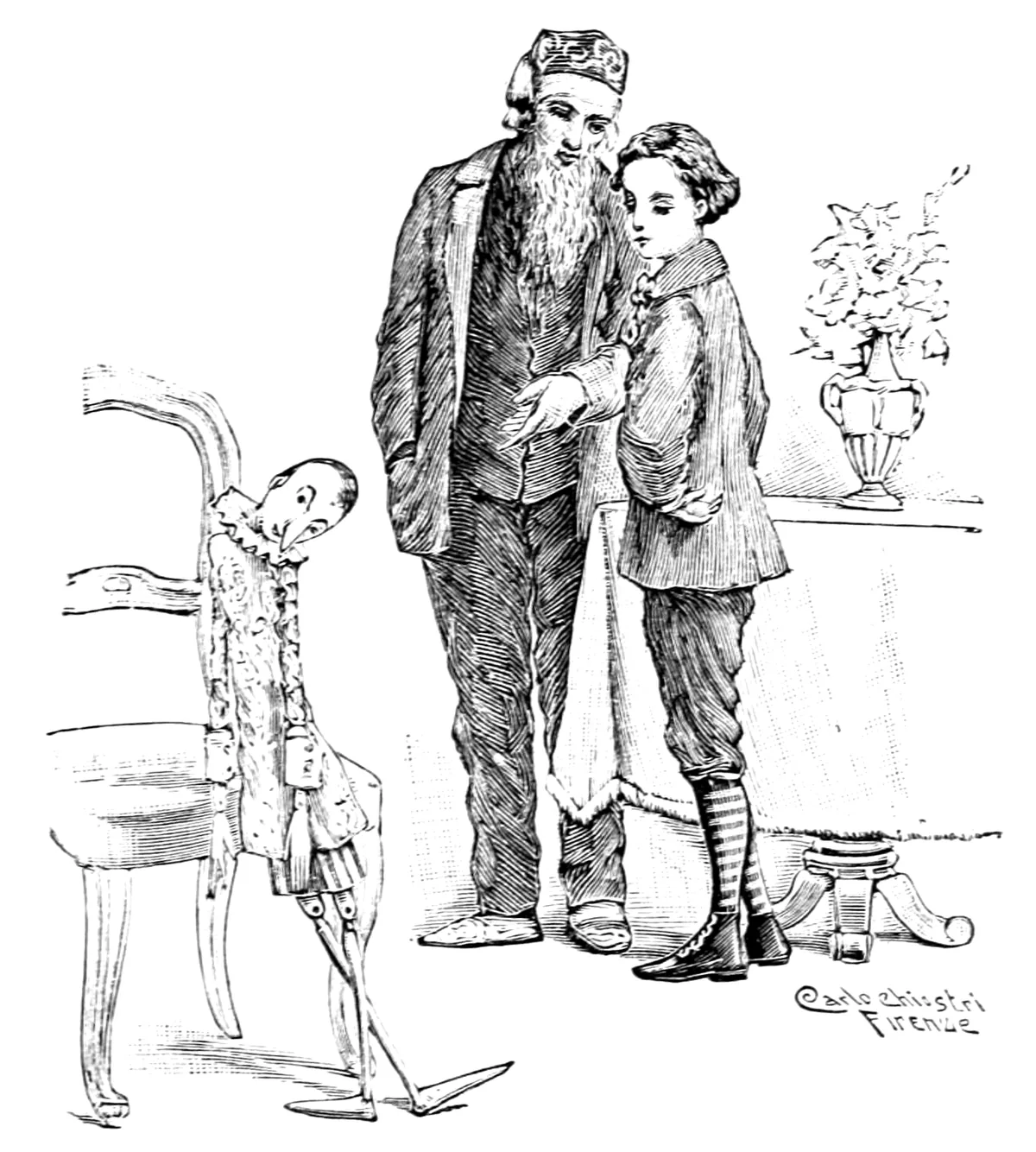
Pinocchio turned to look at it; and after he had looked at it for a while, he said to himself with the greatest satisfaction:
“How funny I was when I was a puppet! And how happy I am now to have become a proper little boy!...”
THE END.