The puppet went back into the town and began to count the minutes one by one; and when he thought it was time, he set off at once along the road that led to the Field of Miracles.
And as he walked along at a hurried pace, his heart beat hard and went tick, tock, tick, tock, like a parlour clock when it is really running. And all the while he was thinking to himself:
“And what if, instead of a thousand coins, I found two thousand on the branches of the tree?… And what if, instead of two thousand, I found five thousand? And what if, instead of five thousand, I found a hundred thousand? Oh, what a fine gentleman I'd be then!… I'd like to have a beautiful palace, a thousand little wooden horses and a thousand stables to play with, a cellar full of cordials and alchermes, and a library crammed with candied fruit, cakes, panettoni, almond nougat and cream-filled wafers.”
Daydreaming like this, he came near the field, and there he stopped to see if he could catch sight of a tree with its branches laden with coins: but he saw nothing. He went another hundred steps forward, and nothing; he went into the field… he went right up to that little hole where he had buried his gold pieces, and nothing. Then he grew thoughtful and, forgetting all the rules of etiquette and good manners, he took a hand out of his pocket and gave his head a long, long scratch.
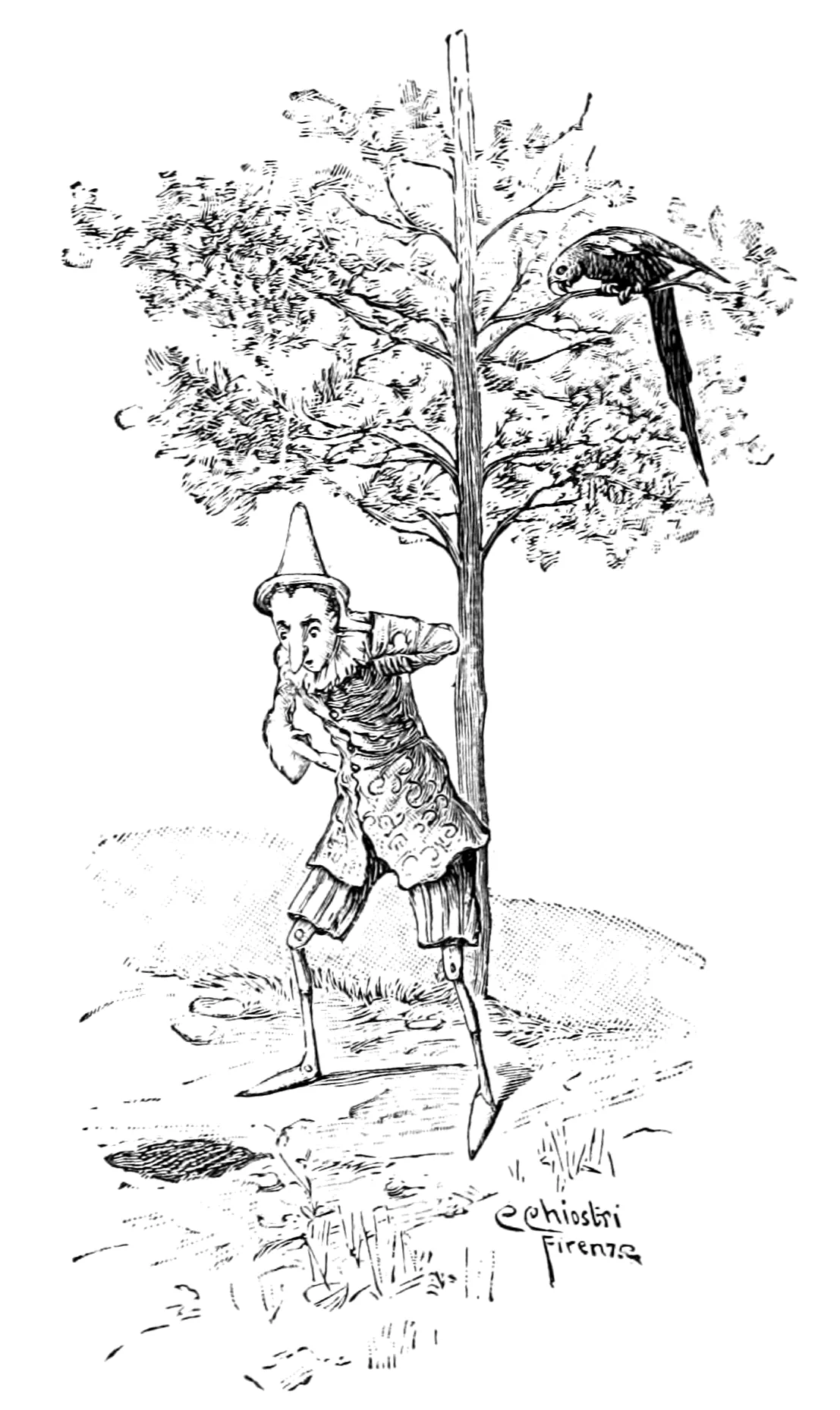
At that moment he heard a great burst of laughter whistle in his ears; and looking up, he saw a big Parrot in a tree, picking over the few feathers he had left.
“What are you laughing at?” Pinocchio asked him crossly.
“I'm laughing because, while I was preening, I tickled myself under the wings.”
The puppet did not answer. He went to the millstream, filled the same old slipper with water, and set about watering the earth that covered the gold pieces once again.
And then another burst of laughter, even cheekier than the first, rang out in the silent loneliness of that field.
“Well, really!” shouted Pinocchio, losing his temper. “May I know, you ill-mannered Parrot, what you are laughing at?”
“I'm laughing at those numskulls who believe every bit of nonsense and let themselves be trapped by people cleverer than they are.”
“Are you talking about me, by any chance?”
“Yes, I'm talking about you, poor Pinocchio: about you, who are so soft in the head that you believe money can be sown and harvested in fields, the way you sow beans and pumpkins. I believed it too, once, and now I'm paying for it. Now (but too late!) I have had to come round to the idea that, to scrape a few pennies together honestly, you have to know how to earn them, either by the work of your own hands or by the wits in your own head.”
“I don't understand you,” said the puppet, who was already beginning to tremble with fear.
“Never mind! I'll explain myself better,” the Parrot went on. “You must know, then, that while you were in the town, the Fox and the Cat came back to this field: they took the buried gold pieces and then ran off like the wind. And now, anyone who can catch them is a clever one!”
Pinocchio stood there open-mouthed and, not wanting to believe the Parrot's words, began to dig up the ground he had watered with his hands and his nails. And he dug, and dug, and dug, and made a hole so deep that a haystack could have stood upright in it: but the coins were no longer there.
Then, seized with despair, he ran back to the town and went straight to the court, to report to the judge the two scoundrels who had robbed him.
The judge was a big ape of the Gorilla tribe: an old ape, respected for his great age, for his white beard and above all for his gold spectacles without any glass in them, which he was obliged to wear all the time because of an inflammation of the eyes that had been tormenting him for several years.
Standing before the judge, Pinocchio told him every last detail of the wicked swindle of which he had been the victim; he gave the first names, the surnames and the descriptions of the scoundrels, and he ended by demanding justice.
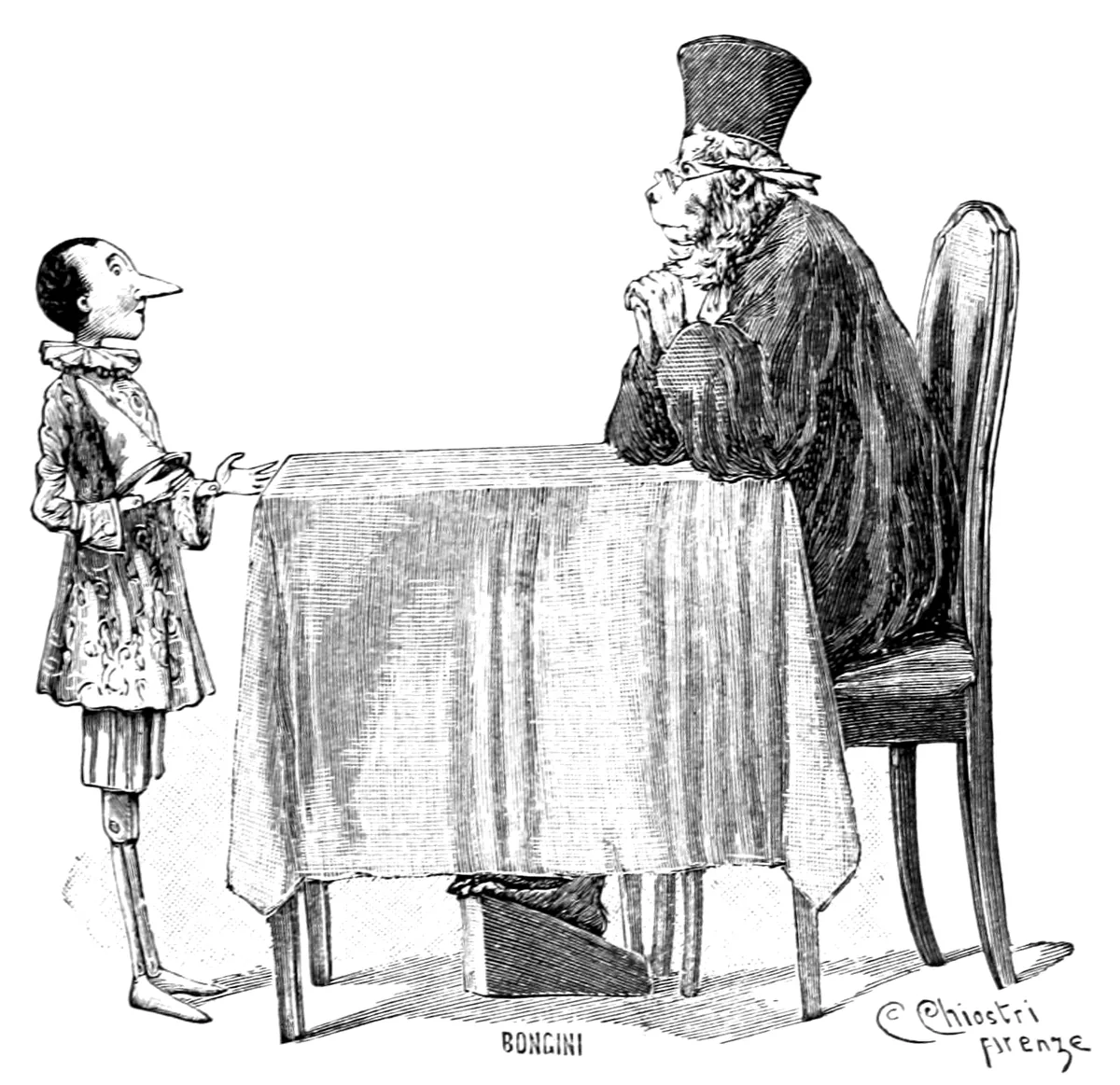
The judge listened to him with great kindness; he took the liveliest interest in the story; he was touched, he was moved; and when the puppet had nothing more to say, he reached out his hand and rang the bell.
At the ring of the bell two mastiffs dressed as gendarmes appeared at once.
Then the judge, pointing Pinocchio out to the gendarmes, said to them:
“This poor devil has been robbed of four gold pieces: so take him, and put him in prison at once.”
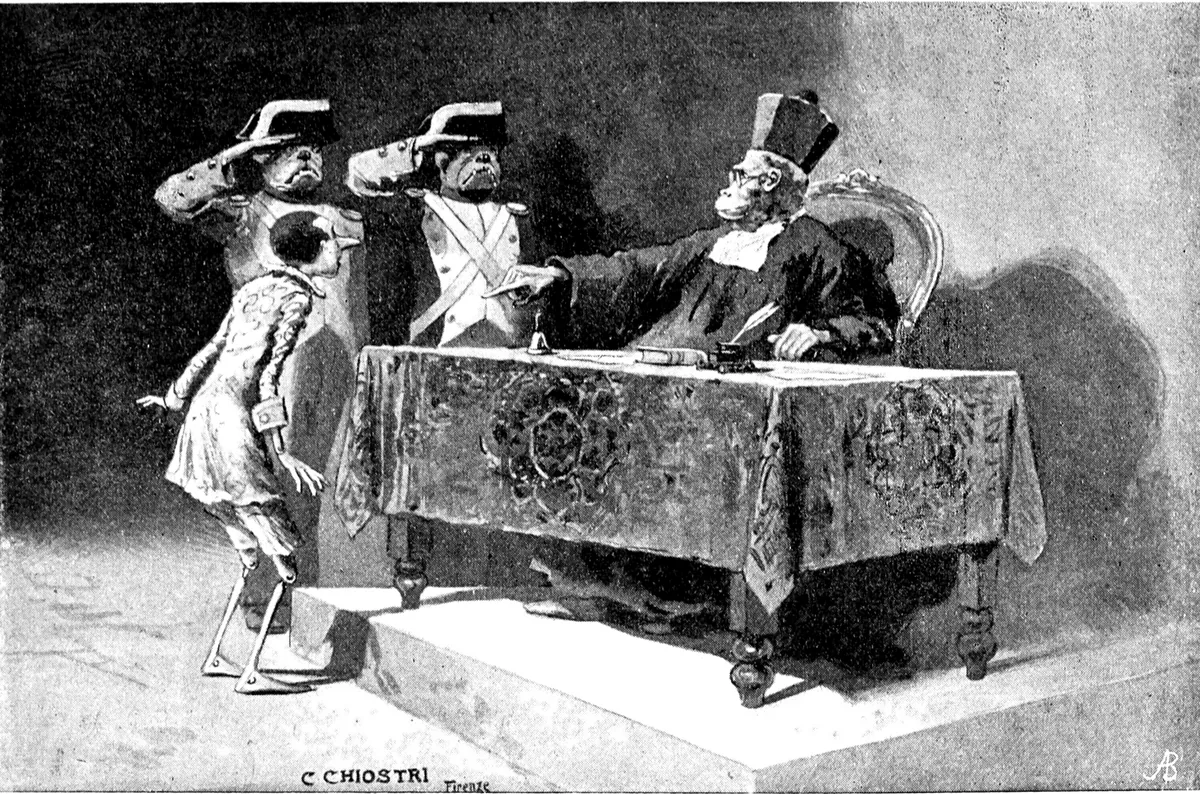
The puppet, hearing this sentence fall on him out of the blue, was struck dumb and wanted to protest; but the gendarmes, to avoid wasting time, stopped his mouth and marched him off to the lock-up.
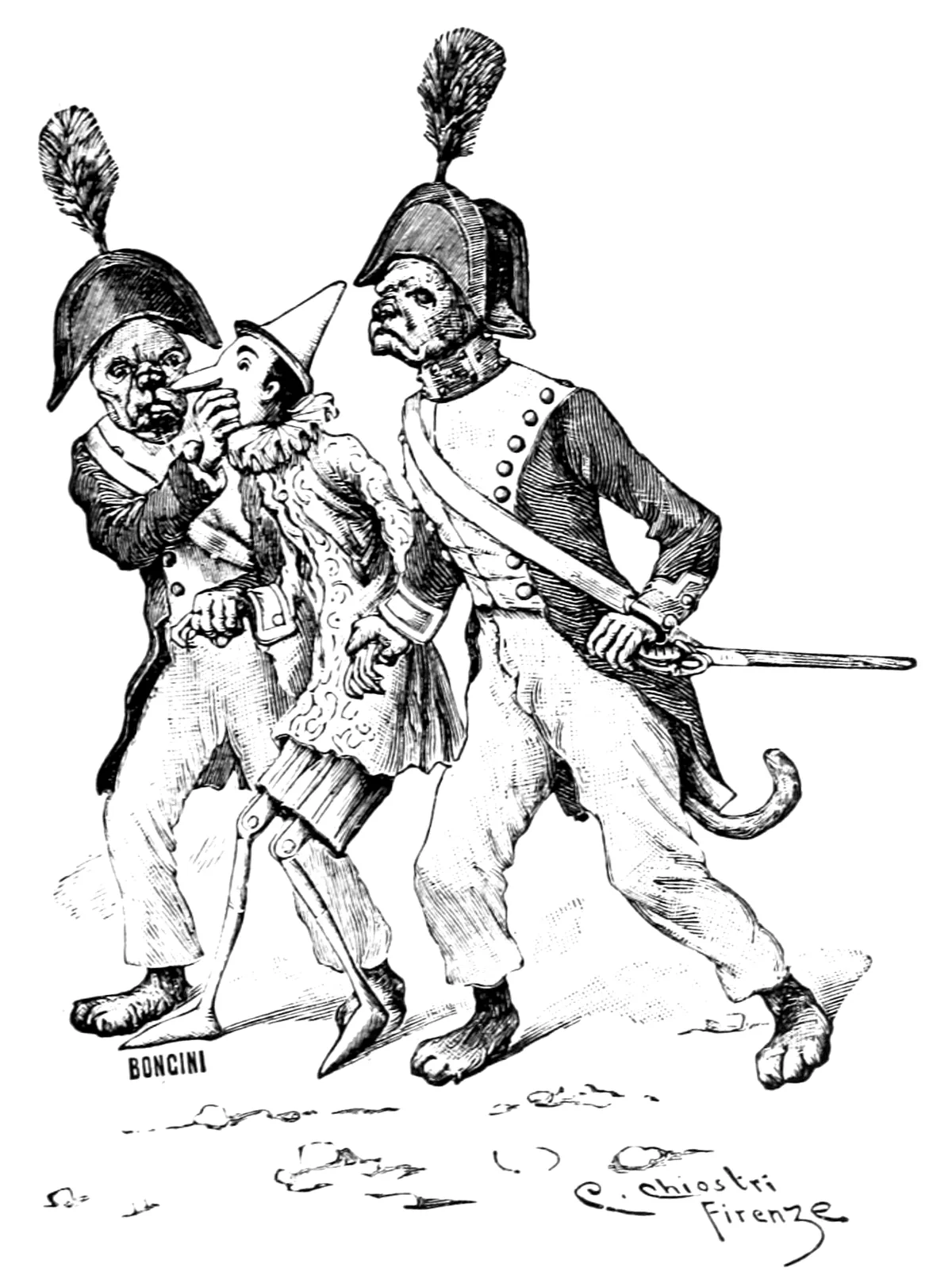
And there he had to stay for four months: four very, very long months; and he would have stayed there even longer if a most lucky thing had not happened. For you must know that the young Emperor who reigned over the town of Catchfools had won a fine victory over his enemies, and he ordered great public celebrations, illuminations, fireworks, horse races and bicycle races; and as a sign of still greater rejoicing, he wanted the prisons to be opened as well and all the scoundrels to be let out.
“If the others are getting out of prison, I want to get out too,” said Pinocchio to the jailer.
“Not you,” answered the jailer, “because you aren't one of the lucky lot…”
“I beg your pardon,” replied Pinocchio, “I'm a scoundrel too.”
“In that case you are perfectly right,” said the jailer; and taking off his cap respectfully and bowing to him, he opened the prison doors and let him go.