“Really....” the puppet said to himself as he set off again, “how unlucky we poor boys are! Everybody scolds us, everybody warns us, everybody gives us advice. If you let them, they would all take it into their heads to be our fathers and our schoolmasters; all of them; even the Talking Crickets. There you are: just because I wouldn't listen to that tiresome Cricket, who knows how many misfortunes, according to him, are supposed to happen to me! I'm even supposed to meet the assassins! A good thing I don't believe in assassins, and never have. As far as I'm concerned, assassins were invented on purpose by fathers, to frighten boys who want to go out at night. And anyway, even if I did meet them here on the road, do you think they'd scare me? Not a bit of it. I'd go right up to their faces and shout: ‘Gentlemen assassins, what do you want with me? Remember that I'm not to be trifled with! So be off about your business, and not a word!’ At a little speech like that, made in earnest, those poor assassins, I can just see them, would run off like the wind. And if they happened to be so ill-mannered that they wouldn't run away, why, then I'd run away myself, and that would be the end of it....”
But Pinocchio could not finish his reasoning, because at that moment he thought he heard behind him the faintest rustle of leaves.
He turned round to look, and saw in the dark two ugly black figures, all wrapped up in two charcoal sacks, running after him with leaps and bounds and on tiptoe, as if they were two ghosts.
“Here they are, really!” he said to himself: and not knowing where to hide the four gold pieces, he hid them in his mouth, right under his tongue.
Then he tried to run away. But he had not yet taken the first step when he felt himself seized by the arms and heard two horrible, hollow voices saying to him:
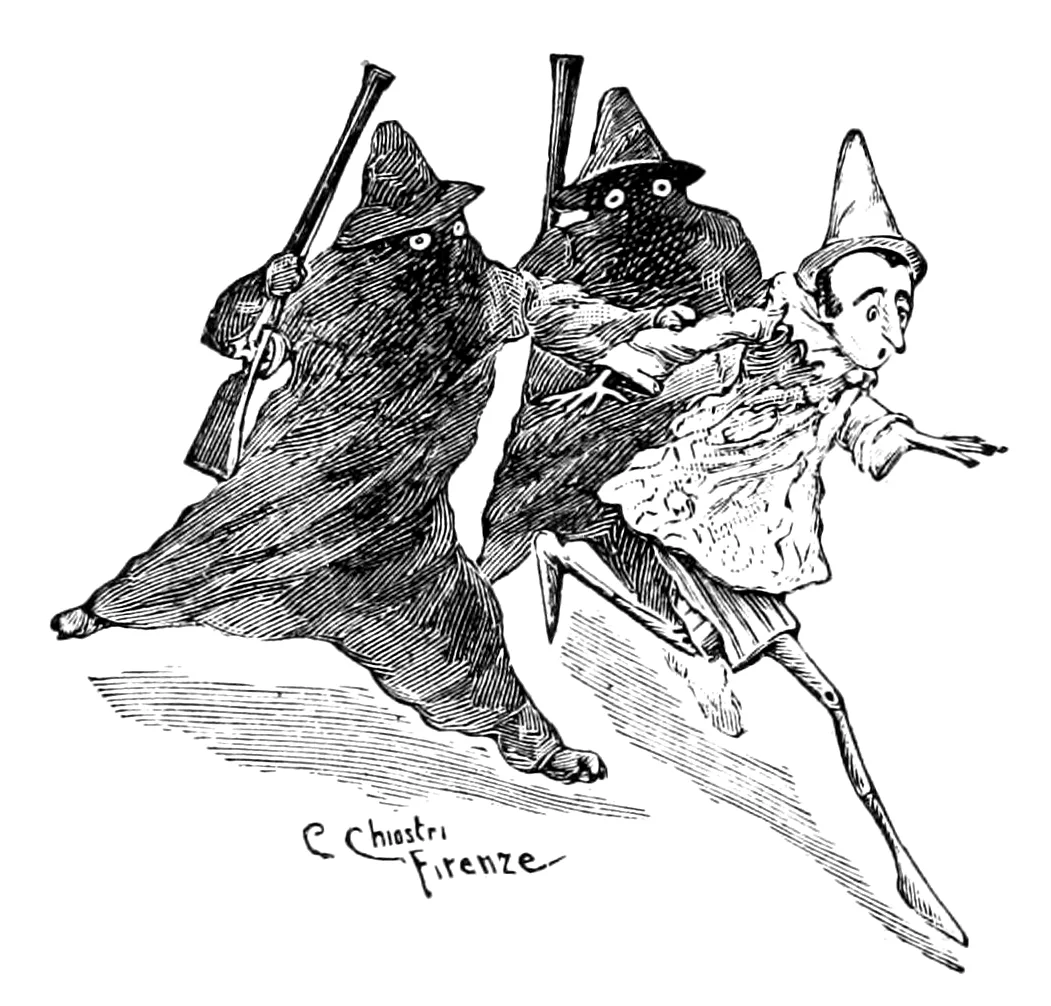
“Your money or your life!”
Pinocchio, unable to answer in words because of the coins in his mouth, made a thousand bows and a thousand gestures, to make those two hooded figures, whose eyes alone could be seen through the holes in the sacks, understand that he was a poor puppet and did not have so much as a bad penny in his pocket.
“Come on, come on! Less chatter and out with the money!” the two robbers shouted menacingly.
And the puppet made a sign with his head and his hands, as if to say: “I haven't got any.”
“Out with the money or you're dead,” said the taller of the assassins.
“Dead!” repeated the other.
“And after we've killed you, we'll kill your father too!”
“Your father too!”
“No, no, no, not my poor father!” cried Pinocchio in a desperate voice: but as he cried out, the gold pieces jingled in his mouth.
“Ah, you scoundrel! So you've hidden the money under your tongue, have you? Spit it out at once!”
But Pinocchio held firm.
“Ah! Pretending to be deaf, are you? Just you wait, we'll see to it that you spit them out!”
And sure enough, one of them grabbed the puppet by the tip of his nose and the other took him by the chin, and they began pulling roughly, one this way and the other that way, to force him to open his mouth wide: but it was no use. The puppet's mouth seemed to be nailed and riveted shut.
Then the shorter of the assassins pulled out a big ugly knife and tried to force it between his lips like a lever or a chisel: but Pinocchio, quick as lightning, sank his teeth into the man's hand, bit it clean off, and spat it out; and imagine his amazement when he saw that what he had spat on the ground was not a hand but a cat's paw.
Encouraged by this first victory, he tore himself free from the assassins' claws, jumped over the hedge by the road, and began to run away across the fields. And the assassins ran after him, like two dogs after a hare: and the one who had lost a paw ran on one leg only, though nobody has ever found out how he managed it.
After a run of fifteen kilometres, Pinocchio could go no further. Then, seeing himself lost, he climbed up the trunk of a very tall pine tree and sat down at the very top of the branches. The assassins tried to climb up too, but when they got halfway up the trunk they slipped, and tumbling back to the ground, they skinned their hands and feet.
But they did not give up for all that: on the contrary, they gathered a bundle of dry sticks at the foot of the pine and set fire to it. In less time than it takes to tell, the pine began to burn and blaze like a candle flickering in the wind. Pinocchio, seeing the flames climbing higher and higher, and not wanting to end up like a roast pigeon, took a great leap from the top of the tree, and off he went running again across the fields and the vineyards. And the assassins behind him, always behind him, never tiring.
Meanwhile day was beginning to glimmer, and suddenly he found his way barred by a wide and very deep ditch, full of filthy water the colour of milky coffee. What was he to do? “One, two, three!” cried the puppet, and taking a long run-up, he jumped across to the other side. And the assassins jumped too, but they had not judged the distance properly, and splash-a-dash!... down they fell, right into the middle of the ditch. Pinocchio, hearing the splash and the spray of the water, shouted, laughing and still running:
“Enjoy your bath, gentlemen assassins!”
And he was already picturing them well and truly drowned, when instead, turning round to look, he saw that both of them were running after him, still wrapped up in their sacks and dripping water like two baskets with the bottoms knocked out.