The next day Fire-Eater called Pinocchio aside and asked him:
“What's your father's name?”
“Geppetto.”
“And what is his trade?”
“Being poor.”
“Does he earn much?”
“He earns just enough never to have a centesimo in his pocket. Just imagine, to buy me my ABC book for school he had to sell the only coat he had on his back: a coat so full of patches and darns that it was one big sore.”
“Poor devil! I almost feel sorry for him. Here are five gold coins. Go and take them to him at once, and give him my very best regards.”
Pinocchio, as you can easily imagine, thanked the puppet-master a thousand times: he hugged all the puppets of the company one by one, even the gendarmes; and, beside himself with joy, he set off on his way back home.
But he hadn't gone even half a kilometre when he met on the road a Fox lame in one foot and a Cat blind in both eyes, who were jogging along, helping each other like good companions in misfortune. The Fox, who was lame, walked leaning on the Cat: and the Cat, who was blind, let himself be guided by the Fox.
“Good morning, Pinocchio,” the Fox said to him, greeting him politely.
“How is it you know my name?” asked the puppet.
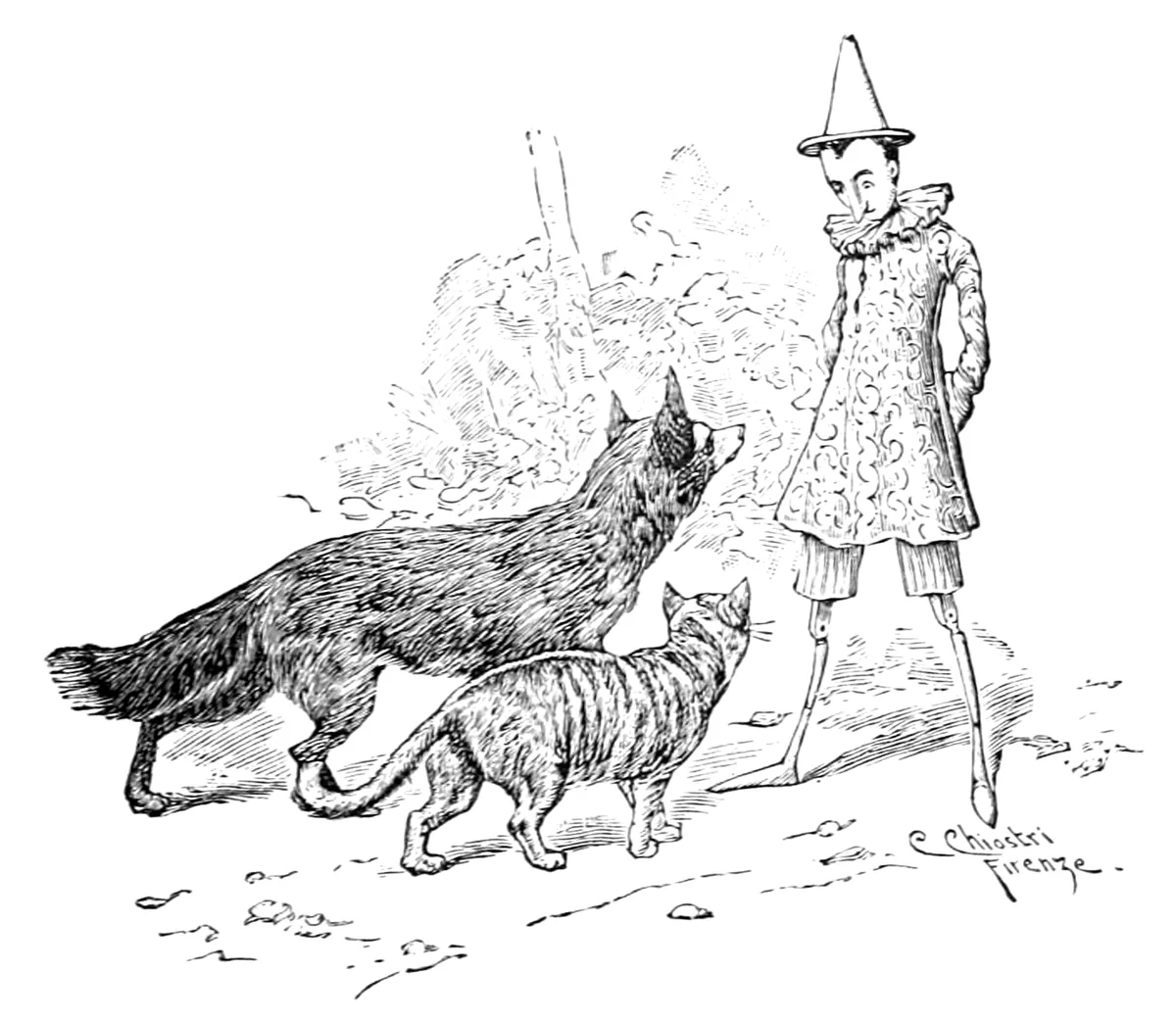
“I know your father well.”
“Where did you see him?”
“I saw him yesterday at the door of his house.”
“And what was he doing?”
“He was in his shirtsleeves and shivering with cold.”
“Poor Father! But, God willing, from today on he won't shiver any more!”
“Why?”
“Because I've become a great gentleman.”
“You, a great gentleman?” said the Fox, and began to laugh a coarse, mocking laugh: and the Cat was laughing too, but so as not to let it show, he was combing his whiskers with his little front paws.
“There's nothing to laugh about,” cried Pinocchio, offended. “I'm really sorry to make your mouths water, but these here, if you know anything about it, are five beautiful gold coins.”
And he pulled out the coins Fire-Eater had given him.
At the pleasant jingle of those coins, the Fox, with an involuntary movement, stretched out the leg that had seemed crippled, and the Cat opened both his eyes wide, so that they looked like two green lanterns; but then he shut them again at once, so quickly that Pinocchio noticed nothing.
“And now,” the Fox asked him, “what do you want to do with those coins?”
“First of all,” answered the puppet, “I want to buy my father a fine new coat, all of gold and silver, with diamond buttons: and then I want to buy an ABC book for myself.”
“For yourself?”
“Yes, really: because I want to go to school and start studying in earnest.”
“Look at me!” said the Fox. “Because of a silly passion for studying, I lost a leg.”
“Look at me!” said the Cat. “Because of a silly passion for studying, I lost the sight of both my eyes.”
At that moment a white Blackbird, which was perched on the hedge beside the road, gave its usual call and said:
“Pinocchio, don't listen to the advice of bad companions: or else you'll be sorry!”
Poor Blackbird, if only he had never said it! The Cat gave a great leap and pounced on him, and without even giving him time to say ouch, ate him up in one mouthful, feathers and all.
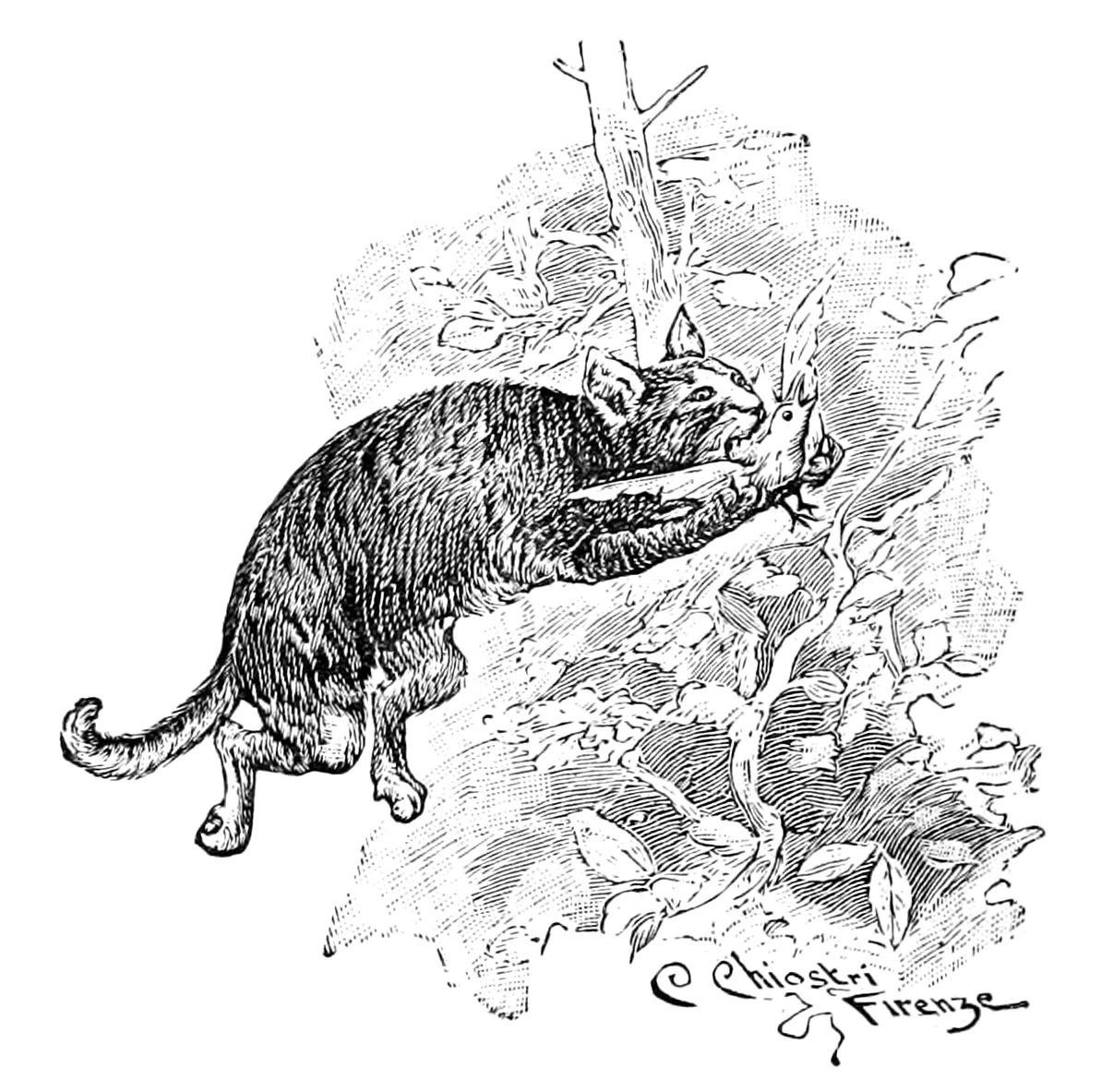
When he had eaten him and wiped his mouth clean, he shut his eyes again and went back to playing blind as before.
“Poor Blackbird!” Pinocchio said to the Cat. “Why did you treat him so badly?”
“I did it to teach him a lesson. That way, next time he'll learn not to poke his beak into other people's conversations.”
They had come more than halfway when the Fox, stopping short, said to the puppet:
“Would you like to double your gold coins?”
“How do you mean?”
“Would you like to turn five miserable gold pieces into a hundred, a thousand, two thousand?”
“I'd love to! But how?”
“It's very easy. Instead of going back home, you should come with us.”
“And where do you want to take me?”
“In the Land of the Barn Owls.”
Pinocchio thought it over for a little while, and then said firmly:
“No, I don't want to come. I'm nearly home now, and I want to go home, where my father is waiting for me. Who knows how the poor old man sighed yesterday when I didn't come back. I'm afraid I've been a bad son, and the Talking Cricket was right when he said: ‘Disobedient boys can never do well in this world.’ And I've learnt it the hard way, because lots of misfortunes have happened to me, and only last night at Fire-Eater's house I was in danger.... Brrr! It gives me the shivers just to think of it!”
“So,” said the Fox, “you really want to go home? Off you go, then, and so much the worse for you.”
“So much the worse for you!” repeated the Cat.
“Think it over carefully, Pinocchio, because you are kicking good fortune away.”
“Good fortune away!” repeated the Cat.
“Between today and tomorrow your five gold pieces would have turned into two thousand.”
“Two thousand!” repeated the Cat.
“But how can they possibly turn into so many?” asked Pinocchio, his mouth hanging open in amazement.
“I'll explain it to you straight away,” said the Fox. “You must know that in the Land of the Barn Owls there is a blessed field which everybody calls the Field of Miracles. In this field you dig a little hole, and into it you put, let us say, one gold piece. Then you cover the hole up with a bit of earth, water it with two buckets of fountain water, sprinkle a pinch of salt on top, and in the evening you go peacefully off to bed. Meanwhile, during the night, the gold piece sprouts and blossoms, and the next morning, when you get up and go back to the field, what do you find? You find a lovely tree loaded with as many gold pieces as a fine ear of wheat has grains in the month of June.”
“So then,” said Pinocchio, more and more astonished, “if I buried my five gold pieces in that field, how many gold pieces would I find there the next morning?”
“That's a very easy sum,” answered the Fox, “a sum you can do on your fingers. Suppose each gold piece gives you a bunch of five hundred gold pieces: multiply five hundred by five, and the next morning you'll find two thousand five hundred shining, jingling gold pieces in your pocket.”
“Oh, how wonderful!” cried Pinocchio, dancing for joy. “As soon as I've gathered these gold pieces, I'll take two thousand for myself, and the other five hundred I'll give as a present to you two.”
“A present to us?” cried the Fox, growing indignant and declaring herself offended. “Heaven forbid!”
“Forbid!” repeated the Cat.
“We,” the Fox went on, “do not work for vile profit: we work to make other people rich.”
“Other people!” repeated the Cat.
“What good people!” Pinocchio thought to himself; and forgetting, then and there, his father, the new coat, the ABC book and all the good resolutions he had made, he said to the Fox and the Cat:
“Let's go at once, I'm coming with you.”