When Pinocchio went into the little puppet theatre, something happened that caused something close to a revolution.
You must know that the curtain was up and the play had already begun.
On the stage you could see Harlequin and Punchinello, who were quarrelling with each other and, as usual, threatening any moment to exchange a whole load of slaps and blows with a stick.
The audience, all attention, were splitting their sides with laughter as they listened to the squabbling of those two puppets, who gesticulated and called each other every name under the sun as convincingly as if they had really been two rational creatures and two people of this world.
When all of a sudden, quick as a wink, Harlequin stops acting and, turning towards the audience and pointing to someone at the back of the stalls, begins to shout in a dramatic tone:
“Gods of the firmament! Am I dreaming or am I awake? And yet that is Pinocchio down there!...”
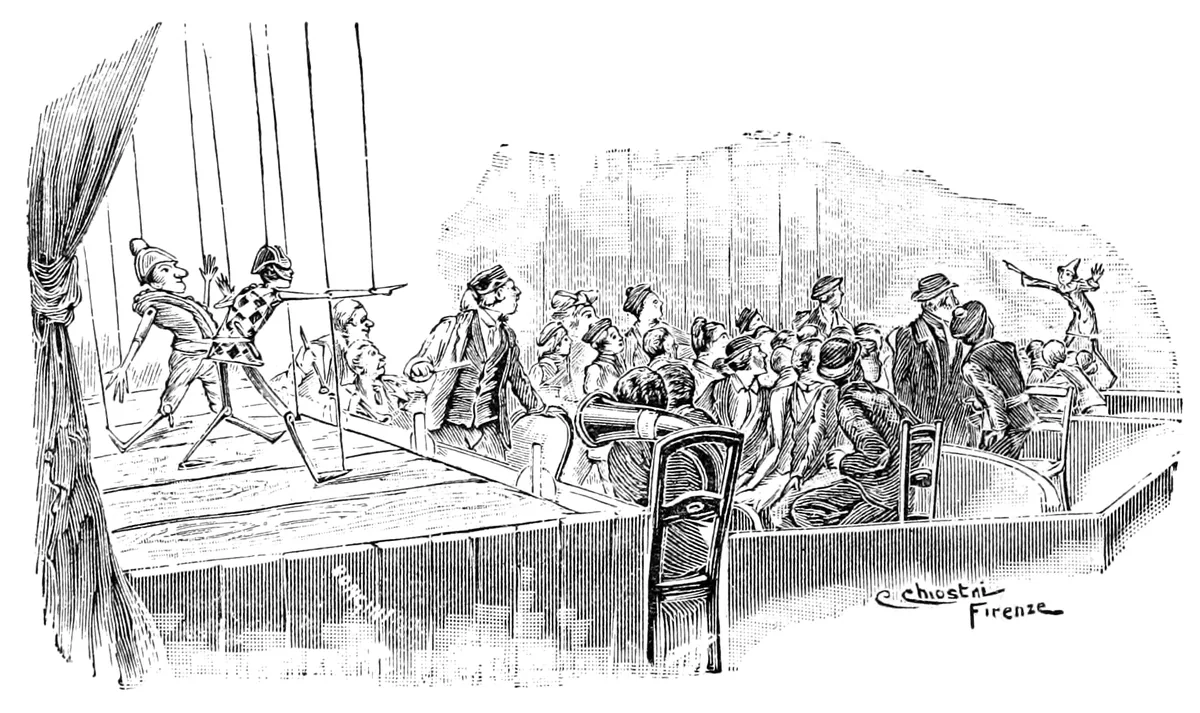
“It really is Pinocchio!” cries Punchinello.
“It's him all right!” shrieks Signora Rosaura, peeping out from the back of the stage.
“It's Pinocchio! It's Pinocchio!” all the puppets shouted together, leaping out from the wings.
“It's Pinocchio! It's our brother Pinocchio! Hurrah for Pinocchio!...”
“Pinocchio, come up here to me!” cries Harlequin. “Come and throw yourself into the arms of your wooden brothers!”
At this affectionate invitation, Pinocchio gives a leap, and from the back of the stalls he lands in the best seats; then with another leap, from the best seats he climbs onto the conductor's head, and from there he shoots up onto the stage.
It is impossible to imagine the hugs, the squeezes round the neck, the friendly pinches and the head-butts of true and sincere brotherhood that Pinocchio received amid all the hubbub of the actors and actresses of that dramatic-vegetable company.
This spectacle was touching, there's no denying it: but the audience in the stalls, seeing that the play wasn't going on any more, grew impatient and began to shout: “We want the play! We want the play!”
All breath wasted, because the puppets, instead of carrying on with the performance, doubled their din and their shouting, and, hoisting Pinocchio onto their shoulders, carried him in triumph up to the footlights.
Then out came the puppet-master, a huge man so ugly that just looking at him was enough to frighten you. He had a horrid beard as black as an ink scribble, and so long that it came down from his chin all the way to the ground: suffice it to say that when he walked, he trod on it with his feet. His mouth was as wide as an oven, his eyes looked like two red glass lanterns with the lamp lit behind them; and in his hands he cracked a great whip, made of snakes and foxes' tails twisted together.
At the unexpected appearance of the puppet-master, everybody fell silent: nobody breathed a word. You could have heard a fly buzz. Those poor puppets, the men and the women, were trembling like so many leaves.
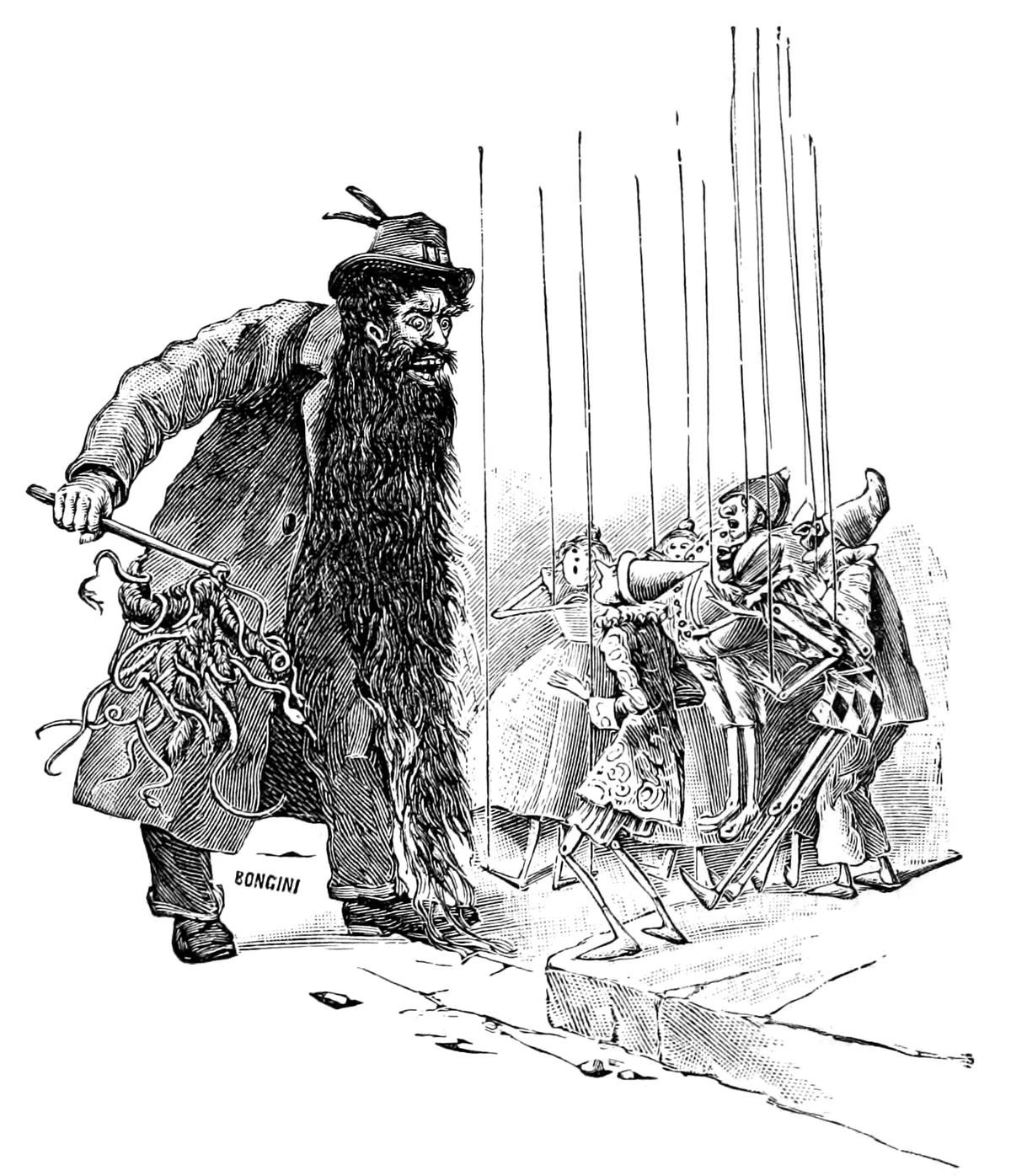
“Why have you come and turned my theatre upside down?” the puppet-master asked Pinocchio, in the great booming voice of an ogre with a bad cold in the head.
“Believe me, your Worship, it wasn't my fault!...”
“That's enough! We'll settle our accounts this evening.”
And sure enough, when the play was over, the puppet-master went into the kitchen, where he had got a fine sheep ready for his supper, turning slowly on the spit. And because he hadn't enough wood to finish cooking and browning it, he called Harlequin and Punchinello and said to them:
“Fetch me that puppet you'll find hanging on the nail. He looks to me like a puppet made of very dry wood, and I'm sure that if I throw him on the fire he'll give me a splendid blaze for the roast.”
Harlequin and Punchinello hesitated at first; but, frightened by a nasty glare from their master, they obeyed: and soon after they came back into the kitchen carrying poor Pinocchio in their arms, who, wriggling like an eel out of water, was screaming desperately: “Father, save me! I don't want to die, no, I don't want to die!...”