Geppetto's home was a little ground-floor room that got its light from under a staircase. The furniture could not have been simpler: a wretched chair, a not-very-good bed and a battered little table. On the back wall you could see a fireplace with a fire burning; but the fire was painted, and beside the fire there was a painted pot that was boiling merrily and giving off a cloud of steam that looked like real steam.
As soon as he was indoors, Geppetto at once took up his tools and set to carving and making his puppet.
“What name shall I give him?” he said to himself. “I'll call him Pinocchio. That name will bring him luck. I once knew a whole family of Pinocchios: Pinocchio the father, Pinocchia the mother and Pinocchi the children, and they all got along nicely. The richest of them was a beggar.”
When he had found a name for his puppet, he began to work in earnest, and he made him first his hair, then his forehead, then his eyes.
The eyes made, imagine his astonishment when he noticed that the eyes were moving and were staring hard at him.
Geppetto, seeing himself stared at by those two wooden eyes, almost took offence, and said in a resentful tone:
“Nasty wooden eyes, why are you looking at me?”
Nobody answered.
So after the eyes he made the nose; but the nose, as soon as it was made, began to grow: and it grew, and grew, and grew, and in a few minutes it became an enormous nose that never seemed to end.
Poor Geppetto wore himself out cutting it back; but the more he cut it and shortened it, the longer that impertinent nose became.
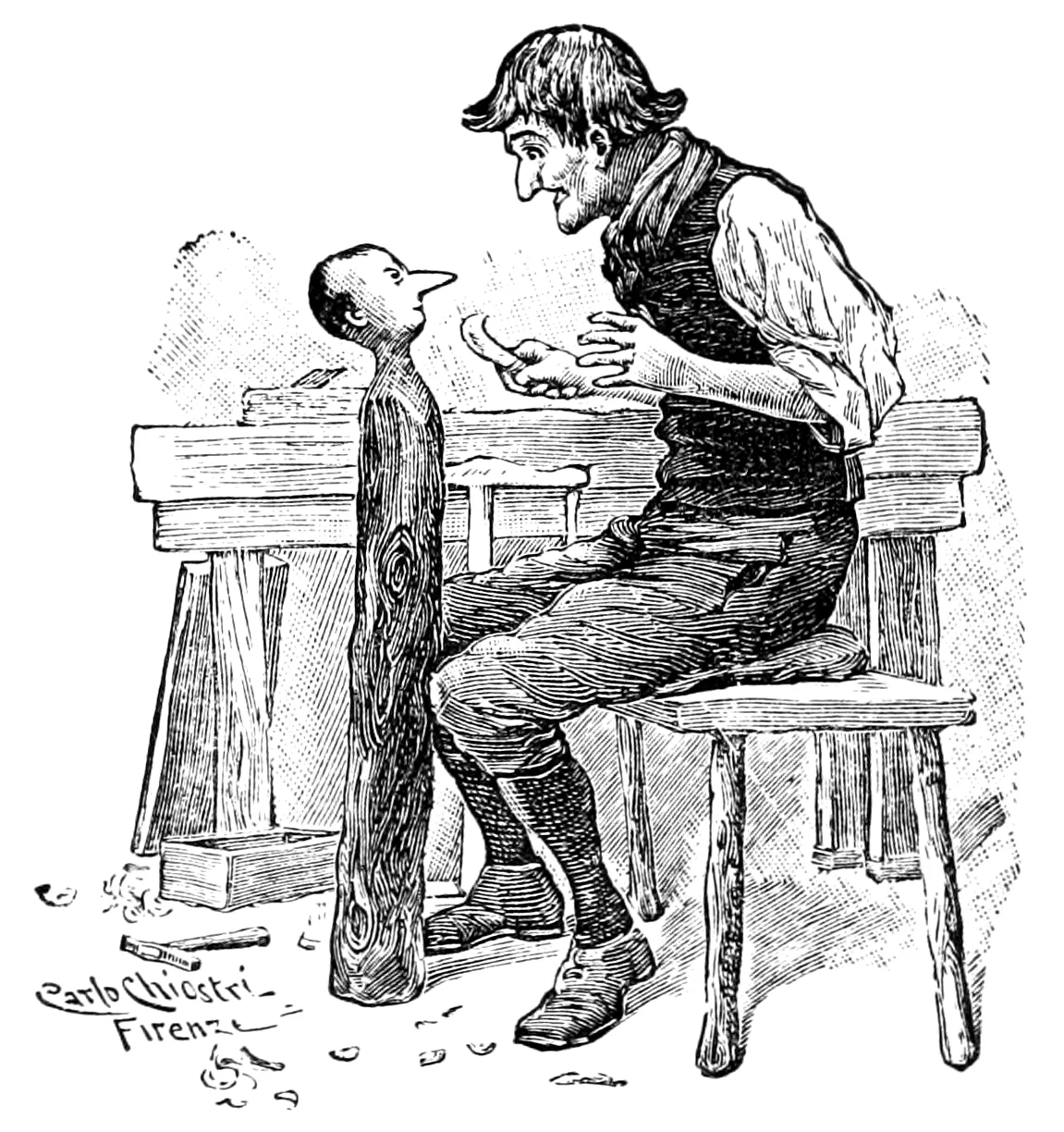
After the nose he made the mouth.
The mouth was not yet finished when it at once began to laugh at him and make fun of him.
“Stop laughing!” said Geppetto, offended; but he might as well have been talking to the wall.
“Stop laughing, I tell you again!” he shouted in a threatening voice.
Then the mouth stopped laughing, but stuck its whole tongue out.
Geppetto, so as not to spoil his work, pretended not to notice, and went on working. After the mouth he made the chin, then the neck, then the shoulders, the stomach, the arms and the hands.
The hands were barely finished when Geppetto felt his wig being snatched off his head. He looked up, and what did he see? He saw his yellow wig in the puppet's hand.
“Pinocchio!... give me back my wig this minute!”
And Pinocchio, instead of giving him back the wig, put it on his own head, and was half smothered underneath it.
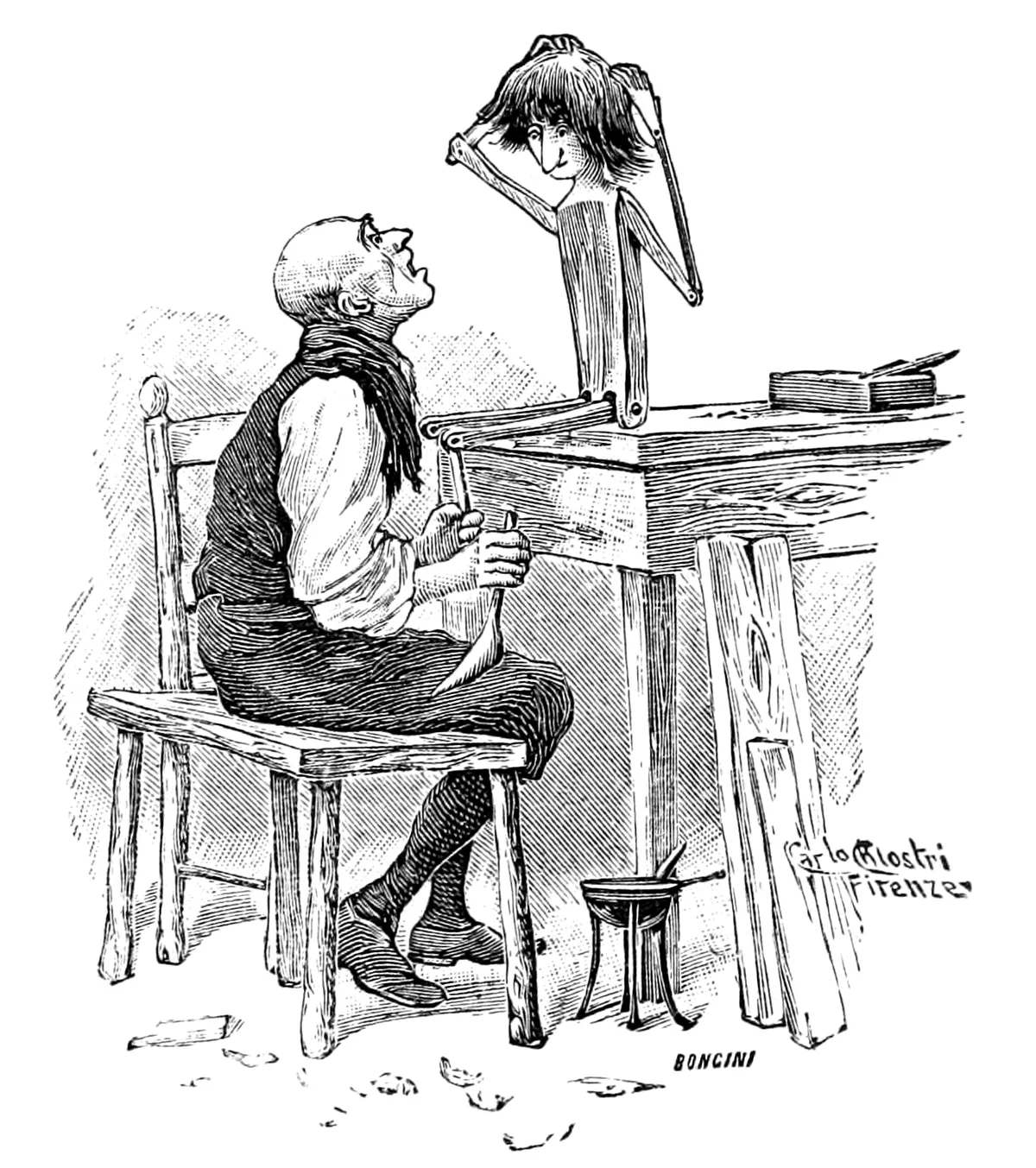
At such insolent, mocking behaviour, Geppetto grew sad and gloomy as he had never been in his life: and turning to Pinocchio, he said to him:
“You rascal of a son! You're not even finished yet, and already you're beginning to disrespect your father! That's bad, my boy, bad!”
And he wiped away a tear.
There still remained the legs and feet to be made.
When Geppetto had finished making the feet, he felt a kick land on the tip of his nose.
“I deserve it,” he said to himself then. “I should have thought of it before! Now it's too late!”
Then he took the puppet under the arms and set him down on the floor of the room, to make him walk.
Pinocchio's legs were stiff and he did not know how to move, and Geppetto led him by the hand to teach him to put one step after another.
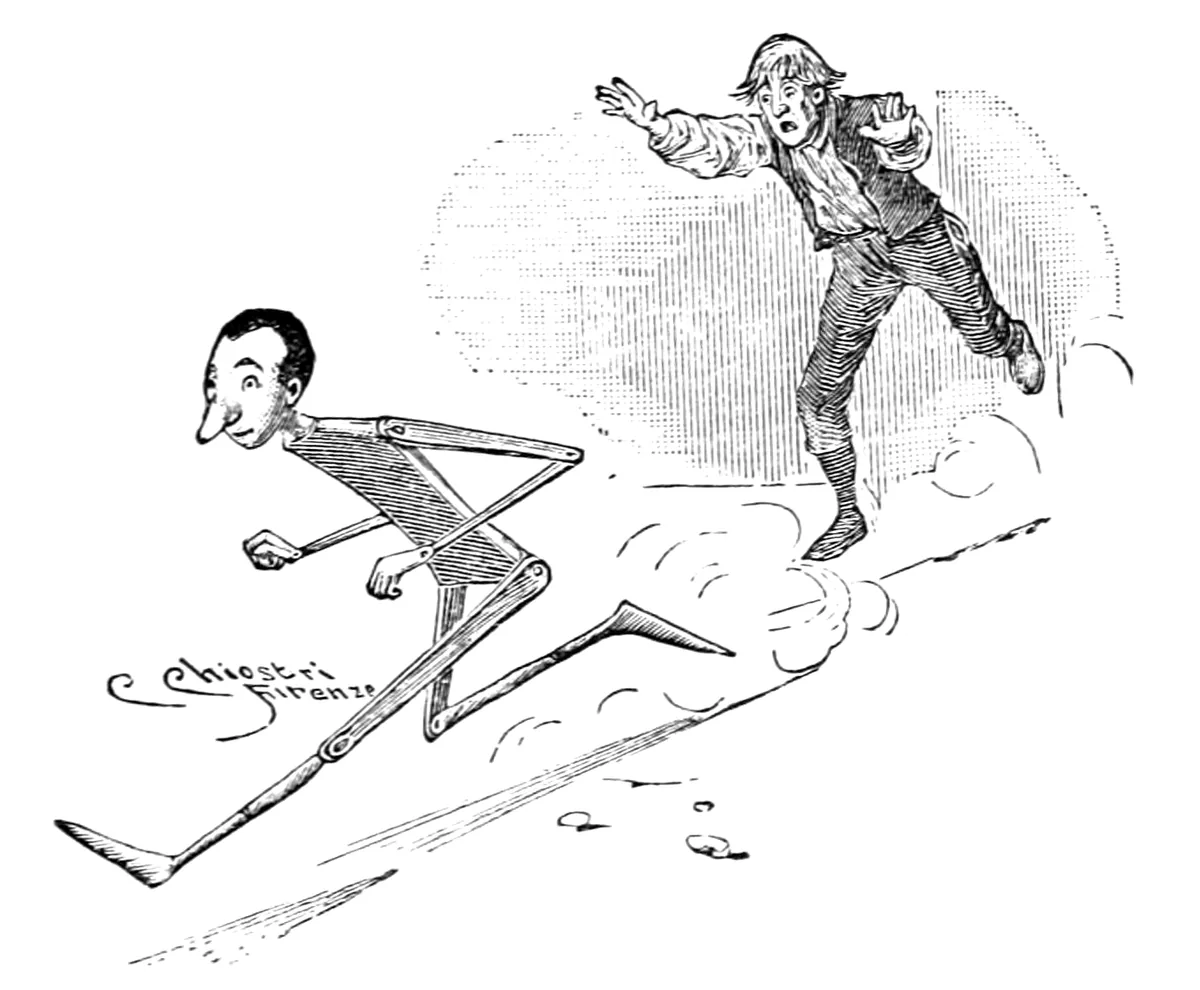
When his legs had loosened up, Pinocchio began to walk by himself and to run round the room; until, slipping out of the front door, he jumped into the street and took to his heels.
And poor Geppetto ran after him without being able to catch him, because that little rascal Pinocchio went leaping along like a hare, and as he beat his wooden feet on the paving stones of the street, he made a din like twenty pairs of peasants' clogs.
“Catch him! Catch him!” shouted Geppetto; but the people in the street, seeing this wooden puppet running like a racehorse, stopped spellbound to look at him, and laughed, and laughed, and laughed, more than you can imagine.
At last, and by good luck, along came a carabineer who, hearing all that uproar and thinking it was a colt that had got the better of its master, planted himself bravely in the middle of the street with his legs wide apart, firmly determined to stop it and prevent any worse mishaps.
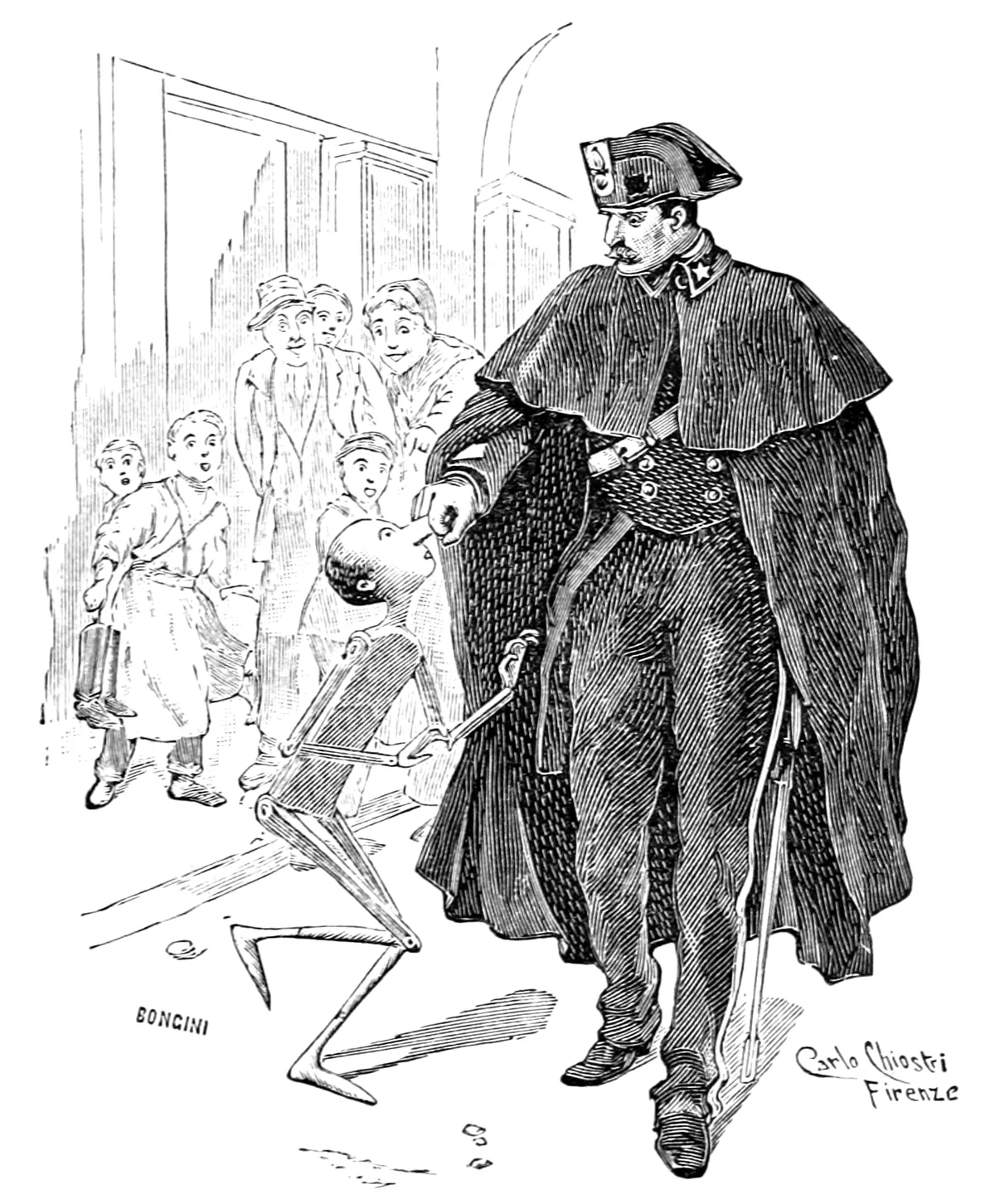
But Pinocchio, when he spotted the carabineer from afar, barring the whole street, tried to take him by surprise and slip through between his legs, and instead he failed miserably.
The carabineer, without budging an inch, neatly caught him by the nose (it was an enormous, outrageous nose, which seemed made on purpose to be grabbed by carabineers) and handed him back into Geppetto's own hands; and Geppetto, by way of punishment, meant to give him a good tweak of the ears there and then. But imagine how he felt when, looking for his ears, he could not manage to find them: and do you know why? Because, in his hurry to carve him, he had forgotten to make them.
So he took him by the scruff of the neck, and as he led him back, he said to him, shaking his head threateningly:
“Let's go straight home. When we get home, you can be sure we'll settle our accounts!”
Pinocchio, hearing this tune, threw himself on the ground and refused to walk another step. Meanwhile the curious and the idlers were beginning to stop round about and gather in a little crowd.
Some said one thing, some another.
“Poor puppet!” some were saying. “He's right not to want to go home! Who knows how that brute Geppetto would beat him!...”
And the others added spitefully:
“That Geppetto looks like an honest fellow! But he's a real tyrant with boys! If they leave that poor puppet in his hands, he's quite capable of smashing him to pieces!”
In short, they said so much and made such a fuss that the carabineer set Pinocchio free and marched that poor man Geppetto off to prison. And he, having no words there and then to defend himself, wept like a little calf, and as he set off towards the jail, he stammered, sobbing:
“Wretched son! And to think how hard I worked to make him a decent puppet! But it serves me right! I should have thought of it before!...”
What happened afterwards is a story so strange that you will hardly believe it, and I shall tell it to you in the chapters that follow.